Food Labels, Corporate Power And Public Health: Asia’s Regulatory Test
Rising obesity and diabetes across India and Southeast Asia are intensifying demands for stronger food labelling regulations. India is considering front-of-pack warnings, while Indonesia has strengthened legal requirements for nutritional information. Singapore, Thailand and Malaysia follow different approaches.

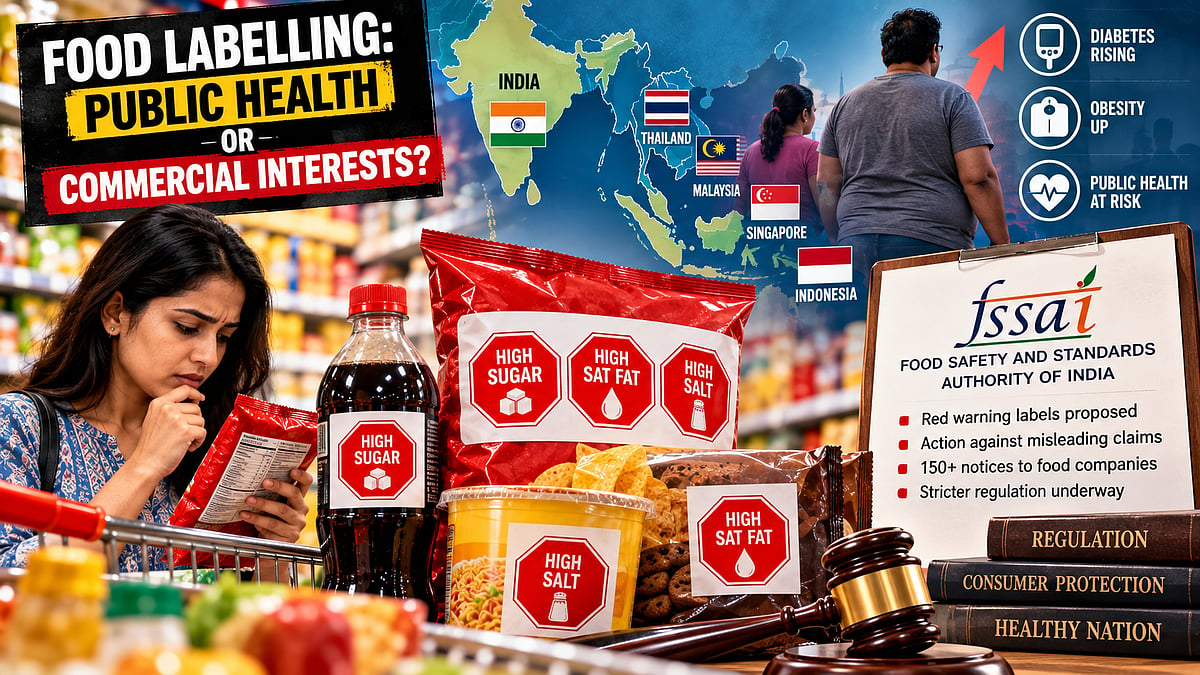
Food Labels, Corporate Power And Public Health: Asia’s Regulatory Test | AI
Across India and Southeast Asia, the fight over food labelling is becoming a test of whether governments will put public health ahead of commercial interests. The urgency is plain: diet-related illness is rising, packaged foods are spreading, and the burden of making sense of what is in them still falls heavily on consumers. The paradox is that regulatory action is gathering force, yet the rules intended to help consumers identify less healthy products remain uneven in scope, strength, and enforcement.
India’s weight and blood-sugar figures are moving in the wrong direction. In India, the latest National Family Health Survey (NFHS 6) shows overweight or obesity among women aged 15 and 49 rising from 24 per cent to 30.7 per cent between 2019-21 and 2023-24; among men, the spike is from 22.9 per cent to 27.3 per cent. An analysis of the ICMR-INDIAB study, published in The Lancet Diabetes & Endocrinology in 2023, estimated that 101 million Indians had diabetes and 136 million had prediabetes in 2021.
In Southeast Asia, the burden is also substantial. Indonesia’s 2023 National Health Survey found that 23.4 per cent of adults were obese, up from 21.8 per cent in 2018. Malaysia’s 2023 National Health and Morbidity Survey found that 54.4 per cent of adults were overweight or obese. Though the figures are not directly comparable, they point to a shared public-health challenge.
As packaged snacks, sweetened drinks, and ready-to-eat foods spread across the region, governments face a question that cannot be just left to shoppers deciphering small print: how should the food industry be regulated when the costs of unhealthy diets are borne by people, families, and public health systems?
The Food Safety and Standards Authority of India (FSSAI) has proposed red, hexagonal front-of-pack warnings on foods high in sugar, saturated fat or salt. This is after years of debate and Supreme Court scrutiny of regulatory delays. Following criticism of an earlier proposal that would have triggered warnings only when at least two nutrients exceeded thresholds, the regulator has indicated that warnings could apply when even one exceeds its limit. The final rules and implementation timetable remain outstanding.
The labelling debate is unfolding amid what Reuters recently described as an “unprecedented food safety crackdown” in India. Since 2020, government data show, inspectors have tested more than 100,000 food samples annually, with roughly one in five found to be unsafe, substandard or lacking proper labels. Nearly 8,000 food-business licences have also been revoked in the last 3 years.
In August 2026, the FSSAI announced that it had issued more than 150 notices to food and beverage companies over misleading advertisements, false claims, and labelling violations. The companies named included Nestlé India, PepsiCo, Coca-Cola India, Danone India, Mondelez India, and energy-drink makers Red Bull, Monster, and Hell Energy.
Nikkei Asia reported that, “After receiving an FSSAI notice, Mondelez India withdrew health and nutrient-comparison claims from its products, removed related advertisements from major e-commerce platforms, and revised packaging, according to FSSAI.”
These notices concern a range of alleged violations, not just front-of-pack labelling. But they expose a central issue: food companies’ claims and packaging cannot be left to voluntary restraint. Regulation must be able to challenge misleading representations, set enforceable standards, and ensure that consumers receive accurate information. Notices and licence cancellations are a beginning, not a substitute for a comprehensive warning-label system.
Indonesia offers another development. This year, the country introduced new rules for its A-to-D Nutri-Level summary labelling system for ready-to-consume foods, particularly sweetened beverages, initially targeting large-scale businesses. The system grades products according to their nutritional profile.
On September 29, 2026, Indonesia’s constitutional court went further, ruling that consumer-protection and health laws must encompass colour labels and symbols on packaged foods and drinks containing sugar, salt, and fat. The judgement makes clear that providing information is a legal obligation and that governments must regulate and supervise food production, processing, and distribution, including requiring such labels. The task now is to translate that ruling into a workable system with clear standards and enforcement.
Elsewhere in Southeast Asia, approaches vary. Thailand has required Guideline Daily Amount information on specified snacks and ready-to-eat products since 2011. The requirements were subsequently expanded to additional food categories. Singapore’s Nutri-Grade system mandates graded labels on beverages and restricts advertising for certain less healthy drinks. An extension of graded labelling and advertising restrictions to selected products high in sodium or saturated fat—including sauces, seasonings, instant noodles, and cooking oils—is scheduled for 2028. Malaysia has its own voluntary Healthier Choice logo.
These differences matter. A voluntary logo identifying healthier products does not do the same job as a warning flagging excessive nutrient levels. A system covering beverages alone leaves other food categories outside its reach. A warning triggered only when several nutrient thresholds are crossed can miss a product high in just one. The design of a labelling system determines what consumers see—and which products escape scrutiny.
Nor is it enough to announce rules and assume manufacturers will respond in ways that protect public health. Governments need transparent thresholds, independent monitoring, and penalties for non-compliance.
The political question is whether public-health regulation will be strong enough to withstand commercial pressure. When industry interests and public health diverge, it is the regulator’s responsibility to act in the public interest.
Patralekha Chatterjee is a writer and columnist who spends her time in South and Southeast Asia, and looks at modern-day connects between the two adjacent regions. X: @Patralekha2011
RECENT STORIES
-
-
-
-
-