Festive Advertising: From One-Lane Sale Festival To A Festive Maze
India's festive advertising market is expected to reach ₹60,000-62,000 crore in 2026 as consumer journeys become increasingly fragmented across digital platforms, creators, marketplaces and physical stores. Brands need coordinated strategies that connect discovery, content, offers, inventory, retail and customer experience rather than relying on a single festive campaign.

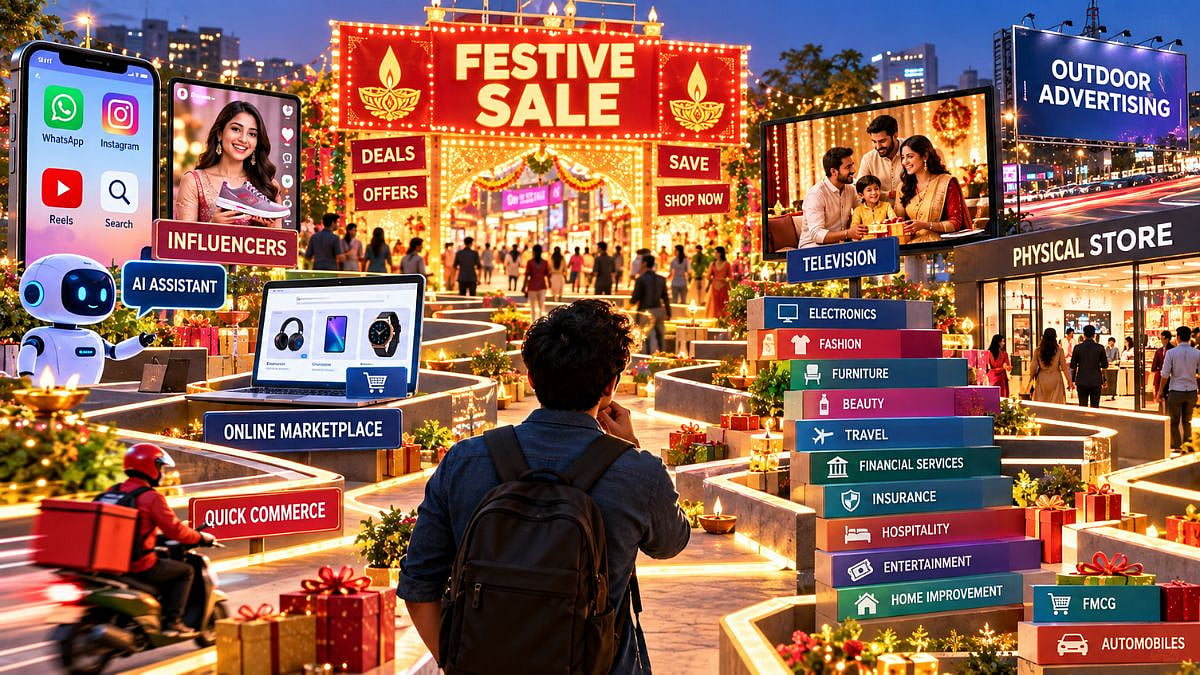
Brands are navigating an increasingly complex festive marketplace as consumers move between digital platforms, stores and multiple influences before buying | AI Generated Representational Image
Earlier, during the festive season, the consumer journey was relatively simple. Advertising helped consumers discover the sale; they visited the market, compared a few alternatives, and bought. The festive marketplace was always large, but the route to it was largely a one-lane road, and product categories’ sales areas were mostly clustered. That lane has now become a maze, with multiple entry points, influences, and opportunities to lose the consumer when they come shopping.
Festive Marketing Becomes Essential
Festive marketing is no longer optional; it is an essential market requirement. The question is not whether a brand should leverage the festive season, but whether it understands the marketplace the festival has become. Festive advertising is expected to reach Rs 60,000-62,000 crore in 2026, representing 34-35% of India's total advertising expenditure. For some categories, dependence is considerably higher: the festive period from Onam through Dussehra and Diwali typically accounts for 30-40% of annual sales for appliance manufacturers.
The festive opportunity has also expanded across categories. Diwali was once instinctively associated with jewellery, automobiles, apparel, consumer durables, sweets, and FMCG, but today's festive basket spans smartphones, furniture, beauty, travel, hospitality, financial services, insurance, entertainment, home improvement, and services. In 2025, CAIT estimated ₹5.40 lakh crore in goods and another ₹65,000 crore in services during the Diwali period. The festival provides the occasion; increasingly, almost every category can find its own reason to participate.
Consumers Enter The Maze
The consumer, meanwhile, has entered the maze. A WhatsApp message can trigger a search; a reel can spark desire; a creator can provide reassurance; an AI assistant can answer the question; a marketplace can offer comparisons; quick commerce can promise immediacy; a store can close the sale. Television, outdoor, family conversations, and neighbourhood recommendations continue to influence the journey. Marketers may call these separate media touchpoints, but consumers experience them as connected steps towards a decision.
If a brand's festive advertising is still in the planning stage, it is already late. In many categories, customers suspend buying in the pre-festive period and wait for the festival whistle to declare the festival games open, but the real game has already begun. Consumers are waiting for the red-and-yellow messages shouting SALE, OFFER, DEAL, and SAVE. Search interest for Diwali sales began surging as early as August, and around 70% of festive shoppers were already exploring products before the major sales began.
Brands Must Choose Their Lanes
The challenge is to be represented across enough of the maze lanes. A brand does not need identical communication across every channel, but consistency is rewarded. Not every brand can afford to be present at every possible touchpoint. It does, however, need to identify the lanes that matter to its consumers and ensure it is discoverable, relevant, and recognisable there. The Instagram brand, marketplace brand, television brand, and store brand cannot feel like unrelated cousins.
The festive campaign has shifted from communication to orchestration. Discovery, content, creators, search, offers, inventory, retail, delivery, customer experience, and post-purchase engagement increasingly need to work as parts of one system. Digital commerce advertising alone is forecast to grow by 27% in 2026, more than twice the growth of the overall advertising market, because the platforms closest to the transaction better connect with the consumer in the context of making a purchase.
Relevance Over Noise
Presence without relevance adds noise to the maze. Not every brand needs another Diwali film filled with diyas, families, sweets, and sentimental music. The more useful question is what changes in the consumer's life during the festival. There may be more guests, more gifting, more travel, more cooking, more entertaining, more cleaning, more aspiration, or simply a willingness to finally make a purchase that has been postponed. Behavioural change should determine the brand's role in the festival.
Osho offers an interesting view of festive celebration: it is not merely something that happens after an achievement; it affirms life. That makes the festival particularly interesting for marketers because it creates a heightened state of consumer interest and behaviour. Brands have to understand what that heightened state of interest means for their category and what trigger will create the brand preference.
The Festival As A Business Opportunity
The festival is a business opportunity before it is an advertising opportunity. For one brand, the objective may be acquisition, for another, premiumisation, gifting, a new launch, inventory movement, relationship building, or simply reinforcing preference. The strategic question is no longer “What is our Diwali campaign?” It is, “What business role can this festive marketplace play for our brand?”
The one-lane sales festival has become a multi-lane maze. Consumers can enter from anywhere and change direction repeatedly before they make a purchase. Brands don't need to occupy every lane, but they do need to know which lanes their consumers are travelling through and be there when they arrive.
Sanjeev Kotnala is a brand and marketing consultant, writer, coach and mentor.
RECENT STORIES
-
-
-
-
-