Emergency Then And Now: The Action And The Government’s Response To It
The JP-led pro-democracy movement of 1974–75 is compared with contemporary protests in India, highlighting mass demonstrations, demands for electoral reform and events preceding the Emergency. The differing approaches of authorities towards protesters across the two periods raise questions about democratic freedoms, state power and the absence of a unifying leader today.

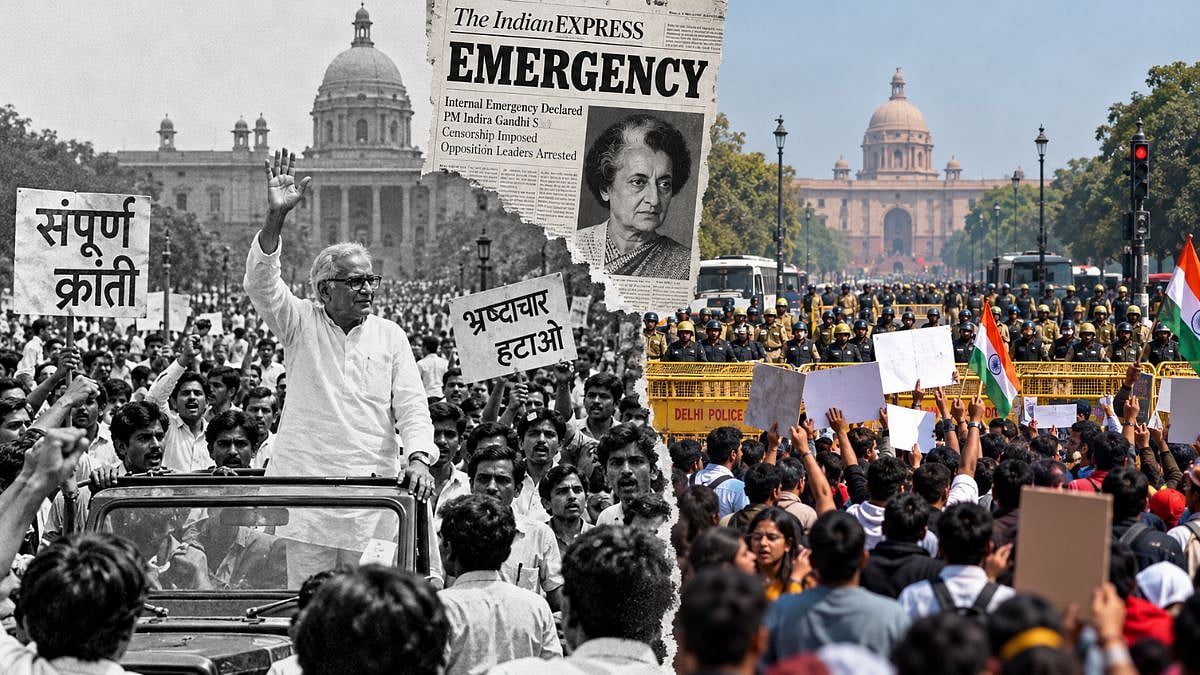
The legacy of Jaiprakash Narayan's Total Revolution movement offers a historical lens for examining contemporary protests and democratic freedoms in India | AI Generated Representational Image
The pro-democracy protests, sweeping the streets of the capital, Delhi, and other cities across the country, have an eerie echo of a long bygone era more than half a century ago. It takes me back to my first few years as a city reporter in the early 1970s when student protests in Gujarat and Bihar rapidly escalated under the leadership of Jaiprakash Narayan, supported by a motley group of parties, including the Socialists and the Jana Sangh.
Student protests and political unrest
In 1974, the year I formally joined a pro-Soviet newspaper, Patriot, towing the CPI line that strongly supported the then prime minister Indira Gandhi’s Congress, a hostel fee hike in Ahmedabad snowballed into the Nav Nirman movement, toppling the Congress government in Gujarat. Soon it was the turn of Bihar, which had seen 11 state governments rise and fall in seven years since 1967 to face the wrath of students agitating against corruption and unemployment. Three of them were shot dead by the Bihar police after they surrounded the Bihar assembly in Patna, creating nationwide outrage. It paved the way for a new apostle of democracy, veteran socialist leader Jaiprakash Narayan preaching Sampoorna Kranti, total revolution, demanding an end to corruption, the cleansing of politics, and the reinvention of the Indian republic rooted in grassroots democracy.
As a city reporter, I didn’t have much to do with these dramatic developments in national politics which were covered by the Special Correspondents Bureau. But we were all aware of the fiercely hostile editorial line adopted by both Patriot and sister publication Link on the student agitations and the Opposition campaign in Gujarat and Bihar against the ruling Congress party and prime minister Indira Gandhi. Significantly, both the CPI and the Soviet Union had firmly backed Mrs. Gandhi against her opponents.
Clashing views on JP’s movement
Moreover, JP was a personal bugbear for my chief editor, Edatata Narayanan, an eccentric genius who had personally known JP and, along with the other Patriot founder, legendary freedom fighter Aruna Asaf Ali, had formed a short-lived political party with him before Independence but had fallen out. Narayanan spared no opportunity, pouring scorn on his former political associate for the latter’s flip-flops between Marxism and Gandhian socialism, openly implying that the aged leader was a weak and vulnerable tool in the hands of anti-national forces like the communal RSS and US imperialists. However, in his magazine, Mainstream, my actual journalistic mentor, veteran journalist Nikhil Chakravarty, although sceptical of JP’s utopian goals and critical of his association with right-wing communal parties, acknowledged the growing public disenchantment with the prime minister and the ruling Congress over widespread agrarian crisis, urban unemployment, mounting inflation, and massive labour unrest like the 1974 railway strike that fuelled JP's momentum.
The march to Parliament in 1975
Matters reached a head in the first few months of 1975 as a four-year-old election petition by Raj Narain, whom Mrs. Gandhi had trounced in the 1971 parliamentary polls, accusing her of electoral malpractices, suddenly resurfaced in the Allahabad High Court. This amplified the JP-led Total Revolution in Bihar into a national crusade rocking the central government. On the sixth of March, I, along with other city reporters, found myself covering a massive people’s march led by Jaiprakash Narain through the streets of Delhi to Parliament House.
The march, one of the largest ever seen in Delhi, with the number of participants mostly young from different parts of the country estimated between 100,000 and 200,000, was boisterous but peaceful. Thousands of bystanders—government employees, street hawkers, and shopkeepers—lined the four‐mile route cheering on the marchers. The frail, ailing JP rode triumphantly in the centre of the procession, standing in a jeep, waving at the demonstrators and bystanders as they raised slogans against Mrs. Gandhi and hailed him as their leader. It was difficult to tone down the size, scale, and spontaneous enthusiasm of the crowd in my report for the paper, which was unsurprisingly buried in one of the inside pages.
From political crisis to Emergency
Events followed at breathtaking speed after the march that ended with Jaiprakash Narayan presenting to Parliament a charter of demands, including sweeping election and educational reforms, effective distribution of land, and the lifting of external emergency measures still in place since the 1971 Bangladesh war that allowed the arrest of dissenters and trade union agitators. Rattled by the march, Mrs. Gandhi was grilled in court a week later, the first Indian Prime Minister to suffer this humiliation. Barely three months afterwards, in a stunning judgement, she was actually disqualified as prime minister, plunging the country into a constitutional crisis. In less than a fortnight, I was taking notes at the vast public rally in Delhi’s Ram Lila Maidan, where JP asked people to lay siege to the prime minister’s residence until she resigned and appealed to the police and security forces to defy unconstitutional orders of the government. By midnight, Emergency was declared, and the rest is history.
Parallels between then and now
Switching back to the present, there are striking parallels and differences between the crisis then and now, both in the pro-democracy protests and the government’s response until the Emergency was imposed. Clearly, the demand for electoral and educational reforms more than 50 years ago by the JP movement resembles that of the cockroaches today backed by the entire Opposition. On both occasions, youth protests have spiralled into an all-out campaign against a discredited ruling party and administration, targeting a larger-than-life prime minister and rocking the central government. The talk by government cheerleaders of a CIA plot to destabilise Mrs. Gandhi are much like the current bid to blame a sinister foreign hand to take down Mr. Modi.
Yet, until Indira Gandhi finally panicked and plunged the country into the Emergency mode at midnight, her government behaved quite differently from the current regime in its approach to the popular upsurge against the establishment, at least in Delhi. The thousands of policemen deployed to handle the march to Parliament in March 1975, or at the Ram Lila Maidan rally, made no attempt to harass the milling crowds, let alone detain them, in stark contrast to the barbarity displayed by the security forces this time. No trains were cancelled; none were arrested from inside a commercial flight, and the country’s capital, while politically volatile, was not turned into a war zone.
Today’s pro-democracy protests are also less overtly political, although opposition parties, most notably the Congress and Rahul Gandhi, have been galvanised against a regime that not so long ago brought them to their knees. With no towering personality like JP leading the struggle and the current protesters spearheaded by an array of semi-autonomous youth groups in collaboration with each other, turning into a protracted guerrilla war, the current incumbent in office may find it difficult to squash his opponents even temporarily.
Ajoy Bose is a senior journalist.
RECENT STORIES
-
-
-
-
-