Courage To Question And Freedom To Fail: Lessons From CV Raman And Marie Curie
CV Raman left a secure government position to pursue scientific research in India, eventually winning the 1930 Physics Nobel. Marie Curie also pursued uncertain experiments, winning two Nobel Prizes. Citing their journeys, an opinion article argues that Indian entrepreneurs need an environment where calculated risks are encouraged and failed attempts do not end future opportunities for innovation.

Courage To Question And Freedom To Fail: Lessons From CV Raman And Marie Curie | AI
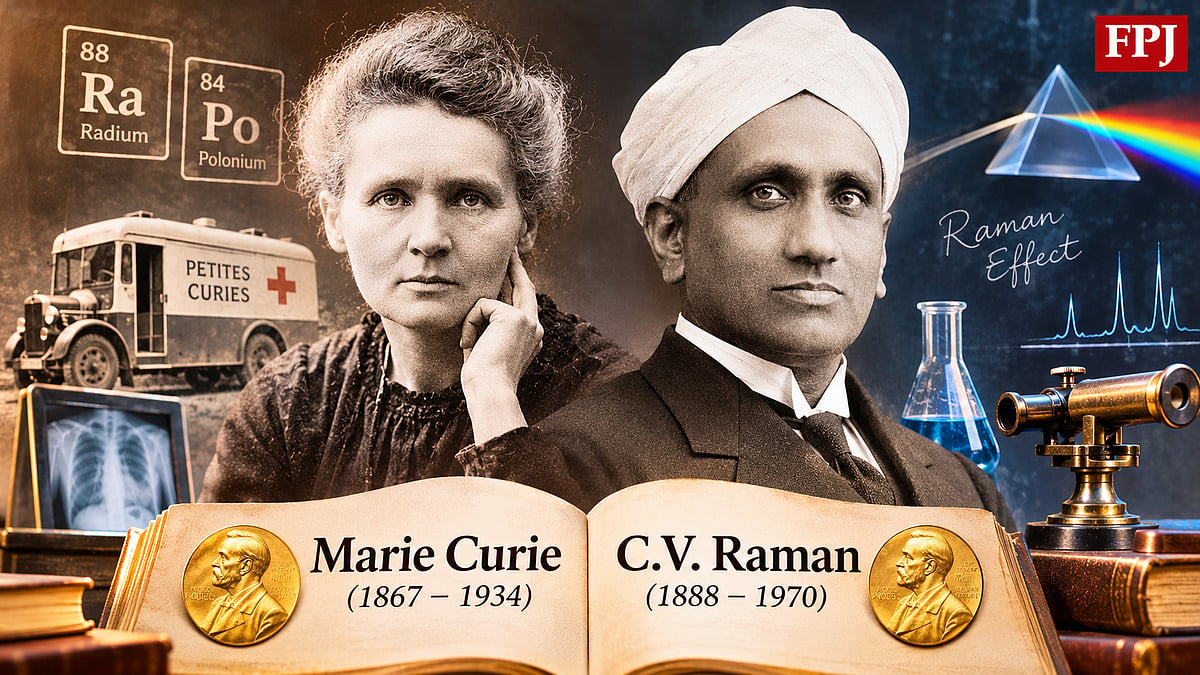
Marie Curie and CV Raman share a common birthdate—November 7. Curie was born in Warsaw, Poland, on November 7, 1867, and Raman on November 7, 1888, in Tiruchirappalli. Curie crossed borders to follow her calling. Raman, too frail to travel abroad by sea, built a Nobel-winning career entirely in India, foregoing his lucrative administrative career. Both chose uncertainty over comfort. The following saying attributed to Marie Curie is instructive: "Nothing in life is to be feared; it is only to be understood”. Now is the time to understand more so that we may fear less. Today, as we remember these two great scientists, there is a learning not just for our young scientists but even more for aspiring Indian entrepreneurs.
Marie Curie's life was a study in calculated risk. With her husband, Pierre, she spent years crushing, boiling, and filtering tonnes of pitchblende to isolate polonium and radium, with no guarantee of success. She shared the 1903 Physics Nobel with her husband, Pierre Curie, and Henri Becquerel, and she also won the 1911 Chemistry Nobel “in recognition of her services to the advancement of chemistry by the discovery of the elements radium and polonium, by the isolation of radium, and the study of the nature and compounds of this remarkable element".
When World War I broke out in 1914, observing that X-ray machines were stranded in hospitals, far from the battlefield, she persuaded donors to supply vehicles and equipment, taught herself to drive, and took the "petites Curies"—custom-built mobile X-ray vans created and deployed by Marie Curie—to the battlefront.
She had to pay a price for it. She, unfortunately, died in 1934 of aplastic anaemia, a disease caused by excessive radiation, which nobody then fully understood. Yet, her legacy is unmatched. Her husband, daughter, Irène, and son-in-law, Frédéric Joliot-Curie, were all Nobel laureates, with five prizes in the family, in all.
Raman, like most brilliant students of his era, aspired to be an Indian Civil Service officer. But the exam required travel to England, and doctors advised that frail Raman could not endure the long sea journey. He chose the next best option and topped the Indian Finance Service. At 19, Raman was posted to Calcutta as an assistant accountant general, a lucrative and respected post under the British government. Many would have stopped there, but not Raman.
One day, travelling in a tram, Raman saw the signboard of the Indian Association for the Cultivation of Science (IACS). It had been created by Dr Mahendralal Sircar, who dreamt that Indians should do science in an institution built by Indians. Sircar had died in 1904, but his institute lived on, and Raman worked there part-time for a decade, pursuing his passion alongside his job.
In 1917, Sir Asutosh Mukherjee, Vice-Chancellor of Calcutta University, offered Raman the Palit Professorship of Physics. Raman resigned from government service for a lesser salary, roughly half, by some accounts. The chair required European training, which Raman lacked. Mukherjee backed merit over paper credentials and persuaded his senate to waive it. The risk was shouldered by Sir Ashutosh Mukherjee.
The decision paid off. Raman's work soon won international attention, and on the evening of February 28, 1928, he announced the discovery of a scattering effect that bears his name. In 1930, he became the first Asian to win a Nobel Prize in science—physics. His experiments had used only a mercury lamp, a flask of benzene, and a pocket spectroscope. Raman broke the myth that great science needed huge budgets, and he helped build a research culture in India that continues to inspire to this day.
Now consider an Indian dilemma: parents love their children and hence protect them—safe job, safe stream, and known path. That is understandable. But, unwittingly, their acts can teach children to fear failure. Yet, when Indians move to risk-rich environments like Stanford and Silicon Valley, they flourish.
Prof. Ilya Strebulaev of Stanford Graduate School of Business found in his 2022 study that 90 of 1,078 founders across 500 US unicorns were born in India, ahead of Israel with 52 and Canada with 42. Indians match the world's most famed risk-takers in numbers in the US, despite coming from a culture that fears failure. A 2026 study by the National Foundation for American Policy also found India-born entrepreneurs behind 96 US unicorns, the largest immigrant group.
Notwithstanding a caveat that these Indians are well-educated emigrants, they prove a point. Talent is not the missing ingredient for Indians; it is an Indian ecosystem, which encourages a culture to fear failure.
Neither Curie nor Raman chose certainty over risk of failure. Raman can be an exemplar for aspiring Indians because he proved courage can be exercised at home. He needed no foreign degree, only an Indian university, an Indian institute, and a mentor willing to back him. The environment Silicon Valley offers today, Sircar, Mukherjee, and Raman built in Calcutta a century ago.
Their lessons can be instructive and help Indian parents to let children fail and treat a failed attempt as an education rather than a disgrace. Educators and institutions can reward questions over rote success and, like Mukherjee, back talent over pedigree.
There is also a learning for investors and policymakers to build funding and insolvency systems where a first failure is not the last chance.
Raman was not reckless. He kept his job for a decade while building his research. He understood risks and, therefore, feared them less.
Today the best tribute we can pay these two great scientists is to carry their spirit into our boardrooms, classrooms, and living rooms.
Let the next generation of Indian entrepreneurs build in India what their tribes have built in Palo Alto.
The writer is a Senior Advisor CSMVS, Trustee, Gandhi Smarak Nidhi, and former director Nehru Science Centre, and NGMA Mumbai.
RECENT STORIES
-
-
-
-
-