Commonwealth Games And The Future Of Indian Sport
India's strong Commonwealth Games performance highlights the need for sustained investment in athletes, coaching and sports infrastructure. The piece argues that professionalising sport, improving athlete welfare and building long-term development programmes are more important than focusing solely on hosting major international events.

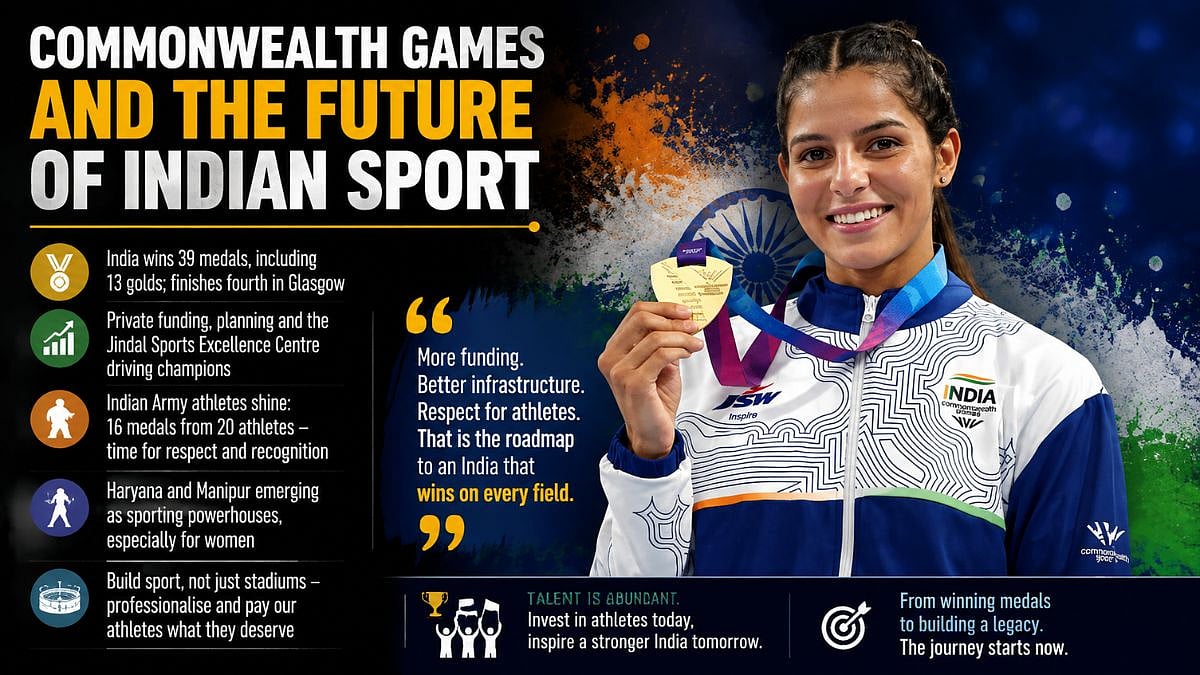
India's Commonwealth Games campaign has intensified calls for greater investment in athletes, sports infrastructure and long-term sporting development | AI Generated Image
The Indian contingent's performance at the truncated Commonwealth Games in Glasgow was stellar. Bagging a total of 39 medals, with 13 golds, India finished fourth in the overall standings, though far below the might of Australia, which bagged 171 medals, including 70 golds.
India is not yet a sporting powerhouse, though it is a cricketing powerhouse, with the IPL recently rated as the second most valuable league in the world, just below the American football league. But the Glasgow performance showed that a bit of planning and lots of funding are the right way to go about it.
India's performance has improved considerably due to the infusion of private funding, mostly from the Jindal Group, whose sports excellence centre in Ballari is producing a good percentage of champions.
The Indian Army has contributed close to half the number of medals. Out of the 20 Army athletes, 16 won medals, which is a grand performance. But the Indian Army needs to consider upgrading its medal winners to officer level instead of keeping these proud and hard-working athletes as sepoys and lance naiks, which is really a shame.
Once their athletic careers are over, they have to go back to doing humble and humiliating work in the barracks, which is not the way we need to repay these athletes who once stood on the international podium, gleaming with pride.
States Leading The Way
Among the states, Haryana, which has an assembly-line production of boxers and wrestlers, really did us proud. Boxing was not part of these Commonwealth Games, or India would have finished third easily.
Haryana, which for many years was seen as a place where patriarchy and misogyny were dominant and where women had a tough life, has, over the last two decades, emerged as a powerhouse in women's sport, especially boxing and wrestling.
Haryana in the north-west of the country and Manipur in the east are really the sporting hopes of the country. More funds need to be given to these states to develop sports infrastructure.
Looking Beyond Hosting Rights
The next Commonwealth Games in 2030 are being hosted in Ahmedabad, most probably followed by the 2036 Olympics as well, which are planned as a global showpiece of the BJP's invincibility and overarching ambition. It is all very fine to host a $25 billion Olympics, but no athletes from Gujarat won medals at the Commonwealth Games.
After the Olympics (if allotted), will the stadiums become architectural ghost houses in a state with a lot of interest in diamonds but little interest in gold medals? Also, what about the pathetic state of our sportsmen, most of whom survive on Class 4 salaries? There has to be a plan to professionalise all sports completely and pay athletes who win medals in the National Games at least Rs 1 lakh a month and junior national winners Rs 50,000. India needs to have a substantial plan to build sport, not just stadiums.
RECENT STORIES
-
-
-
-
-