BJP's Vishwaguru Narrative Faces Reality Check As Pakistan Plays Mediator, Forcing PM Modi To Downplay Global Role In Polls
The Middle East conflict has triggered a political clash, with the Congress criticising the Modi government’s global influence while the BJP downplays the issue during state polls. Rahul Gandhi accused the Centre of failing to protect energy and diaspora interests, while PM Modi hit back, accusing the opposition of politicising the crisis.

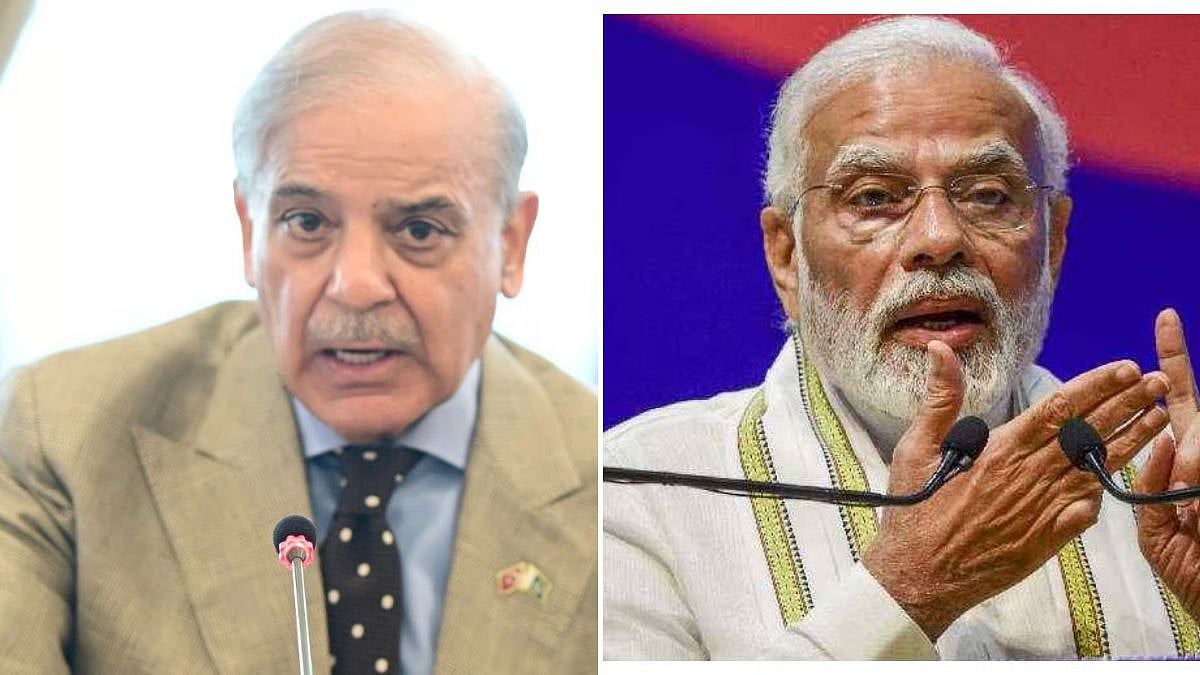
Pakistan PM Shebaz Sharif (L) & Prime Minister Narendra Modi (R) | File Pic
The palpable irrelevance of New Delhi as a player in the ups and downs of the current conflict in the Middle East has forced the BJP to downplay the global catastrophe in its campaign for the ongoing state assembly polls in the country. Although local issues tend to dominate regional elections, the ruling party, under normal circumstances, has been known to project Prime Minister Narendra Modi as the Vishwaguru, whose personal influence with powerful leaders across the world serves as a source of nationalist pride to voters in both state and national polls. Interestingly, while the BJP has largely kept mum on the raging Gulf war, apart from promising to take care of national interests, the Congress has gone out of its way to mock the Modi government for its lack of international clout.
Congress leader Rahul Gandhi, while campaigning particularly in Kerala, which has a vast number of expatriates in the Gulf region, has castigated the central government for failing to look after the security of both India’s energy needs and Gulf expatriates by surrendering its foreign policy to US President Donald Trump. Gandhi and other Congress leaders have repeatedly accused the Prime Minister of being unable to either stop high prices and shortages of petrol and gas cylinders or ensure the safety of Indians working and residing in Gulf countries. The Congress supremo had earlier condemned Mr. Modi for visiting Israel on the eve of the joint US-Israeli military operation, claiming that this had seriously damaged the country’s leverage as a neutral power.
Stung by Congress criticism, the Prime Minister, speaking at a public meeting in his home state of Gujarat, lashed back at the opposition party, accusing it of politicising the Middle East war. He described the Congress as “political vultures” waiting for the impact of the West Asia crisis to deepen in the hope of extracting political gains.
In retrospect, considering the way Pakistan has emerged as a key mediator in bringing about a temporary halt to hostilities in the Gulf, it may have been prudent for the BJP to play down the Middle East war during the campaign. It would have been disastrous for the Prime Minister had he chosen to play his usual Vishwaguru role at home during the conflict, tom-tomming his ability to make friends and influence people in international corridors of power, only to find his arch rivals in Pakistan stealing the limelight. He can wait in safe obscurity, along with many other leaders across the world, for the extremely tentative negotiations between Iran and the United States to begin this week in Islamabad, for it all to go haywire, and then cock a snook at Pakistan for daring to go where angels fear to tread.
Yet, regardless of the outcome of the Pakistani-brokered parleys between Iran and the US, New Delhi can hardly ignore the huge boost this has given to Islamabad. With both protagonists acknowledging Pakistan’s key role in pulling them away at the last minute from the precipice, and almost the entire world showering praise with gasps of relief, this may well be the highest point the country has ever reached on the international stage. For India, particularly the BJP, its leaders and cheerleaders, this is bound to hurt, raising questions about the possible impact on both global and domestic fronts.
While it is extremely unlikely that the ruling party would be dented much in the assembly polls by Pakistan upstaging India in the Middle East, the undoubted larger-than-life international profile enjoyed by Islamabad today does have diplomatic consequences for the government. Over the past several decades, Indian leaders and diplomats have projected a vast superiority in terms of the economy, military capability, as well as democratic credentials of this country over its rival across the western border. This superiority, mostly justified, has in recent years tended to border on arrogance and outright jingoism, particularly under the present political dispensation, making it all the more difficult to accept a sudden shift in the balance of the images of the two countries in global perception.
The dramatic tilt towards Pakistan vis-à-vis India by US President Donald Trump in his second term, particularly evident after Operation Sindoor last year, was a bitter blow to the Prime Minister’s carefully structured global stature. This was followed by a ferocious targeted attack on India by Washington on tariffs, including a wholly arbitrary one on Russian oil. Although some of the tariff tension was defused after the signing of the Indo-US trade framework agreement this year, disquiet continued in Race Course Road and South Block over intelligence reports about hobnobbing between the White House and the Pentagon with Pakistani Field Marshal Astad Muneer and Prime Minister Shebaz Sharif.
Pakistan’s diplomatic coup, in the guise of brokering a seemingly impossible deal between the hardline Iranian Revolutionary Guard Command and an increasingly demented President Trump, has clearly earned Islamabad, at least for the moment, a huge feather in its cap. This is a bitter pill for the Modi government to swallow, and it will be interesting to see how our foreign policy is adapted, since both China and Russia—the two great powers other than the United States—are believed to have helped Pakistan swing the deal.
The problem for the Modi government is that, more than under any previous political dispensation, foreign policy—particularly the Vishwaguru stature of the Prime Minister—has been a key element of the BJP’s bid to create an aura around him at home, especially during elections. This mixing of foreign and domestic policy has often led to embarrassing blunders. A good example was the needless exaggeration of Mr. Modi’s personal ties with President Trump, which became extremely uncomfortable when the latter relentlessly squeezed India on tariffs even as he declared that the Prime Minister was “a good friend”, or when he hosted the Pakistani Field Marshal to a private White House lunch.
The time may have come for the ruling party to ditch the Vishwaguru tag at home, leaving him free to cautiously navigate the choppy waters of international diplomacy.
RECENT STORIES
-
-
-
-
-