Beyond The Machismo Of War Reporting: How Three 'Ink-Stained Amazons' Pioneered New Journalism And Changed The World
A column by Deepa Gahlot highlights pioneering journalists like Martha Gellhorn, Rebecca West and Emily Hahn, who defied norms to report from conflict zones. It says their work brought focus to civilians’ suffering and helped shape narrative journalism long before it was formally recognised.

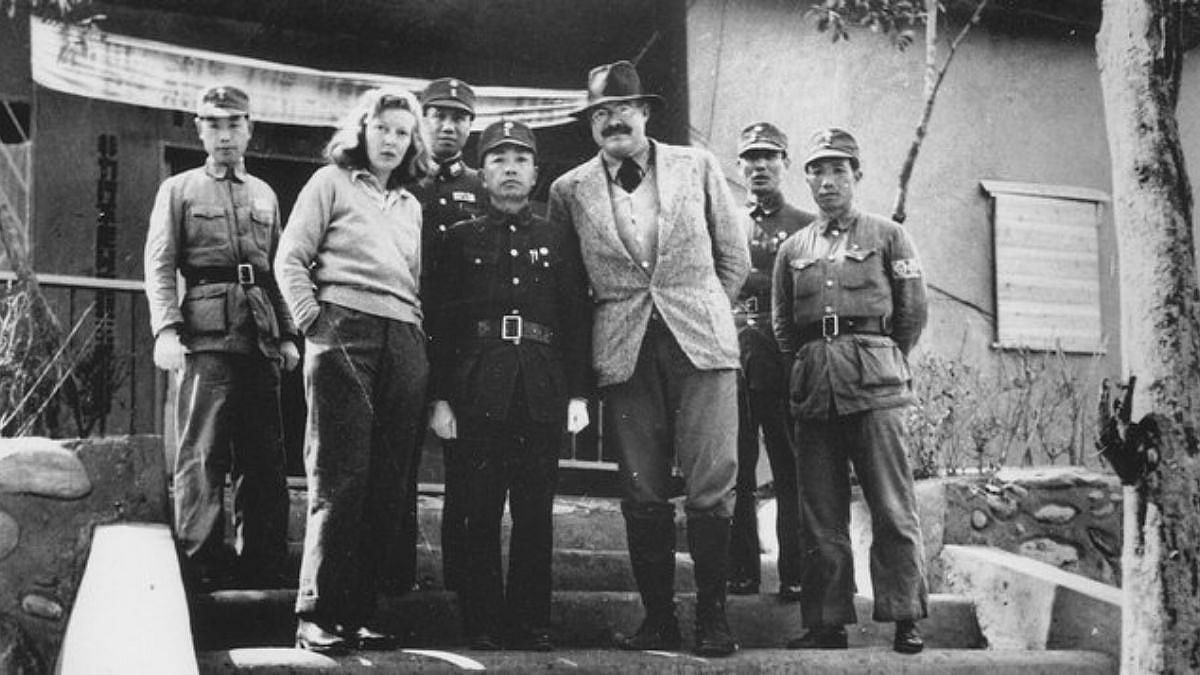
There has hardly been a time when the world has been conflict-free, and reports from the frontline have been brought to readers and viewers sitting safely away from home. | X @TheAmScho
There has hardly been a time when the world has been conflict-free, and reports from the frontline have been brought to readers and viewers sitting safely away from home. Traditionally, men have covered war zones; in the early days of print journalism, when women were finally—and reluctantly—allowed into newsrooms, they were forced to cover soft subjects like cookery, fashion, and c. However, even when women were forbidden from going to the front, there were intrepid female reporters who ignored the risks and wrote about the violence and tragedy of wars. There was a human side to wars that the whisky-swilling, chain-smoking male foreign correspondent, mythologized by novels, movies, and Ernest Hemingway-style machismo, did not think it worth their while to write about. The struggles of women and children coping with destruction, shortages, and paying the crushing cost of survival while the men were away fighting in the trenches were understood by women writers, who could then bring these stories to the world.
Today, names like Oriana Fallaci, Christiane Amanpour, Alex Crawford, Christina Lamb, Arwa Damon, Sarash Ashton-Cirillo, and Barkha Dutt are well known, but long before them, there were women who kicked the door open for other courageous journalists who were part of the golden age of journalism. Their contribution has been downplayed, if not altogether forgotten. Julia Cooke’s triple biography, Starry and Restless: Three Women Who Changed Work, Writing, and the World, turns the spotlight on three pioneering women journalists who were not confined by boundaries or fazed by danger—Rebecca West, Martha Gellhorn, and Emily “Mickey” Hahn—who witnessed history firsthand and wrote about it.
These women travelled when it was far less convenient than it is today, lived in conflict zones under hazardous conditions, and showed that a woman’s perspective was no less vital than a man’s.
They had to fight the perception of editors that journalism was not a proper occupation for the female sex, Cooke writes in her introduction. Writer Nathaniel Hawthorne (of The Scarlet Letter fame) commented on the “unseemliness of a woman who displayed her naked mind to the gaze of the world in print.” He called them “ink-stained Amazons.”
The National Press Club, writes Cooke, refused to allow women to use its facilities, much less join. So in 1919, “a determined group founded the Women’s National Press Club; luncheons, banquets, and guest speakers brought scores of women together. More and more showed up for work in American newsrooms or arrived at the foreign offices of newspapers, holding out stories they’d found—reported and written. Still outnumbered, but there: physical bodies ready to do work.”
Cooke argues that these women invented what came to be known as “New Journalism” decades before the 1960s figures like Tom Wolfe and Hunter S. Thompson took credit for it. Through their work for The New Yorker, Harper’s Bazaar, Collier’s, and The Atlantic, West, Gellhorn, and Hahn pioneered a voice-driven, subjective style of reporting. While men were reporting facts and boasting of proximity to those in the corridors of power, the women recorded the lived experiences of civilians. Readers were eagerly lapping up these vivid accounts that moved them.
Back then, there was a personal cost to professional ambition. There were marriages, affairs, divorces, and scandals, but they did not come in the way of these women’s quest for the truth and, of course, the big story. They had to navigate the double standards of the time—while male war correspondents were praised for their bravery, women were often criticized for abandoning their domestic duties, even when they supported their families—in the case of Mickey Hahn, even the family of her married Chinese lover in Shanghai.
All three wrote fiction as well as nonfiction books alongside their journalistic work. For instance, Cooke narrates how Hahn pulled off a scoop by managing to interview the three Soong sisters, married to the most powerful men in China—Chiang Kai-shek, Sun Yat-sen, and H.H. Kung—who had an enormous impact on the course of history.
Martha Gellhorn is the most recognizable name due to her marriage to Ernest Hemingway, even though she did not ride on his coattails. Cooke describes her illicit landing on Omaha Beach on D-Day, stowing away on a Red Cross barge. Mickey Hahn was the rebel who lived in the red-light district of Shanghai and the jungles of the Congo with a fearlessness that is remarkable at a time when women were expected to conform to strict social norms. Rebecca West, often called the greatest reporter of her time, wrote with deep understanding and empathy about the troubles in Yugoslavia and the Nuremberg trials.
Cooke’s writing brings to life the travels, travails, and triumphs of these women, often reading like a thriller. Meticulously researched and drawing from letters, clippings, and forgotten dispatches, it is a fascinating account of history seen from a female point of view. She observes that “West had a thrilling way of layering the historical, personal, legal, and moral into the reported: her observations were so sharp, her style at the very surface of any story. Hahn’s bestselling books, like her reporting, thrummed with curiosity about human relationships: gendered dynamics, sex, friendship, and family life. Gellhorn’s elegant sentences trained a reader’s attention, often with an unflinching awareness of injustice, on the people impacted by war.” A Kirkus Reviews piece says, “Domestic life could frustrate them: Gellhorn married and divorced Ernest Hemingway, always straining to go out on her own as a war reporter; she adopted an Italian orphan when she was 41. West had a difficult relationship with her son, the offspring of her affair with H.G. Wells. Hahn advised one of her daughters never to learn to cook or drive a car, lest she be tied down to chores. Each allowed for a ‘slippery adherence to some feminine norms’ while staunchly rejecting those that would quash their determination to succeed.”
Hawthorne’s “ink-stained Amazons” may have been meant as a slight, but today—even when ink is no longer used—it is still a label any female reporter would wear with pride.
Deepa Gahlot is a Mumbai-based columnist, critic and author
RECENT STORIES
-
-
-
-
-