Balen's Pragmatic Reset For India-Nepal Relations
India announced a development package worth around ₹15,000 crore for Nepal during Nepalese Prime Minister Balen Shah's meeting with PM Narendra Modi in New Delhi on Monday, according to an opinion piece by UNI's Editor. The two countries also advanced cooperation on railway connectivity, port access and border infrastructure, alongside eight agreements covering institutional cooperation.

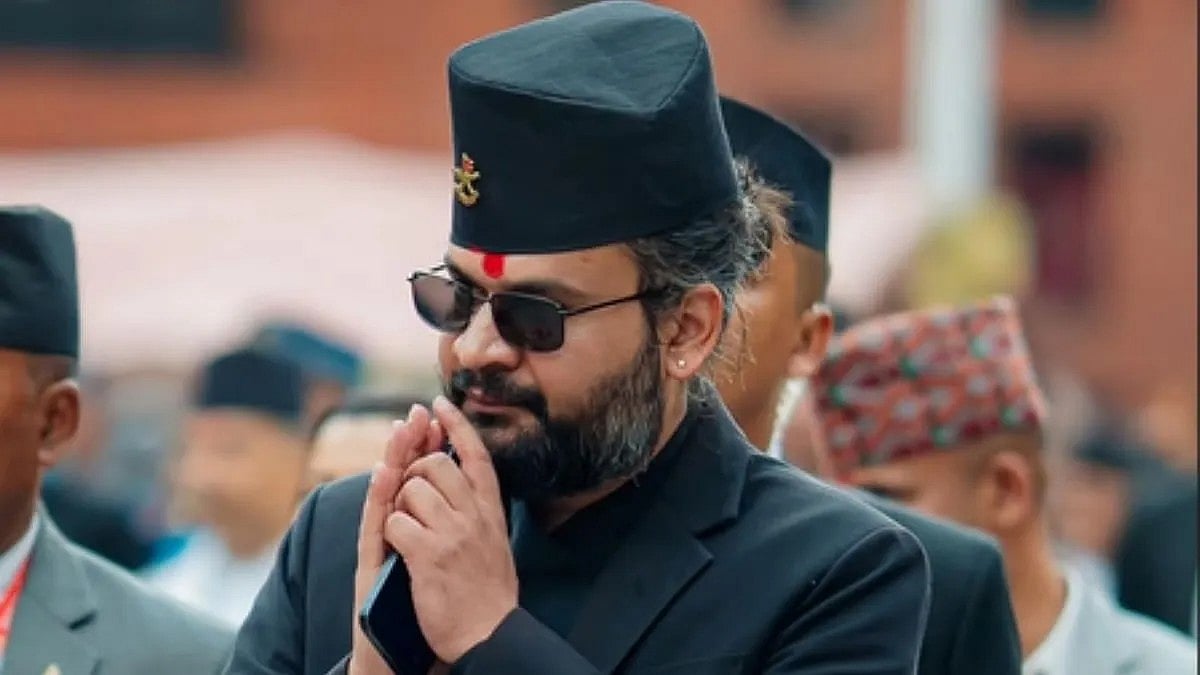
Nepal PM Balen Shah | File
Monday’s high-profile visit by the young and energetic Nepalese Prime Minister Balen Shah seems to have reset the relationship between New Delhi and Kathmandu, allowing little space for Shah’s detractors to attack him for giving way before the larger neighbour.
The meeting between Shah and Narendra Modi in New Delhi marks an important moment in India-Nepal relations, not because it has dramatically altered the strategic landscape but because it could be changing the terms on which the relationship is managed by focusing on the economy and Nepal’s reconstruction rather than on contentious issues, such as boundary pillars and a three-quarter-of-a-century-old pact.
The headline numbers are impressive, as India announced a development cooperation package of NPR24,000 crore, equivalent to roughly Rs15,000 crore. For Nepal, with reconstruction following the August floods and longer-term development a pressing priority, the help should go a long way. The two sides also moved forward on rail connectivity, additional port access, border infrastructure, and eight agreements spanning an unusually broad range of institutional cooperation.
However, moving away from the big announcements, the significance of Shah’s visit lies less in the financial package than in the political messaging that accompanies it. Nepal appears to be seeking a more practical, outcome-driven engagement with India, one that converts the country’s geographical dependence into economic opportunity without surrendering its strategic autonomy. New Delhi’s Mandarins must have heaved a sigh of relief, as this gave them an opportunity to reinforce the much-vaunted neighbourhood-first policy through visible delivery at a time when infrastructure, trade, and connectivity are increasingly becoming instruments of geopolitical influence, without the fractious baggage of the past.
For decades, India-Nepal ties have been characterised by a paradox: extraordinary geographical, cultural, and economic interdependence, alongside periodic political mistrust. The open border, deep societal connections and Nepal’s need for Indian transit routes make the relationship intimate, but at the cost of it being interpreted as dependence and resented. Hence, periodic perceptions of Indian interference, assertion of sovereignty, disputes over the boundary, and Kathmandu’s efforts to diversify strategic options through engagement with China continue to strain ties with India.
Shah’s New Delhi visit appears to recognise that the baggage must be ditched or put behind and trust deficiency addressed. The way out, which both sides have decided upon, is a clever mix of development finance, transport links, port accesses, border facilities, and technical cooperation, which offer benefits which can be seen on the ground by businesses and ordinary citizens.
The Rs15,000 crore development package is, therefore, politically significant and, being the first big promise from this summit, has become headline news in the Kathmandu Valley. However, the “value of the deal” will ultimately be determined not by the announcement or the immediate goodwill but by how quickly projects move from commitments to visible reconstruction and development in a nation-state where political legitimacy increasingly rests on performance and public expectations with a quick turnaround.
Quick delivery will also provide India with an opportunity to demonstrate that its neighbourhood-first diplomacy can produce tangible results, rather than merely compete with China’s cheque-book diplomacy.
Possibly the most strategically consequential announcement is Nepal’s access to Kandla and Paradip ports, in addition to Kolkata. It basically means Nepal can bring in large tankers and cargo vessels, carrying its own consignment of fuel and fertilisers—two essential goods for which it has long been dependant on India. Nepal’s landlocked geography has long made transit access a central vulnerability of its economy, and by expanding its choices for transit, Kathmandu can tell its citizens that dependence has been converted into interdependence, as port incomes from Nepal will make India equally dependent on promoting the transit commerce.
China, of course, will remain an important consideration in both New Delhi’s and Kathmandu’s calculations. Nepal’s pursuit of alternative connectivity and economic partnerships is part of a broader strategy to avoid excessive dependence on any single external power. The Indian port announcements could strengthen Nepal’s negotiating position, even as they deepen its integration with the Indian economy.
This, however, will remain the paradox of Nepal’s foreign policy—the greater its connectivity with India, the fewer chances Kathmandu has of heading towards Tibetan routes to reach out to the world.
It would be tempting in New Delhi to interpret Shah’s visit as evidence of Nepal moving closer to India, as border disagreements and negotiations on rewriting the contentious existing 1950 agreement, which many in Nepal consider a one-sided agreement that casts India in the role of the bigger power, were placed on the backburner without being dismissed.
Perhaps this was done not merely because Nepal, in the ultimate analysis, needs an Indian defence umbrella from an expanding China, but also because the American and European policymakers, who applauded the Gen Z revolt in the Kathmandu Valley, realise that a Nepal in the Chinese orbit would be one shield less in the ultimate global array for the coming competition between Washington and Beijing.
However, any reading that the outcome of Shah’s visit to New Delhi moves Nepal closer to India may be premature, as the Himalayan state’s foreign policy has historically sought room for manoeuvre between its two large neighbours.
India possesses advantages that geography and history have made difficult for China to replicate. But by no means are those advantages permanent entitlements. Kathmandu’s willingness to deepen economic engagement with India will depend partly on the quality of India’s offer—its speed, reliability, predictability, and sensitivity to Nepali political concerns.
In that sense, Shah’s visit is less a geopolitical victory for India than an opportunity to consolidate its position through performance.
The writer is Editor, United News of India.
RECENT STORIES
-
-
-
-
-