Arvind Kejriwal's Recusal Plea Against Delhi High Court Judge: Legal Debate Or Desperate Political Theatre?
An opinion piece questioned Arvind Kejriwal’s plea seeking a judge’s recusal in the Delhi excise case, arguing the bias claims lack strong legal basis. It said recusal rests on judicial discretion, not litigant preference, and described the move as resembling bench shopping, while stressing appeal mechanisms exist to challenge adverse rulings.

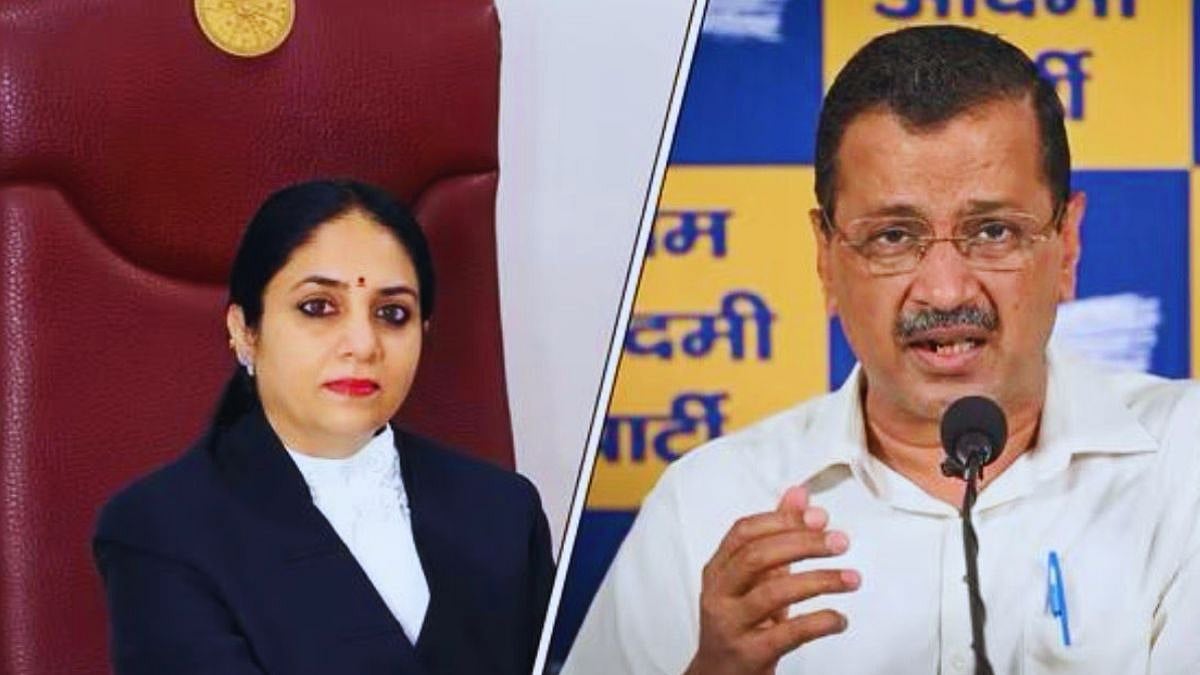
Left: Swarna Kanta Sharma Right: Arvind Kejriwal |
Whether former Delhi chief minister Arvind Kejriwal was legally correct in asking Justice Swarana Kanta Sharma of the Delhi High Court to recuse herself from the Delhi Excise Policy case is a matter of legal debate, involving a conflict between established procedural norms and the principles of natural justice. In Indian law, there is no codified statute governing recusal; it is primarily guided by Supreme Court precedents, which emphasise that recusal is a matter of judicial discretion and conscience. Kejriwal argued that a "reasonable apprehension" of bias existed, which is a valid legal ground for seeking recusal (based on Ranjit Thakur v. Union of India 1987), as justice must not only be done but must appear to be done.
In Ranjit Thakur (supra), the Supreme Court was adjudicating on a court-martial order in which it ruled that military court-martial proceedings must adhere to principles of natural justice and fairness. The court established that punishments must be proportional to the offence, holding that a sentence "strikingly disproportionate" to the misconduct constitutes an arbitrary, unreasonable action violating Article 14. The court held that a punishment that shocks the conscience of the court justifies judicial review. In this case, sentencing a soldier to a year of rigorous imprisonment and dismissal for refusing to eat (as a protest) was considered highly excessive even by the peremptory standards of court martial trials. The judgement emphasised that a Summary Court Martial (SCM) must be free from bias. The participation of the commanding officer—whom the soldier had complained against—as the judge in the SCM was deemed a violation of the rule against bias. That was a judgement in the armed forces ecosystem, where sterner norms are taken as axiomatic, but the Supreme Court disabused the notion that SCM can disregard fundamental rights enshrined in the Constitution.
Kejriwal is clearly clutching at straws because his case is not entirely on all fours with the Ranji Thakur case—the SCM was guilty of violating the legal tenet that one should not be a judge in his own cause. The commanding officer was the superior cum court martial rolled into one. Justice Swarna Kanta Sharma was hardly judging her own cause. That the judge's children are empanelled as Central Government Counsel and receive work through Solicitor General Tushar Mehta, who appears for the CBI (the prosecuting agency), cannot be held against her, as the Solicitor General was a mere prosecutor with no interest in the outcome of the case. That the High Court termed the trial court's discharge order "prima facie erroneous" at the very first hearing before his side could fully present the arguments smacked of a closed mind is an unfounded fear. She was, after all, aware of the minutiae of the case from her bail hearings, and naturally the trial judge’s discharge order of Kejriwal and others in the liquor policy case on the ground that there was no shred of evidence must have impelled her to make such an observation. Obiter dicta, a judge's expression of opinion uttered in court or in a written judgement, is not essential to the decision and, therefore, not legally binding as a precedent. The then SC Judge Khanna, while dealing with Manish Sisodia’s bail petition, observed that a money trail to the tune of Rs 338 crore was tentatively established in the money laundering case against AAP bigwigs pursued by the ED. Was he too biased or prejudiced? That there was a pattern of "strong and conclusive" findings against him and other Aam Aadmi Party (AAP) members in previous bail/arrest matters by the same judge, thus warranting her recusal, ignores the fact that a verdict can be appealed against. Justice Sharma didn’t have to have the mortification of her judgements being reversed. All AAP bigwigs got bails, ultimately, not because Sharma’s denial was found to be unlawful but because the Apex Court held that the CBI and the ED cannot infinitely keep them in confinement.
In India, recusal is purely left to the judge’s conscience. That she attended an RSS affiliate seminar cannot be held against her. Advocates and judges have their own unstated political leanings, if not affiliations, and that cannot be held against them. The Delhi High Court Chief Justice had already declined an earlier administrative request to transfer the case, stating it was assigned according to the roster. The judge had reserved her order on whether she would recuse herself or not on April 13. Meanwhile, Kejriwal has filed a special leave petition (SLP) even before the order on recusal, which is rather strange. Kejriwal is moving heaven and earth to prevent the appeal against the CBI court order being heard by her lordship Sharma. Remember, he has already filed an Article 32 petition questioning the Delhi High Court Chief Justice’s administrative order rejecting his plea to transfer the CBI appeal to some other judge.
In India there are apocryphal stories of bench fixing or shopping. But what Kejriwal is saying effectively boils down to this—I want a judge who is sympathetic to my cause. The hierarchy of appeals ensures a fair appeal in India. If Justice Sharma doesn’t recuse herself and delivers a judgement overturning the CBI court absolution given to Kejriwal, he can by all means appeal to the division bench, and when the division bench upholds her judgement, he can go all the way to the Apex Court in appeal. But Kejriwal is a true dramatis personae. He wants attention to be riveted on him. Not for him is the wait involved in the judicial process. He is a man in a hurry trying to cast aside anything coming in his way to political ascendance. A judge’s judgement can be criticised on merits and appealed against, but mudslinging and aspersion-casting must not be allowed.
S Murlidharan is a freelance columnist and writes on economics, business, legal and taxation issues.
RECENT STORIES
-
-
-
-
-