A Superpower Seeking Stability, Not Dominance
Trump’s Beijing visit revealed a changing global balance in which Washington appeared increasingly eager for accommodation while China projected the confidence of a rising power — a shift whose consequences could directly reshape India’s strategic future

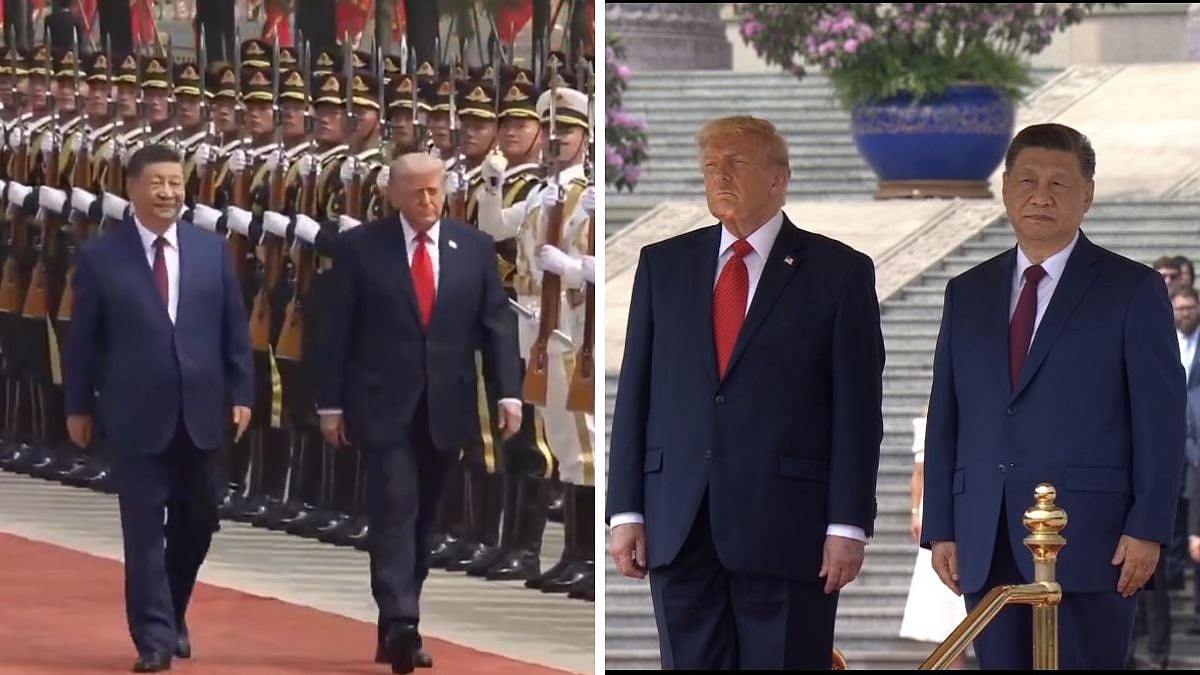
A Superpower Seeking Stability, Not Dominance | file pic
Trump’s Beijing visit may eventually be remembered less as a display of American power and more as a defining moment in the changing balance of global politics whose consequences could directly shape India’s strategic future. History may not repeat itself exactly, but it often returns in familiar rhymes — and that proverb appears strikingly relevant to United States President Donald Trump’s dramatic outreach to China at a time when America is simultaneously grappling with the Iran war, economic stagnation, trade anxieties and growing geopolitical fatigue.
Ironically, only recently senior officials in Washington had argued that the United States would never again commit the “historic mistake” of helping China rise economically as it allegedly did in the 1970s by integrating Beijing into the global industrial order. Yet Trump’s Beijing outreach reflected precisely that contradiction: a strategically fatigued America once again turning toward China in the hope of stabilising an increasingly unstable world order.
What unfolded in Beijing was not merely a bilateral summit between two rival powers. It was a high-stakes negotiation whose outcome could have direct implications for India’s security, economic interests and geopolitical relevance. Trump arrived in Beijing seeking Chinese cooperation on trade, Iran, maritime security, energy stability and supply chains after months of strategic setbacks arising from the Iran conflict and mounting domestic economic pressures. The American president appeared particularly eager to persuade Chinese President Xi Jinping to use Beijing’s leverage over Tehran to help stabilise the Strait of Hormuz and reduce tensions in West Asia — a conflict that threatens global oil markets and could politically damage Republicans ahead of the mid-term elections.
Six Major Takeaways from the Summit
The first major takeaway from the summit was the unmistakable shift in American posture from confrontation to accommodation. Trump, who once championed tariff wars and economic decoupling, arrived in Beijing seeking stability rather than escalation.
Second, China successfully projected itself as an equal global power capable of negotiating with Washington on nearly every major international issue — from trade and energy security to Iran and Taiwan. Xi Jinping’s emphasis on “strategic stability” and “equal-footed consultation” reflected Beijing’s growing confidence. Two countries did agree that the Strait of Hormuz – the critical waterway Iran has all but closed – must remain open and that Iran can never have a nuclear weapon.
Third, despite optimistic diplomatic language, there was no breakthrough on Taiwan. Xi strongly reiterated that Taiwan remained the core issue in bilateral ties and warned that mishandling it could trigger confrontation. Trump’s decision to avoid public hostility on the issue reinforced regional perceptions that Washington may be softening its posture toward Beijing.
Fourth, the Iran issue exposed America’s increasing dependence on China’s diplomatic leverage. Washington sought Beijing’s assistance in persuading Tehran toward de-escalation as instability in the Strait of Hormuz threatened global energy flows. Yet China carefully avoided any explicit commitment beyond generic appeals for stability.
Fifth, trade tensions were temporarily managed but not fundamentally resolved. Both sides spoke about “balanced and positive outcomes”, expanding cooperation and reducing disputes. However, the structural rivalry between the two economies remains intact beneath the conciliatory rhetoric.
Finally, the summit strengthened Xi politically and diplomatically. The image of an American president arriving in Beijing amid global turmoil seeking Chinese cooperation reinforced Beijing’s narrative that China has emerged as an indispensable pillar of the emerging world order.
Xi’s Strategic Messaging and America’s New Realism
Perhaps the most symbolically important moment of the summit came when Xi invoked the “Thucydides Trap” — the theory popularised by political scientist Graham Allison that war often erupts when a rising power threatens to displace an established one.
Xi declared that China and the United States must avoid such a confrontation and “join hands to create the future”. The message carried unmistakable strategic weight. Beijing no longer speaks as a junior player seeking accommodation within an American-led order; it increasingly speaks as a peer power insisting Washington adjust to a multipolar world.
China’s official readout prominently highlighted Xi’s warning that Taiwan remained “the most important issue” in China-US relations and stressed that “Taiwan independence” and peace across the Taiwan Strait were “as irreconcilable as fire and water”. Beijing also reiterated opposition to the “militarisation” of the Taiwan Strait.
The White House statement, however, reportedly omitted Taiwan entirely and instead focused heavily on trade deals, agricultural exports, investment, business opportunities and cooperation on fentanyl-related issues.
The asymmetry was revealing. While Beijing asserted strategic red lines, Washington appeared more focused on economic stability and diplomatic accommodation.
Why the Trump-Xi Understanding Directly Impacts India
For India, the outcome of the Trump-Xi dialogue carries direct strategic, economic and geopolitical consequences. New Delhi emerged as one of the principal beneficiaries of sustained rivalry between Washington and Beijing because both powers increasingly viewed India as a crucial counterweight in Asia. That competition accelerated defence cooperation, technology partnerships, capital inflows, semiconductor investments and deeper geopolitical coordination between India and the United States.
Trump’s conciliatory posture toward China in Beijing therefore marks a significant shift with immediate implications for India. Washington’s softer tone on Taiwan coupled with omission from Washington DC statement and its visible eagerness to secure Chinese cooperation on trade, Iran and economic stability strengthen Beijing’s strategic confidence across the Indo-Pacific. A more confident China inevitably sharpens pressure along the Himalayan frontier while simultaneously expanding its regional influence from the South China Sea to South Asia.
The summit also signalled the possibility of a broader US-China accommodation that could reduce India’s strategic centrality in Washington’s Indo-Pacific calculations. New Delhi’s leverage grew substantially during years of intense US-China rivalry because American policymakers viewed India as an indispensable balancing power against Beijing. As Washington moves from confrontation toward managed coexistence with China, India risks losing part of that geopolitical advantage.
The economic fallout is equally significant. Any exclusive trade arrangements, tariff adjustments or sectoral understandings between Washington and Beijing could bypass India at a time when New Delhi has been positioning itself as an alternative manufacturing and supply-chain destination. India’s gains from the “China Plus One” strategy weaken if American companies and policymakers begin restoring greater economic comfort with Beijing.
India will closely assess the technology dimension of the summit. Reports that Washington has cleared limited access for several Chinese firms to Nvidia’s advanced H200 AI chips indicate that economic compulsions are beginning to override earlier strategic restrictions on China’s technological rise. Such decisions directly affect India’s ambitions to emerge as a global technology, semiconductor and artificial intelligence hub.
The implications extend beyond economics and technology. Washington’s growing willingness to reopen strategic space for countries like Pakistan while simultaneously reducing pressure on Beijing adds another layer of concern in New Delhi. Indian policymakers increasingly view the emerging US-China engagement not merely as a diplomatic reset, but as a structural shift that could gradually dilute India’s importance in the evolving Asian balance of power.
Asia’s Fear of Strategic Reordering
The broader Asian reaction has been marked more by caution than celebration.
US allies across Asia worry that Trump’s desire for tactical accommodation with Xi could trigger fears of strategic abandonment, particularly in Taiwan, Japan and parts of Southeast Asia. Any dilution of American support for Taiwan would dramatically strengthen Beijing’s regional confidence and alter the Indo-Pacific equilibrium.
Asian economies are equally concerned about how any restructuring of US-China trade arrangements could affect regional supply chains, tariffs and energy security.
The Iran conflict and the Strait of Hormuz crisis have added another layer of anxiety for countries heavily dependent on Gulf energy supplies. Many Asian nations therefore welcomed the reduction in immediate tensions between Washington and Beijing, but they remain deeply uncertain about the long-term consequences of a possible US-China accommodation.
What Trump Gained — And What Xi Won
Trump may still attempt to project the visit as a diplomatic success ahead of the mid-term elections. He can claim that tensions were reduced, communication channels remained open and trade negotiations survived a dangerous phase of confrontation.
Domestically, even symbolic stability may help him politically after months of pressure arising from economic slowdown and the Iran conflict.
Yet the larger strategic gains appeared to favour Xi Jinping.
China succeeded in presenting itself as a calm, stable and indispensable global actor while the United States appeared anxious for cooperation. Xi avoided major concessions, protected China’s core interests and reinforced Beijing’s image as America’s equal rather than subordinate rival.
Trump-Xi Trade Talks Focus on Tariffs, Technology and Economic Cooperation
US President Donald Trump and Chinese President Xi Jinping held extensive trade-focused talks in Beijing aimed at reducing tensions between the world’s two largest economies. The discussions centred on tariffs, technology restrictions, supply-chain stability, energy cooperation and greater Chinese purchases of American agricultural and energy products. Both sides described the talks as constructive, with Trump calling the meeting “extremely positive” while Xi stressed that China and the US should remain “partners, not rivals.”
The US delegation included Secretary of State Marco Rubio, Treasury Secretary Scott Bessent, Commerce Secretary Howard Lutnick and Trade Representative Jamieson Greer. Several leading American business executives, including Elon Musk, Tim Cook and Jensen Huang, were also present for commercial discussions linked to AI, semiconductors and investment cooperation.
In the end, Trump’s Beijing visit may have reduced immediate tensions between the world’s two largest powers, but it also revealed an uncomfortable truth for many countries in Asia. The United States arrived seeking stability; China used the opportunity to reinforce its image as an indispensable global power whose cooperation America increasingly needs.
Trump may claim diplomatic progress, but Xi arguably secured the larger strategic victory by demonstrating that even America now needs China not merely as a trading partner, but increasingly as a geopolitical stabiliser in a fractured and uncertain world order.
(Writer is strategic affairs columnist and senior political analyst based in Shimla)
RECENT STORIES
-
-
-
-
-