A Little Hope For A Big Bird: Great Indian Bustard Chick Born In Gujarat Signals Conservation Gains Amid Habitat Threats
The birth of a Great Indian Bustard chick in Gujarat offers rare hope for the critically endangered species, aided by coordinated conservation efforts between Rajasthan and Gujarat. However, habitat loss, power lines and policy gaps continue to threaten survival, underscoring the urgent need for stronger ecosystem protection alongside breeding programmes.

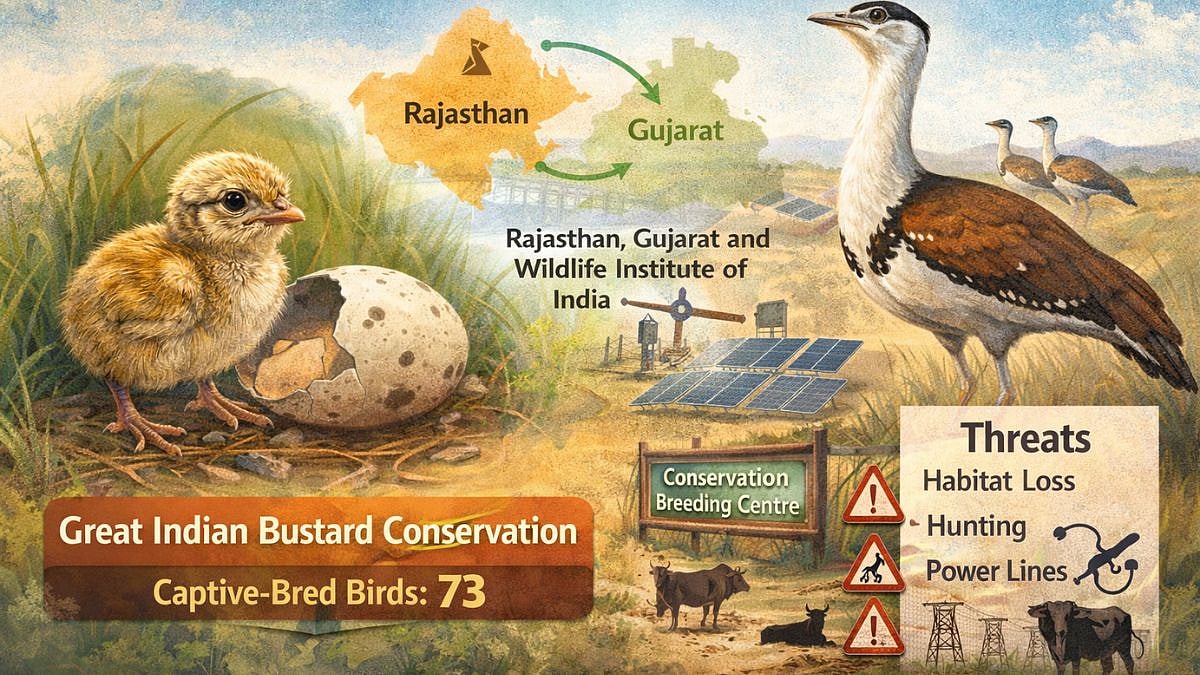
A newly hatched Great Indian Bustard chick in Gujarat highlights fragile conservation gains amid ongoing threats to its natural habitat | AI Generated Representational Image
The birth of a Great Indian Bustard (GIB) chick is cause for celebration, considering the precarious status of the bird in the wild. The hatching of the chick in Gujarat’s Kutch area, from an egg brought from Rajasthan and incubated by a foster mother, is a stroke of good fortune.
Prospects of breeding the GIB in its natural habitat are bleak, and the latest addition to the population has been made possible by ‘jumpstarting’ the process — Rajasthan, Gujarat, and the Wildlife Institute of India are coordinating to connect conservation breeding centres in Rajasthan with field sites.
The fortunes of the species have dramatically declined due to a variety of factors, not the least of which is the conversion of grasslands into agriculture and changes to sandy deserts. The threats were highlighted by the then Union Minister Jairam Ramesh in 2010, and Narendra Modi, as Gujarat Chief Minister, addressed those concerns with a special conservation initiative.
The unfortunate reality is that this bustard, a large and heavy bird that was once proposed by the ornithologist Salim Ali for national bird status, has, over the decades, lost its grassland habitat to farming and a growing population of livestock. Two similar species, the lesser and Bengal floricans, are also under severe pressure.
By contrast, populations of the peacock, which was recognised as the national bird, have grown to a point where it is overrepresented in some landscapes. Hunting, power lines, and solar farms planted across large areas have further eroded the survival chances of the GIB in the wild.
Conservation challenges and policy gaps
While the arrival of a bustard chick is rightly seen as an advance, governments would do well to align their other actions that produce large-scale land-use change and species declines with conservation goals. Bad policies lead to catastrophic wildlife losses.
The Union government has taken up targeted recovery programmes for 24 species, of which the GIB is one, and others include birds such as the Bengal florican, Nicobar megapode, Jerdon’s courser, and vultures, besides various threatened animals. These programmes become meaningful only when the integrity of critical habitats is protected, and economic extraction is both restricted and kept well away from them.
The indices of India’s environmental dashboard often point to harmful decisions taken in the name of ease of doing business. Much effort and expense has gone into the GIB conservation programme, with special breeding centres set up in Sam and Ramdevra in Rajasthan; the Union government says there are now 73 captive-bred birds in the two locations.
To give them a fighting chance at survival under a rewilding programme, the habitat should be freed from human pressures. A review by the Bombay Natural History Society said in 1987 that the bustard is totally protected, but not its home. Scientific conservation may yet raise the GIB population.
Published on: Monday, March 30, 2026, 07:11 PM ISTRECENT STORIES
-
-
-
-
-