A Footpath For Mrs Biswas To Enjoy An Uninterrupted Walk
India’s cities need safer and wider footpaths as growing vehicle use, encroachments and poor maintenance make walking increasingly difficult. The article calls for obstruction-free pedestrian spaces, accessible footpaths, better public transport, stricter enforcement and stronger civic monitoring to make urban areas safer and more liveable.

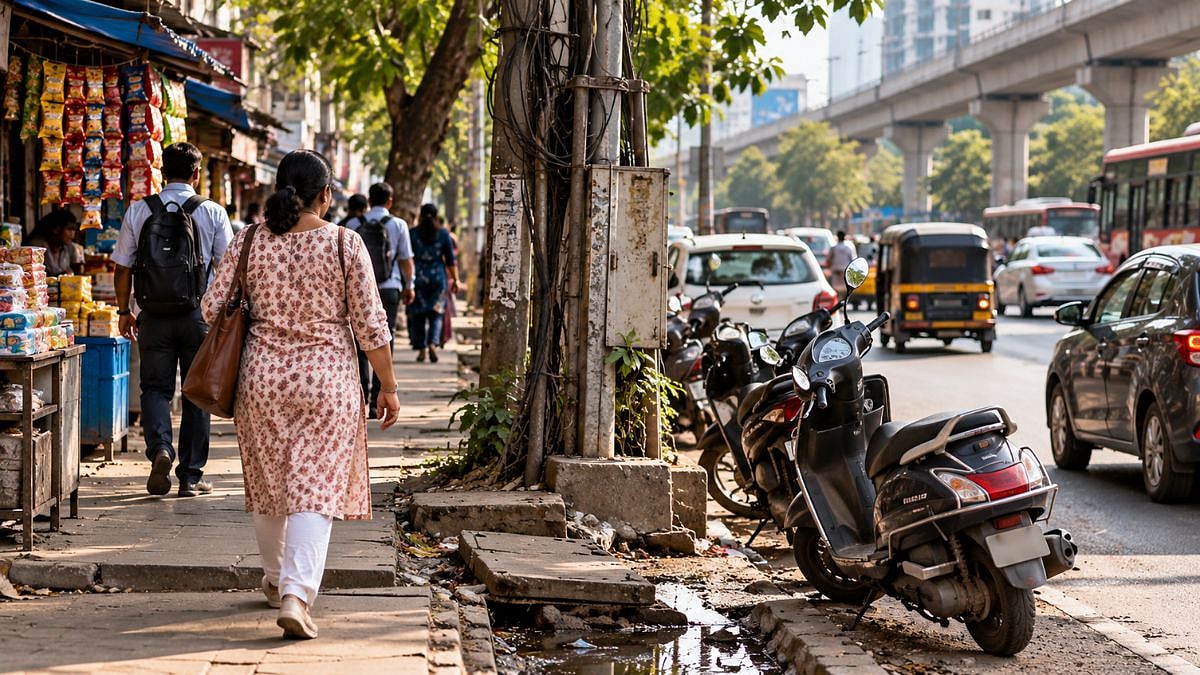
Poorly maintained and encroached footpaths often force pedestrians to share congested roads with vehicles | AI Generated Representational Image
The de-pedestrianisation of India’s cities since the rise of personal automobiles in the 1980s is a constantly expanding project, and the sole metric of healthy urbanisation is now a continuous flow of vehicular traffic.
In the frenetic life of Indian citizens, being able to walk easily to the local train station or bus terminus, to a park or lake, sit at a quiet roadside cafe at dusk, take children on a stroll, or simply stand and admire the skyline is difficult in most places. Utilitarian, hazardous, and joyless walking is imposed on the pedestrian, who negotiates an obstacle course every day.
Right To Walk
The Supreme Court’s recent order in a motor vehicle accident case, emphasising the citizen’s fundamental right to walk under Articles 19(1)(d) and 21 of the Constitution, and giving her the right to restitution and compensation, has stirred some city administrations to announce pedestrianisation programmes. These statements and early measures to remove obstacles have provoked a backlash from some political parties, vendors, rights groups, and groups of citizens, who cite the enshrined rights of hawkers under law and call for a moderate approach.
Indian metros are governed by statutes and democratic processes and do not countenance a Haussmannisation of the city. Georges-Eugene Haussmann, the French civil servant who earnestly took up Napoleon III’s 19th-century mandate of rebuilding the core of Paris, executed his task with strong-arm tactics to partly rid the city of decrepitude and disease but also to create broad avenues if the ruler’s troops had to move against rebels quickly.
While Haussmann’s Paris is criticised by some for taking down the dwellings of the poor to make room for the beautiful boulevards and buildings of the City of Light, it has not evolved into an unredeemed gentrified enclave for the rich, with no vendors or watering holes for the commoner. What is certainly absent is chaos.
Lessons From European Cities
Footpaths along Boulevard Voltaire, a classic central Parisian avenue, are taken over by vendors on Sundays, their right to hawk secured through a small fee paid to a cooperative. On Monday morning, though, there is no trace of vending, and busy Parisians are back to their work routines, hurrying to the Metro station nearby. But vending is permanent along the Seine, with the souvenirs, artwork, and other goods later stored in river-facing metal boxes, without blocking off walking paths.
Post-war Berlin, Germany, the capital of a country so wedded to automobile engineering, makes no compromises when it comes to walkability. Pedestrian crossings sport traffic lights that feature iconic Ampelmann characters, a legacy of the East German Ampelmannchen—one man standing still on red and the other striding ahead when it turns green, a delightful sight for walkers. The most powerful cars stop without a honking frenzy or elitist swagger. Footpath cafes start buzzing in the evening without forcing pedestrians onto the path of vehicles.
Closer home, in Istanbul, both sides of the Bosphorus retain their Byzantine-Ottoman charm but provide enough walking room for the legions of tourists that besiege the Turkish city each year. Unlike Kolkata and other Indian metros, which ripped up their tram lines, these are still mainstream in Istanbul, serving to keep its economy humming.
Why Footpaths Matter
All of which makes Mrs. Biswas, the Indian pedestrian, wonder why it is a near-impossibility to expect continuous walking paths that are free of assorted hazards, such as obstructing electricity pillars and cables, commercial encroachments, pools of sullage, garbage, gaping drains, and, increasingly, parked cars and scooters.
It could be the skewed policy attention being devoted to meeting the needs of 1,400 to 2,100 vehicles registered in the biggest cities every day on average, part of about 7.1% of GDP contributed by the automobile industry. That view ignores the loss of productivity to the economy from gridlock, which the Economic Survey of 2025-26 says costs even an unskilled worker in Delhi ₹14,600 in losses annually.
Moreover, if German cities can maintain a big automotive industry, along with thriving railways, metros, trams, buses, and citywide bicycle tracks, offer free, unlimited nationwide travel by public transport for €63 a month and still keep cities civilised for walkers, why cannot India?
Funding Better Footpaths
Europe’s avenues are wide, but they do not make room for more cars at the cost of footpaths. No flyovers are visible. Left parties and Greens in the current German local elections promise stronger public transport and green cities.
If funds to maintain footpaths are a sticking point in India, it can well be remedied with a state levy of a rupee on every litre of automotive fuel or a FasTag-based congestion charge within cities. Heavier parking fees in core cities are another avenue.
Wide footpaths make it possible to have roadside amenities and restaurants, bringing a much-needed human scale to cities. They allow older adults to walk safely, children to ride their tricycles, parents to move with baby strollers, and shops to welcome more customers who would otherwise not come due to congestion and pollution. All of this adds to the local economy, which people in passing cars do not.
Standards And Accountability
Even if wide tree-lined boulevards and artistic drinking water fountains at street junctions are seen as a luxury in a populous India, the case for footpaths at least two metres wide, kerb cuts for wheelchair users, bus stops designed for the present century, enforced traffic signals, and strict penalties for rogue motorists is stronger than ever.
Spending on footpaths, however, does not guarantee that one gets to use them. Many cities show regular expenditure on footpaths, but the facilities never meet any norms and quickly disintegrate or are encroached upon. The Supreme Court could monitor this aspect by asking for a compliance report on meeting Indian Roads Congress standards for footpaths from state governments.
Citizen Groups Push Change
In the absence of a sincere government response to making cities walkable, the task of carrying out audits shifts to citizen groups. Many have emerged nationwide, their effervescent campaigns amplified by social media. It may be rewarding now to institute ‘worst footpath’ awards for civic bodies in the big cities, inviting the public to vote and mayors and ministers to enter halls of shame. As the tide turns, the best performers can hope for true honours.
G. Ananthakrishnan is a senior journalist.
RECENT STORIES
-
-
-
-
-