Will G7 And US-Iran Diplomacy Reopen Door For Peace In Ukraine?
With a landmark US-Iran peace treaty set for June 19 in Geneva, acute war fatigue and crippling resource crunches are forcing Russia and Ukraine to reconsider their positions as global diplomatic focus likely to shift back toward Eastern Europe at the G7 summit

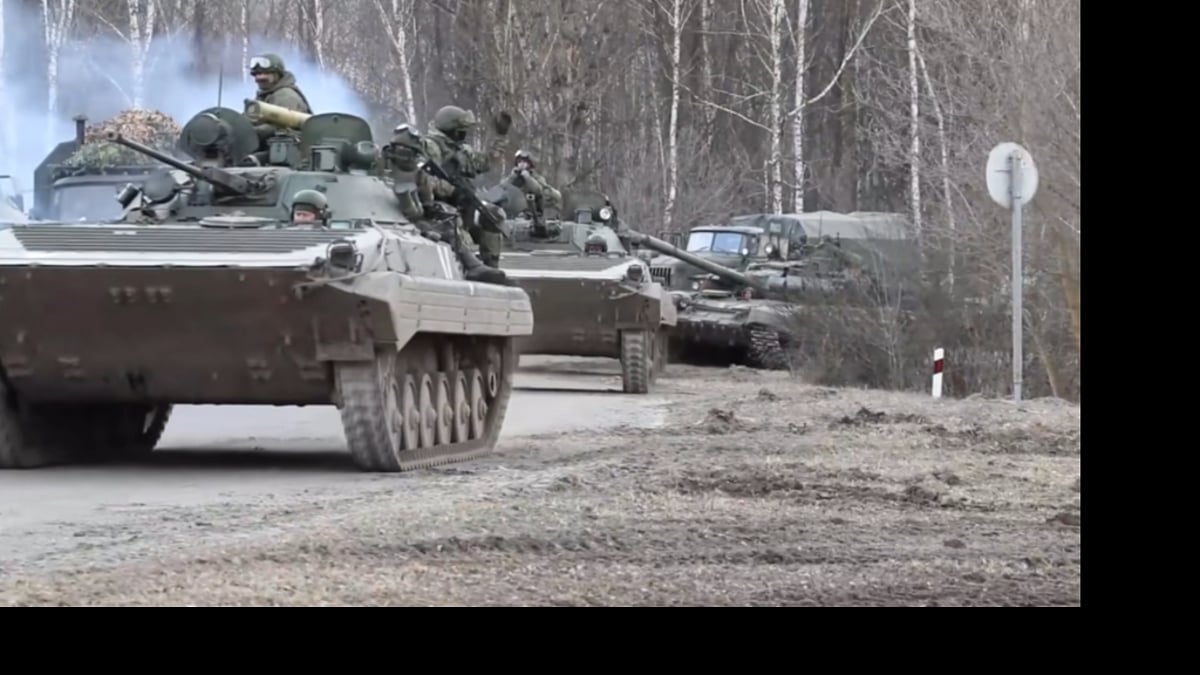
Russian army in the Kyiv area. | Wikimedia Commons
Following a intense three-month war that broke out in February 2026, the United States and Iran have agreed to a comprehensive peace deal mediated by Pakistan. According to announcements by US President Donald Trump and Pakistani Prime Minister Shehbaz Sharif on June 14, 2026, a formal memorandum of understanding (MOU) is scheduled to be officially signed on Friday, June 19, 2026, in Geneva, Switzerland.
The conflict began earlier this year with US-Israeli airstrikes on Iran, triggering retaliatory Iranian strikes and a devastating maritime showdown. Iran effectively blocked global energy shipping through the crucial Strait of Hormuz, prompting a retaliatory US naval blockade of Iranian ports. The new framework agreement calls for an immediate and permanent termination of military operations on all fronts, explicitly extending to the parallel conflict in Lebanon, alongside the removal of the US blockade and the reopening of the Strait of Hormuz to let global oil flow again.
As the global spotlight is on Geneva for this week, the war in Ukraine, now grinding through its fifth year since Russia’s February 2022 invasion, is feeling the secondary effects of Middle Eastern diplomacy.
Will the world give Ukraine undivided attention after June 19?
Once the US-Iran peace treaty is officially signed in Geneva on June 19, the international community will have a rare window to give its undivided attention back to Eastern Europe. For the past several months, global markets, naval resources and Western diplomatic capital were entirely consumed by the threat of a wider Middle Eastern war and the closure of the Strait of Hormuz.
With the maritime blockades dissolving and global energy supplies hopefully stabilising, the G7 nations are actively shifting their focus. The timing of the G7 Summit in France provides an immediate platform for Western allies to coordinate a unified stance on Ukraine. However, total global focus is not guaranteed to translate into an easy resolution.
Russia is attempting to leverage its battlefield presence to force territorial compromises while Ukraine is using its successful logistical degradation of Russian forces in Kherson and Zaporizhzhia to prove it can hold the initiative. The coming weeks will reveal if the world's renewed focus can successfully translate into a viable framework for a lasting peace.
Why Russia and Ukraine are talking about peace now
On June 14, 2026, Ukrainian President Volodymyr Zelensky and Russian President Vladimir Putin held separate, consecutive phone calls with President Trump, who was celebrating his 80th birthday.
According to a Agence France-Presse report, Zelensky and Trump discussed immediate pathways to peace, agreeing to hold a critical working session on Tuesday at the G7 Summit in Evian-les-Bains, France.
Simultaneously, Kremlin aide Yuri Ushakov confirmed that Putin held a "friendly and frank" call with Trump. With the US-Iran war nearing its official end, Trump's special diplomatic representatives, Steve Witkoff and Jared Kushner, are slated to return to Russia to revive stalled shuttle diplomacy between Moscow and Kyiv.
How war fatigue and resource crunches are affecting both sides
The sudden urgency for diplomacy is being heavily driven by an inescapable reality. Both Russia and Ukraine are suffering from acute war fatigue and severe resource constraints. US-led peace efforts in Eastern Europe had been sidelined for months due to the high-stakes war with Iran. Now, battlefield dynamics show that Russia’s grinding offensive in eastern Ukraine is visibly losing steam.
While Kremlin narrative insists the "special military operation" is highly successful, Al Jazeera reports that President Putin publicly acknowledged that intensifying Ukrainian long-range drone strikes are inflicting tangible damage on the Russian economy and society. The Institute for the Study of War highlights that Ukraine's targeted drone campaign has battered vital Russian oil refineries, pipelines and depots while midrange strikes have choked off fuel supplies into occupied Crimea, triggering the worst domestic fuel crisis the Black Sea peninsula has seen since its illegal annexation in 2014.
However, Ukraine faces its own severe resource crunch.
Kyiv's cities are absorbing near-daily pummelling from Russian drones and missiles. While Ukrainian Commander-in-Chief Oleksandr Syrskii noted that Ukraine successfully clawed back more territory than it lost in May, reversing Russia's multi-month streak of net gains, the sustainability of this push is highly fragile.
Ukraine remains deeply dependent on its allies for ammunition and defensive hardware and there are mounting questions about whether domestic production and western supplies can keep pacing the rate of attrition before Moscow adapts.
RECENT STORIES
-
-
-
-
-