Inflation At 300% And Stock Markets Plunging: True Cost Of Pakistan's Energy Vulnerability
To shield its fragile economy from Middle East war shocks, Pakistan is launching a plan to build its first-ever strategic oil reserve by redirecting fuel tax revenue, aiming to ease severe public inflation and secure vital energy supply lines

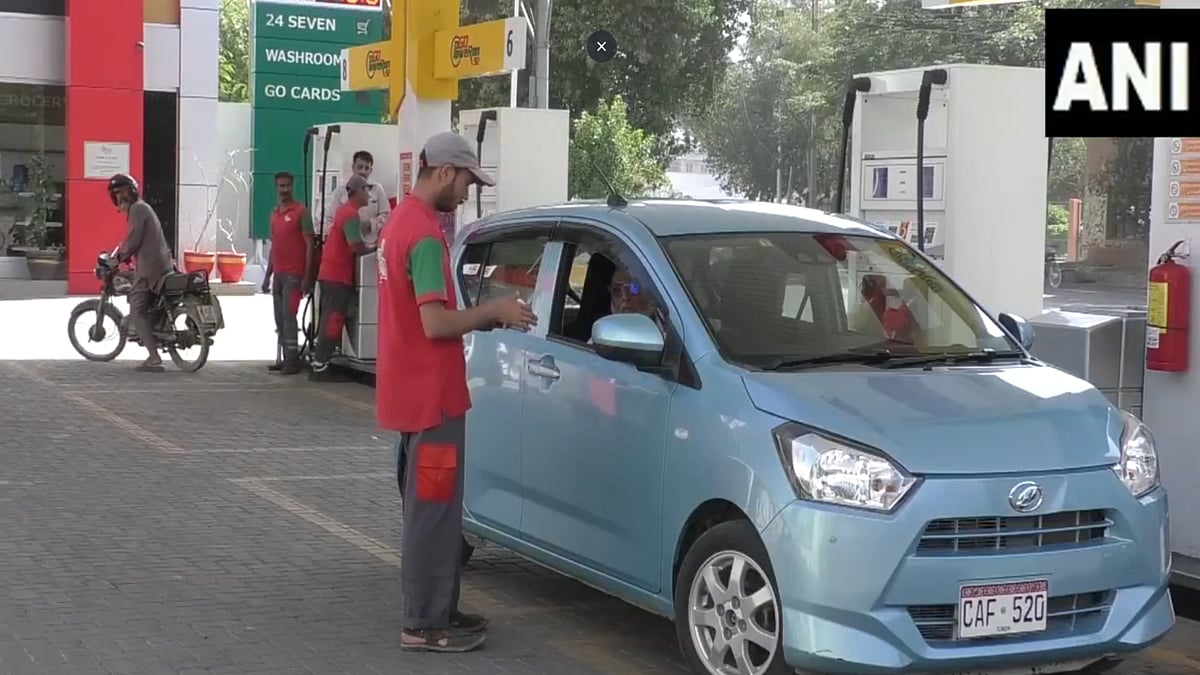
Pakistan is reeling under severe fuel crisis. ANI |
Beyond the flamboyant rhetoric of a peace broker, a major geopolitical crisis in the Middle East has exposed a severe vulnerability in Pakistan's energy security, pushing the country’s fragile economy to the brink of collapse.
The ongoing conflict involving Iran has blocked crucial shipping lanes and caused global fuel prices to skyrocket. Because Pakistan relies almost entirely on imported energy, this supply shock has triggered record-high inflation, a collapsing stock market and a desperate race by the government to fundamentally rewrite how it secures and stores fuel.
What triggered Pakistan's current energy and economic crisis?
The immediate catalyst is the three-month-old military conflict in the Middle East, specifically the war involving the United States, Israel and Iran. This geopolitical shock has severely disrupted shipping through the Strait of Hormuz, a narrow and vital maritime chokepoint through which roughly 20 per cent of the world's oil trade passes.
According to reports from Nikkei Asia and credit rating data, Pakistan is exceptionally vulnerable to this specific disruption because it relies on the Strait of Hormuz for up to 90 per cent of its oil and liquefied natural gas (LNG) imports. The country primarily buys its oil from Saudi Arabia and the United Arab Emirates (UAE).
When the conflict disrupted global supplies, Pakistan was caught without any sovereign emergency oil stocks, forcing the government to consider incredibly expensive "spot" market purchases of LNG and implement aggressive, nationwide fuel-saving measures just to keep the lights on.
Who is being impacted by the shockwaves?
The crisis is hitting every level of Pakistani society, from the highest financial institutions to ordinary households.
On a macroeconomic scale, global ratings agency Fitch noted that Pakistan's high exposure to energy shocks is threatening to sharply erode its foreign exchange reserves. While Fitch affirmed Pakistan's foreign-currency credit rating at ‘B-’ with a stable outlook—largely because the country has adhered to its International Monetary Fund (IMF) programme—it warned that escalating energy costs will push inflation well above prior levels.
The financial sector has taken a massive beating. Since the onset of the Iran war, Pakistan’s benchmark KSE-100 stock index has plunged by more than 21 per cent from its January peak, while panicked foreign investors have pulled out $383 million in equities. Rating agencies are now preparing to downgrade Pakistan's GDP growth forecasts for the 2027 fiscal year to a sluggish 2.5 per cent to 3.0per cent.
On the ground, ordinary citizens are bearing the heaviest burden. Local accounts reveal that petrol and diesel prices, which once stood around Rs250 rupees per litre, spiked to nearly Rs450 before stabilising slightly above Rs400 per litre.
Residents report that these soaring fuel rates have immediately trickled down into everyday life, causing public transport fares to climb and driving up the costs of food and basic necessities. Some lower-income and middle-class households claim local inflation has functionally surged by up to 300% for essential goods, leaving millions struggling to survive.
In May, the Human Rights Council of Pakistan strongly condemned the government's recent decision to mandate a single-day increase of Rs14.92 per litre for petrol and Rs15 for diesel. The rights group labelled the hikes a "direct assault on the public".
Where and how the government is intervening
To prevent a total economic shutdown, Pakistan's Petroleum Division (a branch of the Energy Ministry) has floated a tender for a feasibility study to do something the country has never done before: build strategic petroleum reserves (SPRs).
The government plans to implement a "multimodal" model. This means the buffer will not just rely on one type of storage, but will combine state-backed emergency stocks, mandatory inventories that private oil companies must maintain and "bonded commercial storage."
A bonded storage terminal is a customs-controlled facility where domestic and international traders can store imported fuel without paying immediate duties or taxes. If a trader stores oil there, they can re-export it later, but the Pakistani government will retain the "first right" to seize and utilise that fuel during a national emergency.
Government officials familiar with the matter told Nikkei Asia that Pakistan is actively negotiating with Saudi Arabia, Kuwait, Qatar, UAE and China to set up these bonded terminals, pointing to the deep-water port of Gwadar as a primary destination.
How much will this plan cost and how it will be funded
Building a security buffer from scratch is incredibly expensive. Official data shows that Pakistan consumes roughly 300,000 barrels of oil per day, but produces only about 62,000 barrels locally. To truly cut its import dependence, experts say Pakistan needs to boost domestic production to at least 150,000 or 200,000 barrels per day, which would require an investment of $6 billion or more.
For the physical reserves, the International Energy Agency (IEA) recommends that countries hold a 90-day supply of oil. For comparison, Japan holds 254 days' worth of consumption and India holds about 74 days. Pakistan is aiming lower for its initial rollout, planning an emergency reserve that covers 45 days before trying to scale up to 90 days.
What the main obstacles of the plan are
Despite the clear urgent need for energy security, there are serious red flags regarding how this policy will actually work.
First, there is a distinct lack of regulatory clarity. As per the Japanese buisness daily, Osama Rizvi, an energy strategist at the US-based consultancy Primary Vision, warned that bonded storage only provides true energy security if the government clearly defines rules around emergency access, product pricing, stock rotation and how foreign-exchange settlements will be handled. Second, there is an intense debate over whether building massive fossil fuel infrastructure is the right move during a period of extreme fiscal strain.
The bitter truth is while Pakistan is trying to project itself as a new messiah of diplomacy, it's coffers and energy supply are both in tatters.
RECENT STORIES
-
-
-
-
-