How A Viral Chinese Social Media Post Possibly Led To The Downing Of A US Fighter Jet
A Chinese engineer's viral tutorial on using passive infrared sensors has reportedly enabled Iran to down a sophisticated US fighter jet, exposing critical vulnerabilities in stealth technology

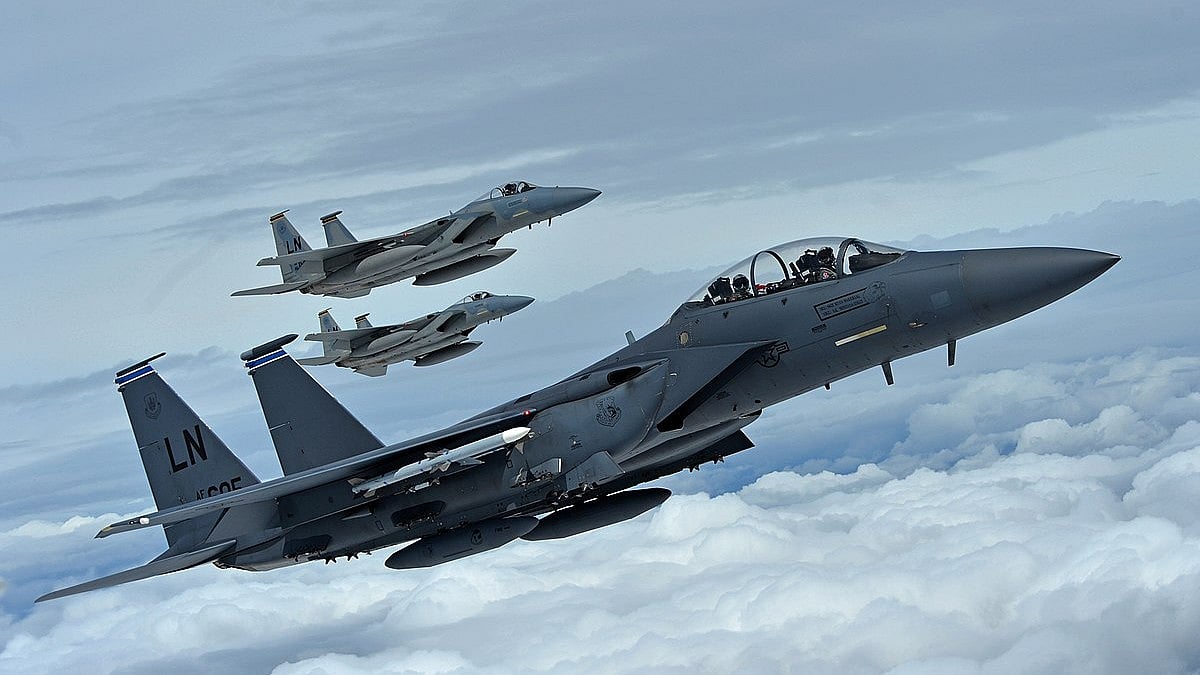
A formation of F-15C Eagles assigned to the 493rd Fighter Squadron, and an F-15E Strike Eagle assigned to the 492nd Fighter Squadron | Senior Airman Erin Trower/Wikimedia Commons
A startling and unprecedented front has opened in the ongoing conflict between the United States and Iran, and it is located not on a traditional battlefield, but within the digital architecture of Chinese social media.
In March, a technical tutorial posted by a Chinese civilian engineer reportedly provided the precise tactical blueprint for Iran to successfully down a sophisticated US fighter jet. This brought high-level military intelligence from classified government briefings to open-source viral content that too with devastating effect.
From digital post to physical wreckage
The chain of events that stunned the Pentagon began on March 14 this year, when a social media account titled "Laohu Talks World" uploaded a meticulously detailed video tutorial to Chinese platforms. The creator, a STEM professional and former student of the prestigious, US-sanctioned Northwestern Polytechnical University (NPU), meticulously explained how Iran could utilise low-cost, readily available systems to target and destroy advanced American stealth fighters.
To ensure the message reached its intended recipients in the Middle East, the video included Persian subtitles and specifically analysed the vulnerabilities of the F-35.
The impact of the digital post was nearly instantaneous. The video garnered tens of millions of views within days, and the Iranian government soon claimed its first strike against a US F-35 on March 19. The situation escalated into a full-blown crisis on 3 April, when an American F-15E Strike Eagle was confirmed to be in a crater in central Iran. According to geoplotical analyst Shanaka Anslem Perera, the wreckage sat as a testament to the "new aerospace defence system" used by the Islamic Revolutionary Guard Corps (IRGC)—a system that appeared to be the exact operationalisation of the tactics described in the Chinese tutorial just three weeks prior.
Science of defeating stealth
The core of the tutorial’s success lies in an elegant but devastating scientific pivot, which is, moving from active detection to passive detection. For decades, US military dominance has relied on stealth technology designed to evade radar. Radar is an active system as it emits radio waves that bounce off a target to locate it. However, every modern American fighter is equipped with a Radar Warning Receiver (RWR) that alerts the pilot the moment those waves touch the airframe. By the time a radar-guided missile is fired, the pilot has already begun evasive manoeuvers.
The Chinese tutorial advocated for abandoning radar in favour of passive infrared (IR) sensors and electro-optical trackers. Because every jet engine, even those on stealth aircraft, produces an immense heat signature, these sensors can "see" and track a plane without emitting any signals of their own.
Under this strategy, the aircraft’s warning systems stay completely silent. The pilot has no indication they are being tracked until a missile, guided by its own onboard IR camera, is already in the air. This fundamental shift in the "kill chain" turned the US military’s $1.7 trillion stealth investment into a liability, as the technology was optimised for a frequency of warfare the enemy had simply stopped using.
Rise of decentralised volunteer engineer
This phenomenon is not a traditional case of state-sponsored espionage, but rather a reflection of the massive scale of China’s STEM talent pool. China produces approximately five million STEM graduates annually, including 1.3 million engineers, which is roughly ten times the annual output of the United States.
Within this vast population, a segment of highly skilled civilians is now turning their analytical expertise toward "open-source military strategy." These individuals often possess expert knowledge of military hardware, frequently gained at defence-focussed institutions like NPU, where many graduates go on to work in the military equipment industry.
The motivations driving these "volunteer analysts" appear to be deeply personal rather than financial or governmental. According to sources cited by the South China Morning Post, the creator of the "Laohu" account is financially independent and creates content primarily for "fun" and out of a sense of personal conviction.
This sentiment is echoed across Chinese social media, where a desire to demystify American military dominance has merged with a sense of pity and anger over the civilian casualties in the Middle East. By sharing their expertise, these civilians see themselves as helping a David-like figure resist a global Goliath, proving that sophisticated military analysis is no longer confined to the walls of the Pentagon or the Kremlin.
The downing of the F-15E reveals a staggering geopolitical paradox that has left US policymakers in a bind. China currently occupies every seat at the strategic table in this conflict. It is the country that supplies the rare earth magnets found in every F-35 engine and it is simultaneously the country whose civilian engineers are teaching the enemy how to shoot that same engine out of the sky.
A lesson for future global conflict
The success of the "Laohu" tutorial suggests that the very nature of tactical advantage has changed. The F-15E did not fail because its technology was obsolet,; it fell because the assumption that the enemy would always "look" for it using radar failed.
The kill chain that began in a bedroom or a small office in China and ended in a crater in Iran has redefined the boundaries of civilian participation in war, leaving the US to grapple with an adversary that is as much an algorithm and a teacher as it is a soldier.
RECENT STORIES
-
-
-
-
-