From Quebec To Alberta: Canada’s Growing Secession Crisis
Alberta’s renewed separatist movement, driven largely by economic grievances and resentment over federal fiscal policies, is gaining traction. Reports of engagement between Alberta Prosperity Project leaders and US officials have intensified tensions. With alleged American support and political backing, the issue risks reshaping Canada-US relations and North American geopolitics.

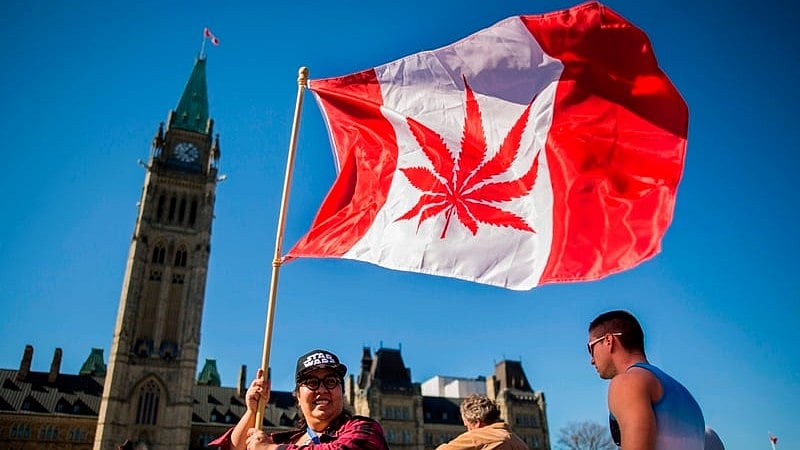
Canada’s Growing Secession | Crisis / AFP PHOTO / Chris Roussakis
The post-World War II international situation is the most confusing situation. On one hand, one noticed countries that were hereto enemies of each other [like UK and France] coming together first in the European Economic Community [EEC] in 1957 that in due course evolved into the European Union [EU]. On the other hand, one notices separatist movements even in advanced countries like Canada, Spain and yes, UK too. The Scottish have been demanding a separate nation-state since decades and founded in 1934 the Scottish Nationalist Party. Then there is separatism in Spain where Catalonia wants to break free from Spain. And the separatism in Canada is quite old where the French-speaking Quebec province wants to move out. As if this was not enough, now some sections of province of Alberta of Canada too is announcing its intention to win its independence from Canada. The whole picture is indeed baffling.
One can relatively easily understand the separatism prevalent in the new nation-states of Asia and Africa. Like the Baloch in Pakistan want to become independent and the Kurdish wants to break free from Turkey. But an advanced country like Canada facing separatism?
This new separatism in Canada’s province of Alberta is good news to White House of USA. Canada’s Alberta, a part of Western Canada and fourth largest province in Canada, shares nearly 300 kms long land border with US state of Montana. Its population is 5.02 million. Canada’s total population is 42 million. The US President Donald Trump has been declaring from the rooftop that Canada is the 51 st state of the USA! We have been reading about separatism in Quebec province of Canada for many years now. But why Alberta all of sudden?
Alberta was established as a province of Canada on September 1, 1905. Its separatism springs from the belief that they are culturally and economically different from the rest of Canada. Not only this, the separatists argue that their province is a net over-contributor to the system of equalization payments in Canada. As we all know nothing happens in vacuum and things slowly move. Similarly even in the case of Alberta, things have been boiling for quite some time. In the year 1980, a lawyer Doug Christie formed the Western Canada Concept [WCC] to promote Western separatism. In the year 2000, the Alberta Independence Party was established and it contested 2001 provincial elections in 14 constituencies with no success. In 2004, another separatist party the Separation Party of Alberta contested provincial elections in 12 constituencies. They too did not win a single seat.
Now this feeling has assumed dangerous proportions. If left unchecked, the right-wing Alberta Prosperity Project [APP] could pull the federal Conservatives further to the right. Here is something interesting about the APP. They often raise a unique slogan: The APP is convinced Albertans are ready for a switch from a democracy to a republic. This slogan has origins in a US based John Birch Society, a far-right group established in 1958. Its followers are referred to as the Birchers who define democracy as the rule of the many, and republic as the rule of law. Some scholars argue that there is a strong connection between the Birchers and popularity of Trump.
Also Watch:
As many scholars have pointed out that the known sources of separatism are language, culture and religion. In case of Alberta it is equally about money. Remember Bill Clinton who famously said once ‘it is economy stupid?’ This is why it becomes a unique case, easy to logically analyze as other demands for separatism are based on emotions. Here the main driver is the power disparity relative to other provinces of Canada like Ottawa. Also Canada’s fiscal policy pertaining to petroleum industry based on Alberta which the separatists argue that it is loaded against Alberta. This issue has gained considerable currency after the federal elections held last year. This election saw a fourth consecutive victory to the Liberal Party.
Though as of now, the future of this issue is uncertain, it is clear that it is not going to dye any time soon. This is because the issue gets help from across the border. Between April 2025 and January 2026, the APP leaders met three times the officers of the US Department of State. It is remoured that a half trillion credit will be made available when Alberta achieves independence. Not only this, US Treasury Secretary described Albertan as ‘a natural American partner’. Some Republican politicians like Andy Ogles commented that he feels that the residents of Alberta might prefer joining the US instead of staying with Canada. This has not gone down well with Canadian politicians. Premier of province of British Columbia David Eby thundered that the Alberta separatists meeting with the Trump administration and seeking financial support amounts to act of treason. These are serious charges.
It is quite clear that with US supporting separatism in Alberta, the issue will be with us for months to come. This is a new phenomenon in US foreign policy. Till some years ago it talked about ‘regime change’ which it did achieve in Iraq and Libya. Now US foreign policy seems to involve territorial expansion. This is quite scary, to say the least.
-- Prof Dr Avinash Kolhe.
RECENT STORIES
-
-
-
-
-