Mysuru Installs Mirrors On Public Wall To Stop Open Urination, Internet Calls It A ‘Genius’ Civic Hack - VIDEO
Mysuru authorities installed reflective mirrors on a public wall near a suburban bus stand to discourage open urination using psychological deterrence instead of fines. The initiative, linked to cleanliness drives, went viral online, drawing praise, humour and criticism. While some called it a genius solution, others questioned its effectiveness

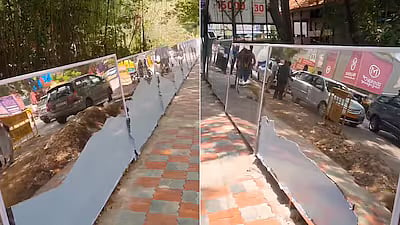
In an unusual yet creative attempt to tackle public urination, authorities in Mysuru have turned to psychology instead of punishment. The Mysuru City Corporation recently installed reflective steel mirrors along a roadside wall near the suburban bus stand, a spot long associated with repeated cleanliness violations despite warnings and awareness campaigns.
A psychological approach to civic behaviour
Rather than relying solely on fines, warning boards, or surveillance, officials adopted a behavioural strategy. The reflective panels force individuals to see themselves while attempting to urinate in public, creating instant self-awareness and discouragement through embarrassment.
The mirror-covered wall, now widely shared on social media, also features LED lighting to ensure visibility after dark. According to local observers, the aim is simple: if people feel watched, even by their own reflection, they are less likely to engage in unhygienic behaviour.
One person filming the viral video explained, “If they had simply put up a board saying that urination here is a punishable offence, no one would’ve taken it seriously. This is the only way people can be stopped."
Part of larger cleanliness efforts
The initiative aligns with broader sanitation drives under nationwide cleanliness campaigns such as Swachh Bharat Abhiyan. Across India, municipal bodies have increasingly experimented with nudges and design-based solutions to influence public behaviour instead of depending only on enforcement.
Urban planners often describe such methods as “behavioural nudging,” where small environmental changes encourage citizens to act responsibly without direct penalties.
Social media reacts
The mirrors quickly sparked discussion online, with reactions ranging from admiration to scepticism.
An X user wrote, “Whoever came up with this idea deserves nothing less than a Nobel… Genius ."
Others argued that infrastructure remains the real solution. “People will do everything except solving the core problem. Build them bloody toilets!," commented another user.
However, some locals countered that public facilities already exist nearby. “There are atleast 4 toilets in 100 mts radius of this place, but our great citizens prefer to pee on the road..."
Humour also flooded the comment sections. One person joked, “Try this for paan spitting in Bihar. Mirrors will be stolen or Picasso will be ashamed. Either of these is for sure."
Questions over effectiveness and safety
Not everyone is convinced the strategy will work long term. Critics questioned whether reflection alone can truly change habits. “What’s the logic here? Someone doesn’t pee on it because they see themselves? I beg to differ," one user remarked.
Some also raised safety concerns, suggesting that sunlight reflecting off mirrors could distract drivers. Another comment asked, “How long will it take to break the glass?"
Beyond humour and debate, the initiative has reignited conversations about civic responsibility. One social media user summed up the broader concern: “First they will spit pan and then they will pee..can’t do much with people without civic sense. Need to go back to school and make kids follow rules and from that generation change will happen."
RECENT STORIES
-
-
-
-
-