Is Your Phone Listening To You? Why Ads Sometimes Seem To Know What You Said
Your phone is probably not secretly recording conversations to target ads. A 2023 “Active Listening” claim by Cox Media Group was later found by the FTC to involve data-broker email lists, not voice recordings. Research has also found no evidence of constant audio capture by Android apps. Instead, searches, locations, purchases and other data help advertisers predict interests.

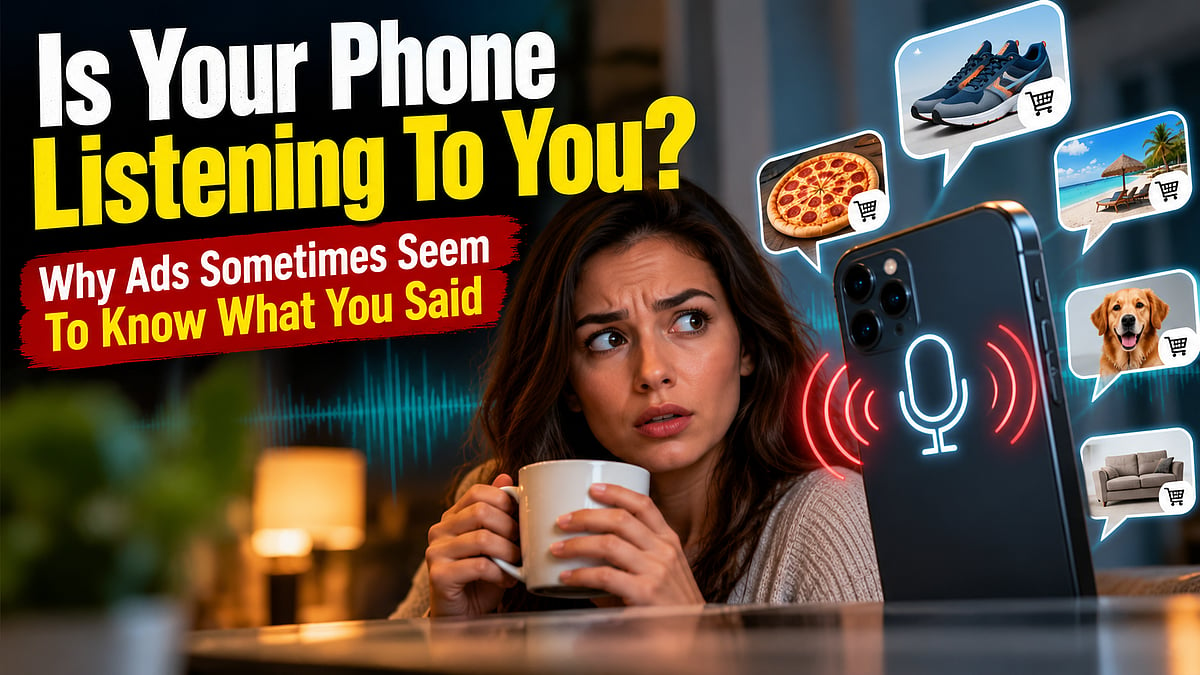
Is Your Phone Listening To You? Why Ads Sometimes Seem To Know What You Said |
You mention a mattress at dinner and an ad for one appears by breakfast. It's one of the most widespread suspicions about smartphones. Your phone is almost certainly not recording conversations to sell you things. The explanation is less spooky and, in some ways, more unsettling.
The case that seemed to prove it
In 2023, Cox Media Group marketed a product called "Active Listening," pitched to small businesses as a way to target ads from conversations picked up near phones, TVs and speakers. Its marketing line was "Your Devices Are Listening to You." In May 2026, the US Federal Trade Commission settled with Cox Media Group and two partner firms. The FTC said the service collected no voice data at all. Customers received email lists bought from data brokers. The company said it relied on materials from a third-party vendor and has stopped using the product.
When microphones do misbehave
None of that means your phone's microphone is harmless. Apple settled a Siri case for $95 million over recordings from accidental activations, and Google agreed to pay $68 million in January 2026 over similar claims about Google Assistant. Neither settlement found the recordings were used for advertising, and both companies say they weren't. The lesson is that voice assistants can record when they shouldn't, and that deserves scrutiny regardless of ads.
Why it still feels uncanny
Research that looked at more than 17,000 Android apps found no evidence of secret round-the-clock recording, according to summaries of the Northeastern University study. Meta also says it doesn't use your microphone for ads. Continuous audio capture would drain batteries, use data and be easy for researchers to detect.
The ads feel accurate because advertisers have richer, cheaper signals:
- Your searches and browsing, and those of people on your Wi-Fi. A partner searching for sofas can make you the next target.
- Location. Visiting a showroom is a stronger signal than a remark.
- Data brokers that combine purchases, app activity and contact details.
- Your own bias. You notice the ad that matches a conversation and forget the hundred that didn't.
An ad can find you through a profile you helped build, using permissions you agreed to, with no microphone involved.
So, is your phone listening in?
I think the 'phone is listening' belief persists because it's easier to grasp than the reality. Eavesdropping is a clear villain. The truth is a quiet system of tracking and inference that predicts what you want without hearing a word. A microphone you could switch off would be simpler to fix.
India's data protection law is built around consent, which is why the question "what did you agree to?" matters more than "what did you say?"
What can you do?
1. Check microphone permissions. On iPhone, go to Settings, Privacy & Security, Microphone. On Android, use the Privacy Dashboard. Turn off access for apps that don't need it.
2. Watch the indicator. iOS shows an orange dot and Android a green one when the mic is in use.
3. Limit ad tracking. Reset or turn off ad personalisation in your Google and Apple settings, and decline cross-app tracking.
4. Turn off 'Hey Siri' or 'Hey Google' if you don't use them.
RECENT STORIES
-
-
-
-
-