Yayoi Kusama: The Woman Who Covered The World In Dots
In her 80s and 90s, Yayoi Kusama became the most commercially successful living female artist. A single canvas sold for $8 million. In 2012 and again in 2023, Louis Vuitton made her dots cover its stores worldwide.

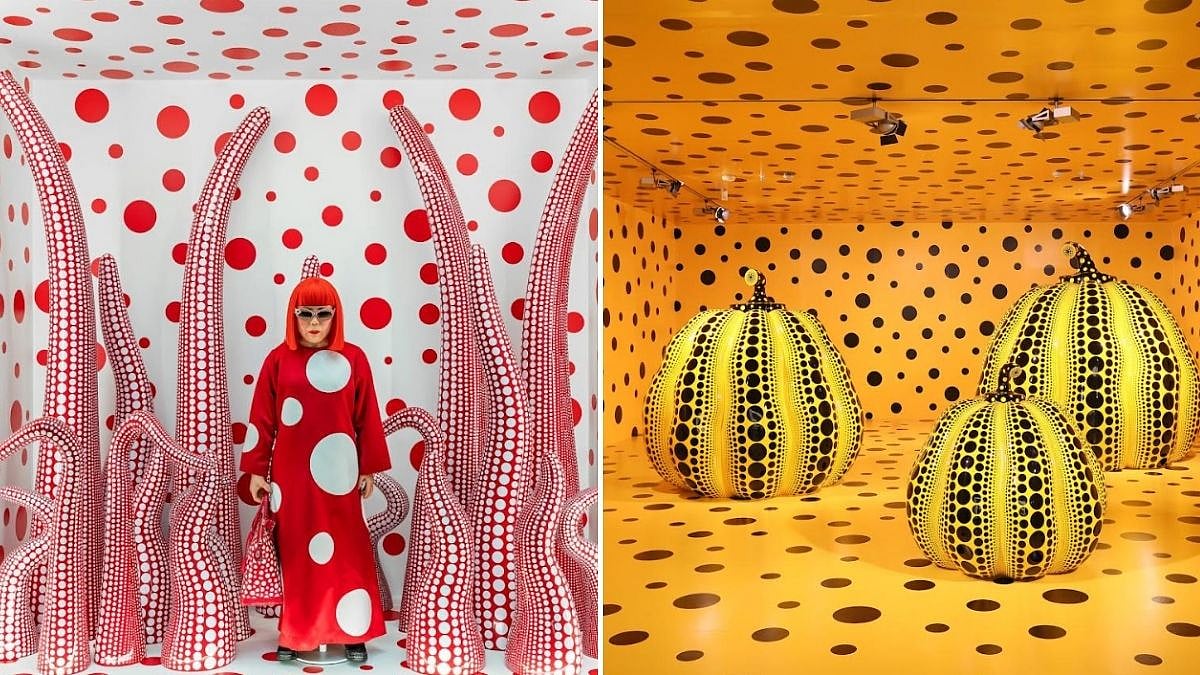
Yayoi Kusama: The Woman Who Covered The World In Dots |
Yayoi Kusama, Japan's polka dot queen and one of the most beloved artists of the 21st century, died on August 14 at a hospital in Tokyo. She was 97.
Her death was announced by the Yayoi Kusama Foundation and Museum. She died of multiple organ failure, painting until her final days. "She continued to paint until her final days, never setting aside her brush, and remained steadfast in her lifelong belief that love can save the world," the foundation said.
Kusama's career lasted more than 70 years, but she will be remembered more than ever for one obsession: the polka dot.
It was not a style for her. It was how she saw the world.
Born in Matsumoto in 1929 into a dysfunctional family, Kusama began hallucinating as a child. She told it plainly all her life: "I still see hallucinations even now. Dots come flying everywhere – on my dress, the floor, things I'm carrying, throughout the house, the ceiling. And I paint them."
She sewed parachutes in a military factory during World War II while drawing those dots. When her conservative mother confiscated her canvases, she drew more.
What began as fear became her language. In 1957, at 27, she decided Japan was "too small" and left for New York with little money and a suitcase of drawings. In a white, male art world, she invented what didn't exist: Infinity Nets - vast canvases of tiny repeated arcs, Soft Sculptures – sofas covered in phallic protrusions, and Polka Dots.
"Polka dots are fabulous," she told the AP in 2012, in her trademark orange bob wig and a dress covered in dots. "Polka dots are a way to infinity."
That idea is key to understanding why dots became her signature.
For Kusama, a dot was not decoration. It was a particle. She said a dot was like a human life – small, lonely, but when multiplied endlessly, it becomes the universe. "The polka dot has the form of the sun... a symbol of the energy of the whole world." By covering a canvas, a body, a room, a pumpkin in dots, she was trying to obliterate the self, to become one with infinity.
She was pen pals with Georgia O’Keeffe. As a young artist in her 20s living in Japan, Kusama wrote a letter asking the famous American painter for career advice, which sparked a supportive friendship and helped Kusama launch her career in the United States.
In the 1960s she staged Happenings where she painted naked bodies with polka dots in protest against the Vietnam War. She called it self-obliteration.
She crashed the 1966 Venice Biennale. Kusama wasn't officially invited to the 33rd Venice Biennale, but she showed up anyway and set up Narcissus Garden – an installation of 1,500 silver plastic spheres – on the lawn, offering to sell them to passersby for $2 each before security shut it down.
She once wrote a letter to Richard Nixon. During the height of the Vietnam War in 1968, Kusama wrote an open letter to the U.S. President offering to paint him in polka dots so he and his enemies could "forget themselves" and make peace.
The world didn't understand. She was poor, overlooked, copied. She later said Andy Warhol and Claes Oldenburg took her ideas and got famous. She had a breakdown, returned to Japan in 1973, and in 1977 voluntarily checked herself into the Seiwa Hospital for the Mentally Ill in Tokyo, where she lived for the rest of her life. Every day, she walked to her studio a few blocks away to paint.
For 20 years, she was almost forgotten.
Then the world caught up.
The dots that once seemed mad became Instagram. Her Infinity Mirror Rooms – dark rooms lined with mirrors, water, and thousands of LED dots of light repeating forever – became the most photographed art in the world. The Broad in LA, the National Gallery in London, her own museum in Tokyo – people queued for 6 hours for 30 seconds inside infinity.
Her yellow and black pumpkins, also covered in dots, became her other icon. The pumpkin, she said, was comforting. "Generous."
In her 80s and 90s, she became the most commercially successful living female artist. A single canvas sold for $8 million. In 2012 and again in 2023, Louis Vuitton made her dots cover its stores worldwide, even building a robot of her painting in its Tokyo window. She was no longer outsider. She was pop culture.
But she never changed.
Until the last week before her passing, she was still painting her daily series "My Eternal Soul" – huge, childlike, vibrant canvases of dots and eyes.
She kept her promise: "I will keep painting until I die. And even after I die, my spirit will keep creating new art."
She leaves behind no immediate family, but leaves behind a universe that now sees dots everywhere because she taught us to.
As she wrote in her poem: "If you remove polka dots from my life, nothing remains."
Now they remain everywhere. Love you Yayoi!
Carol Goyal has a Masters in Art Law from the Sotheby’s Institute of Art, London & New York.
RECENT STORIES
-
-
-
-
-