Hundreds Of Thane Residents Protest Against ₹12,200-Crore Ring Metro Project, Flag Traffic Gridlock And Environmental Concerns
Hundreds of Thane residents marched from Gaondevi Maidan to Thane Station on Friday, demanding cancellation of the proposed ₹12,200-crore Ring Metro project. Led by Citizens For Sustainable Transport Thane (CSTT), protesters warned of traffic congestion, environmental damage and wasteful public expenditure. They urged authorities to expand the city's bus fleet and improve feeder services instead.

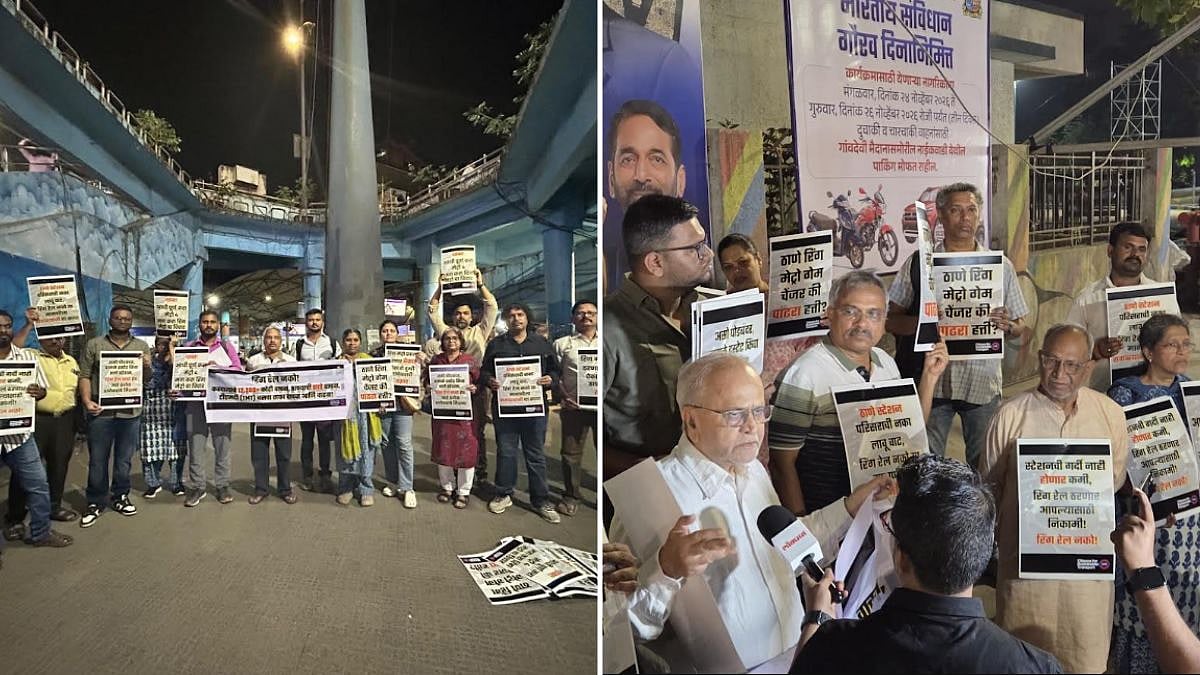
Hundreds Of Thane Residents Protest Against ₹12,200-Crore Ring Metro Project, Flag Traffic Gridlock And Environmental Concerns |
Thane: Hundreds of Thane residents took to the streets on Friday, marching from Gaondevi Maidan to Thane Station to demand the immediate cancellation of the proposed ₹12,200-crore Thane Integrated Ring Metro (TIRM) project. Holding placards and banners, demonstrators called on civic authorities to halt a project they warn will trigger severe traffic gridlock, drain public funds, and destroy thousands of mature trees and mangroves.
Civic And Environmental Groups Join Hands Against Ring Metro
The protest was spearheaded by Citizens For Sustainable Transport Thane (CSTT), a collective comprising local residents, urban planners, and civic advocates. The demonstration drew wide backing from prominent civic and environmental groups, including the Thane Greens Collective, Muse Foundation, Citizens of GB Road, Gaavthan Koliwada Paade Samvardhan Samiti, National Alliance of People’s Movement (NAPM), Ajay Jeya Foundation, and Wake Up Thanekar.
Protesters argue that routing a heavy metro system through Thane’s narrow internal roads is a recipe for urban chaos rather than relief.
"A heavy metro running through congested internal lanes will not solve Thane’s traffic—it will paralyze the city for years during construction and become a white elephant afterward," said a representative from CSTT during the march. "Taxpayers cannot be forced to foot a ₹12,200-crore bill for an ill-conceived project that ignores ground realities."
Key Flaws Flagged in the Project Report
Demonstrators highlighted findings from a comprehensive technical audit released by CSTT in May 2026, which pointed to major discrepancies in the project's Detailed Project Report (DPR):
Unjustified Capacity and Ridership: The DPR projects a peak demand of roughly 28,000 Passengers Per Hour Per Direction (PPHPD) by 2050—well below the 30,000–50,000 PPHPD threshold required to justify a heavy metro, falling instead within Light Rail Transit norms. Furthermore, the report’s target of 6.47 lakh daily riders by 2029 lacks empirical backing, particularly as most Indian metros achieve only 25–35% of projected ridership.
Flawed Planning and Cut-and-Paste Surveys:Advocates noted that Thane’s commuting patterns remain largely radial toward employment hubs rather than circular, undermining the core premise of a ring corridor. Critics also pointed out that Chapter 3 of the DPR bizarrely cites commuter opinions regarding a "new mass transit system in Nagpur," raising doubts about whether Thane-specific mobility surveys were ever conducted.
Premature Push Ahead of Metro Line 4: Despite the DPR acknowledging that the 32.32-km Metro Line 4 will fundamentally reshape local travel patterns, authorities are pushing TIRM forward without evaluating actual ridership data from the operational Line 4 corridor.
Gridlock at Thane Station: The proposed 3-km underground stretch cuts directly beneath Thane Station, the city’s busiest transit bottleneck. Simultaneous surface and sub-surface excavation threatens to trigger a prolonged mobility crisis.
Severe Ecological Toll
Environmental activists voiced alarm over the irreversible green cover loss required for pillars, stations, and infrastructure. According to the civic audit, the alignment will require the felling of over 3,200 trees—including rare heritage trees—and the destruction of roughly 5,380 mangroves spread across 6.6 hectares. Additionally, the route skirts the eco-sensitive zones of Sanjay Gandhi National Park across Majiwada, Chitalsar, Manpada, Waghbil, and Gaimukh, endangering over 300 forest trees.
"Thane’s green lungs and coastal mangroves are our primary defense against urban flooding and extreme heat," said an activist with the Thane Greens Collective. "Sacrificing thousands of heritage trees and 6.6 hectares of mangroves for a redundant corridor is an environmental disaster we cannot afford."
Call for People-First Alternatives
Rejecting claims that TIRM serves as "last-mile connectivity," civic planners noted that true first- and last-mile access requires reliable feeder buses, unobstructed footpaths, and safe cycling lanes rather than an elevated rail loop.
Instead of spending ₹12,200 crore on TIRM, residents urged the administration to redirect funds toward scalable, people-first mobility solutions—most notably expanding the Thane Municipal Transport (TMT) bus fleet to provide high-frequency feeder services connecting residential neighborhoods directly to Metro Lines 4, 4A, and 5 at a fraction of the cost.
To get details on exclusive and budget-friendly property deals in Mumbai & surrounding regions, do visit: https://budgetproperties.in/
RECENT STORIES
-
-
-
-
-