Federation Of Indian Pilots Slams Proposed Relaxation Of FDTL Norms, Warns Of Aviation Safety Risks
The Federation of Indian Pilots has strongly opposed any dilution or extension of Flight Duty Time Limitation norms, warning that relaxing scientifically backed fatigue rules would endanger passenger safety and undermine years of progress in aviation safety culture.

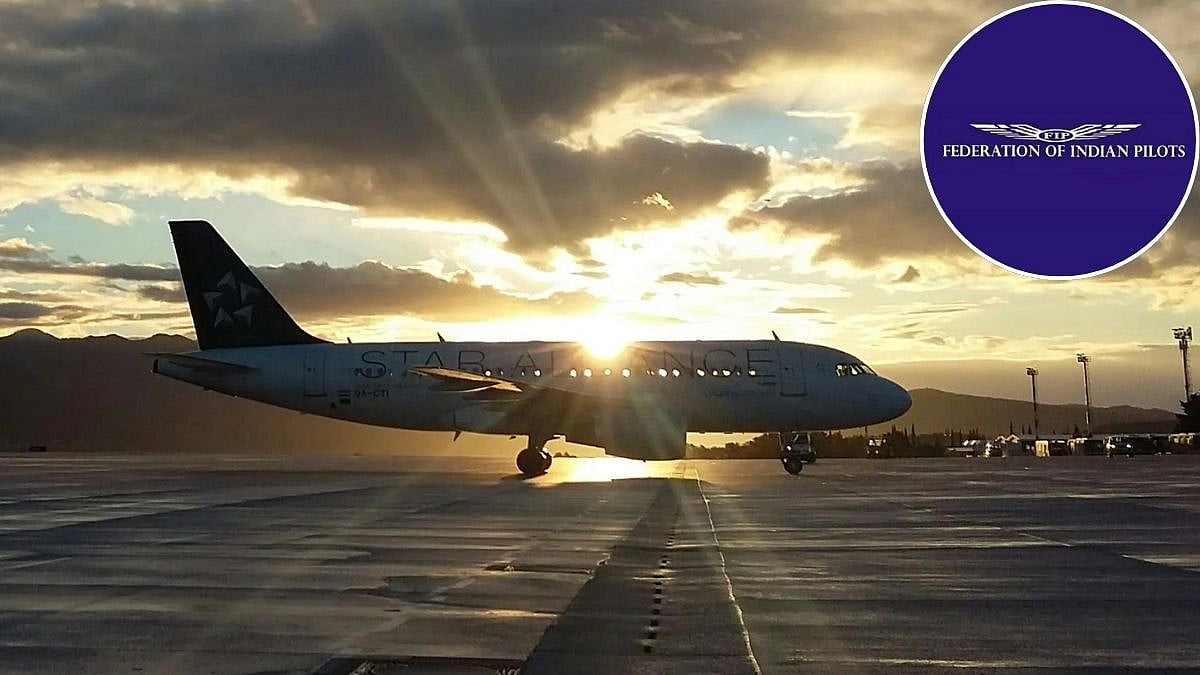
Federation of Indian Pilots warns against diluting Flight Duty Time Limitation norms, citing serious passenger safety concerns | Representational Image
Mumbai, Jan 29: The Federation of Indian Pilots (FIP) has expressed its “deep concern and disappointment” at reports that the Union government is considering granting further extensions or relaxations to the recently implemented Flight Duty Time Limitation (FDTL) regulations.
“This is a sad moment for Indian aviation safety,” FIS president Capt C.S. Randhawa stated. The committee led by Dr Nasim Zaidi, former director-general of civil aviation (DGCA) and ex-civil aviation secretary, comprising doctors and professionals, was formed in 2010 to formulate a scientifically based report on FDTL. The committee submitted an exhaustive report in 2011.
The key findings in the report were:
● Fatigue is biological and cannot be “managed away” by rostering or software;
● Midnight to 0600 am is the highest-risk period due to low human alertness;
● Pilots need predictable rest and weekly off days for proper recovery; and
● Error rates rise sharply after crossing certain duty hour limits.
Background of FDTL regulations
The DGCA in 2014 and again in 2019 never based the FDTL Civil Aviation Regulations (CAR) on the panel’s report. Then FIP in 2019 went to the Delhi High Court to challenge the FDTL CAR, which was arbitrarily based and not providing adequate rest to pilots.
However, the DGCA in October 2023 formulated the FDTL CAR based on the Dr Zaidi report. The FIP hailed this decision. All these highlights were given to two parliamentary committees in December 2025.
The revised FDTL norms were not arbitrary. They were the outcome of years of data, scientific fatigue studies, international best practices, and prolonged legal proceedings undertaken in the interest of passenger safety and crew well-being.
The prime aim of an FDTL is to provide adequate rest to pilots so that they are in a high state of alertness and without fatigue, which in turn enhances passenger safety, the FIP noted. All regulatory bodies around the world have CARs on FDTL with passenger and crew safety as the prime concern.
Objections to relaxations
“It is very unfortunate that least importance is given to FDTL and relaxations are granted to airlines to run commercial schedules. The government should never compromise the safety of passengers by diluting the rules,” Capt Randhawa noted.
These regulations were notified after giving airlines nearly two years of preparation time so that pilot strength could be augmented. All airlines had been resenting the implementation of the new FDTL CAR. The FIP approached the Delhi High Court, where the matter was pending, and requested an order for the implementation of the said CAR.
The High Court passed an order in March 2025. The airlines again approached the DGCA to implement 15 clauses of the CAR on July 1, 2025, and nine clauses on November 1, 2025. The FIP objected but subsequently was helpless in the matter. It is a matter of concern that the government is formulating rules and citizens have to move the courts to get them implemented.
Airlines and manpower issues
All airlines except Indigo recruited pilots to cater for the implementation of the new CAR. However, Indigo stopped manpower recruitment, which resulted in a crisis from December 2 to 15, after which the government succumbed to the pressure of the airlines and granted relaxations. Indigo was granted a total waiver of the FDTL CAR till February 10, 2026.
The fact is that pilots are surplus with every airline except Spice. Hence, there is no question of diluting the rules.
To now describe them as “unsustainable” reflects not a flaw in safety policy, but a failure of planning, manpower forecasting, and operational discipline.
Fatigue and aviation safety
Pilot fatigue is not an abstract concern. It is a proven operational hazard, recognised globally as a contributing factor in serious incidents and accidents.
Fatigue impairs judgement, reaction time, situational awareness, and decision-making — the very competencies that modern airline operations rely upon. Diluting rest norms directly erodes the safety margins that protect passengers and crew alike.
The argument that commercial pressure, fare caps, geopolitical disruptions, or cost escalation justify relaxation of fatigue rules is “deeply troubling”. Safety regulations are not negotiable variables in a business model. If economic stress becomes the basis for weakening human performance safeguards, it sets a dangerous precedent for the entire aviation system.
It is also important to state clearly that when incidents occur, pilots are invariably the first to be blamed, regardless of systemic or organisational contributors.
Any rollback of FDTL protections exposes flight crew to increased health risks, operational stress, and post-incident scapegoating, while transferring institutional risk onto individuals.
Call to uphold safety norms
The fact that most airlines have largely adapted to the new norms only reinforces the point that compliance is possible when there is intent. Operational inconvenience cannot be allowed to override scientific fatigue management.
The Federation of Indian Pilots urges the government and the regulator to stand firm and not grant any dispensation or dilution to the FDTL CAR.
Extending or diluting the implementation of these norms will be a retrograde step, undermining years of progress in safety culture and human factors awareness.
Aviation history is unambiguous: fatigue-driven compromises eventually extract a far higher cost in lives, credibility, and public trust.
Also Watch:
ALSO READ
The safest system in aviation is not automation; it is two alert, rested, and professionally trained pilots.
● Safety cannot be postponed.
● Fatigue cannot be negotiated.
● And responsibility cannot be shifted onto the cockpit.
All the above points have been highlighted while addressing the parliamentary committees. We hope that safety is not compromised and that no dispensations are granted on the FDTL CAR, with prime importance given to passenger safety.
To get details on exclusive and budget-friendly property deals in Mumbai & surrounding regions, do visit: https://budgetproperties.in/
RECENT STORIES
-
-
-
-
-