Bombay HC Acquits Pune Court Clerk In 29-Year-Old ₹500 Bribery Case, Cites Lack Of Proof Of Demand
The Bombay High Court acquitted a former Pune court clerk nearly 29 years after he was trapped in an alleged Rs 500 bribery case, ruling that the prosecution failed to prove the essential element of demand for illegal gratification. The court quashed his conviction and ordered a refund of the fine.

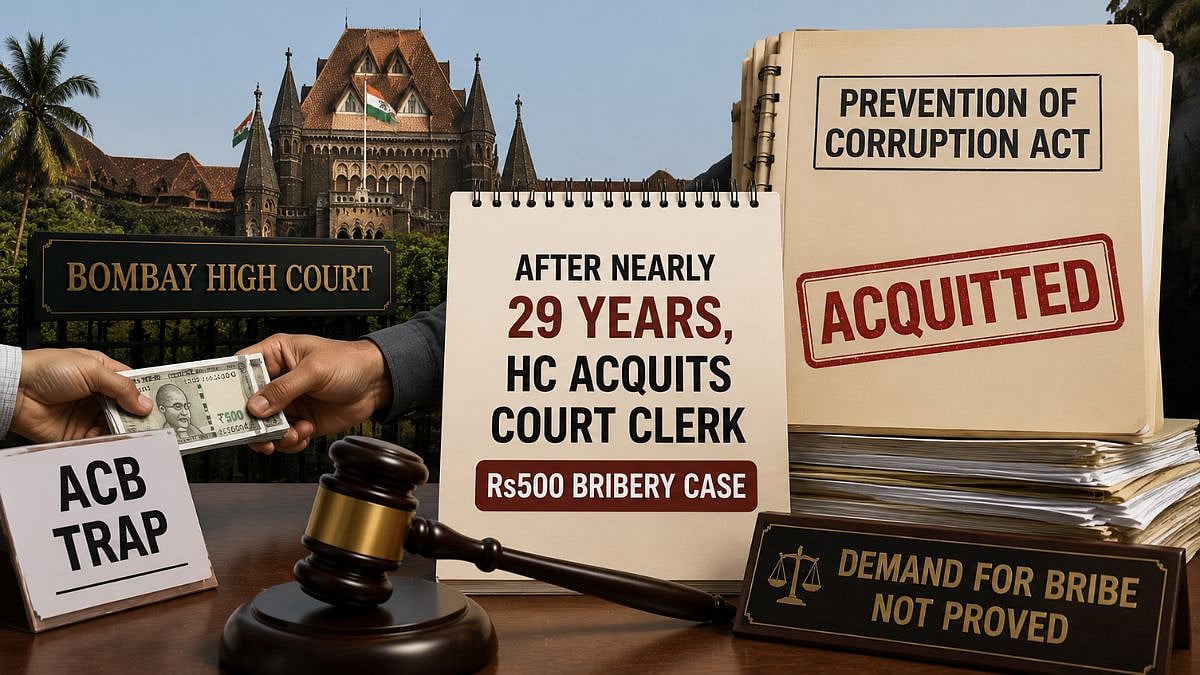
The Bombay High Court acquitted a former court clerk in a 1997 bribery case, holding that the prosecution failed to prove the demand for illegal gratification | AI Generated Representational Image
Mumbai, July 25, 2026: Nearly 29 years after a court clerk was caught in an Anti-Corruption Bureau (ACB) trap for allegedly accepting a Rs 500 bribe, the Bombay High Court has acquitted him, holding that the prosecution failed to prove the essential ingredient of demand for illegal gratification.
Conviction Set Aside
Justice N.J. Jamadar set aside the 2003 conviction of Shailendra Bakare, who was working as a bench clerk in a Pune magistrate's court in 1997. The court observed that the prosecution case was riddled with contradictions and improbabilities, making it unsafe to uphold the conviction.
In September 1997, a doctor had filed a private criminal complaint for defamation, alleging that Bakare demanded Rs 500 to issue a bailable warrant against the accused in that case.
Acting on the complaint, the ACB laid a trap and recovered the tainted currency notes from Bakare's shirt pocket. He was later convicted by a special court in 2003 under the Prevention of Corruption Act.
However, while hearing Bakare's appeal, the High Court found serious inconsistencies in the prosecution's version.
Contradictions In Prosecution Case
One of the key contradictions related to the timing of the complaint. While the complainant claimed the alleged demand was made around 2.30 pm before he immediately approached the ACB, the investigating officer admitted in cross-examination that the complainant had reached the ACB office between 10 am and 10.30 am on the same day. The court said this contradiction struck at the root of the prosecution's case.
The judge also noted that the investigating officer admitted there had been no independent verification of the alleged demand before the trap was arranged.
“In the absence of proof of demand, which is a sine qua non (an essential condition or a strict requirement) for the constitution of the offence, the charge of acceptance of illegal gratification... cannot be sustained,” the court said.
It added that “mere proof of acceptance and recovery of tainted currency notes is not sufficient” to establish an offence under the Prevention of Corruption Act.
Appeal Allowed
The High Court also accepted that the defence version—that the complainant had thrust the currency notes into the clerk's pocket—could not be discredited during the trial. It held that the trial court had relied on assumptions and conjectures instead of legal evidence while convicting the accused.
Also Watch:
Allowing the appeal, the High Court quashed the conviction, acquitted Bakare of all charges, directed that the fine deposited by him be refunded, and cancelled his bail bond.
To get details on exclusive and budget-friendly property deals in Mumbai & surrounding regions, do visit: https://budgetproperties.in/
RECENT STORIES
-
-
-
-
-