What Pitti Uomo 110 Taught Me About The Future Of Menswear
The future of menswear lies not in excess, but in excellence, says Sandeep Gonsalves, Co-founder, Sarah and Sandeep

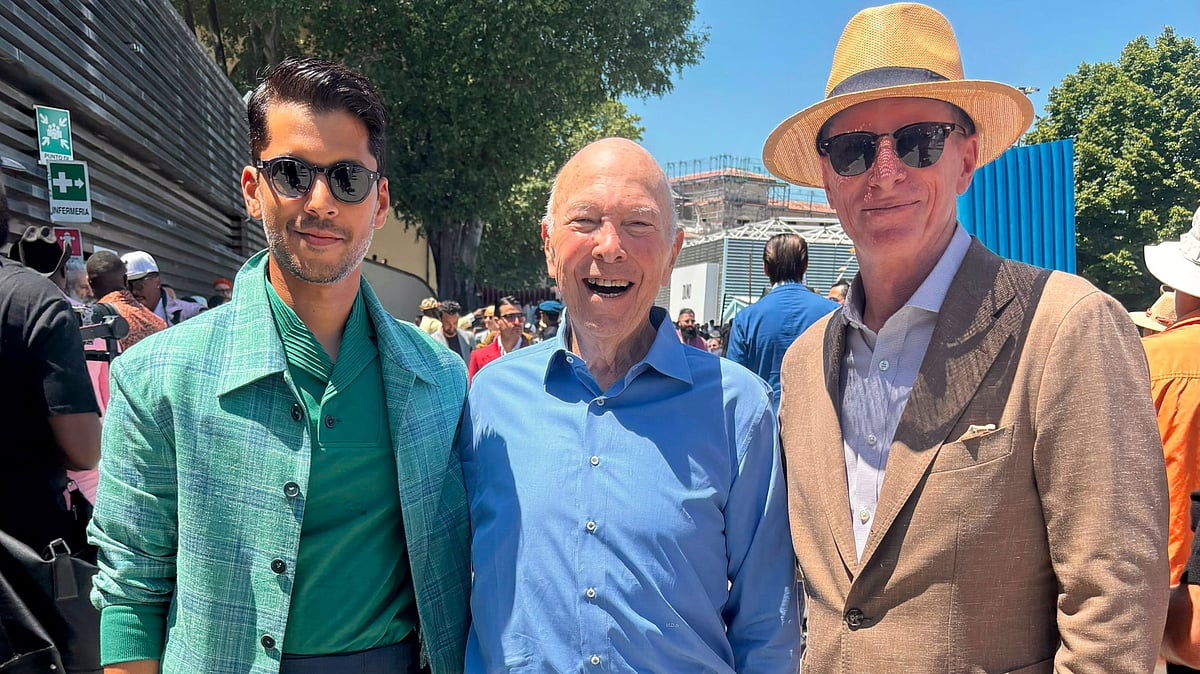
Sandeep Gonsalves with HMS International CEO Mickey Solomon and Bob McAuley President of the HMS International | Pics: Pitti Uomo
Every season, Pitti Uomo, the men’s fashion and lifestyle fair in Florence, serves as a reminder of why menswear remains one of the most fascinating forms of self-expression. While fashion weeks often focus on what’s next, Pitti Uomo is about what endures—craftsmanship, tailoring, heritage and the people who continue to keep these ‘archaic’ traditions alive. Walking through the Fortezza da Basso this year, one thing felt unmistakable: menswear is having a moment globally. Not driven by fleeting trends but by a deeper shift in how men are increasingly conscious of how they present themselves. They’re investing in fewer but better pieces, seeking individuality, craftsmanship and garments with a cool story behind them.
With over 720 brands from more than 30 countries, the fair reflected a renewed energy around craftsmanship, tailoring and material innovation. More notably, the number of Indian designers and buyers exploring the fair has grown significantly over the past few years—a sign that Indian menswear is no longer peripheral to the global conversation but is actively shaping it. As someone who spends most of his time designing for the modern Indian man, I’ve observed the parallels between Italian craftsmanship and our own Indian artisanal traditions and there’s a lot to be proud of.
Craftsmanship beyond borders
At Pitti Uomo, the most inspiring trend was that the conversation around craftsmanship wasn’t limited to tailoring. Whether it was fabric development, garment dyeing, leatherwork or innovative textile blends, there was a genuine appreciation for the human hand and the expertise behind each creation.
Brands like Kiton and Cesare Attolini showcased what true Neapolitan tailoring looks like: jackets that are almost entirely handmade with a soft construction that feels like a second skin. Meanwhile, Brunello Cuccinelli presented collections that seamlessly blend luxury with restraint, hand-finished details and fabrics sourced from heritage mills. Their take on leisure denim was particularly fresh. Yet, what feels strikingly familiar is how closely this mirrors India’s own artisanal traditions. Our embroiderers, hand-weavers and textile craftsmen carry generational knowledge that is equally nuanced and deeply rooted in process. This parallel presents a powerful opportunity. Much like Italy, India’s strength lies not in mass production but in craftsmanship. The challenge is to translate this heritage into a contemporary design language that resonates globally.
The soft power of tailoring
One of the strongest shifts across the fair was the continuous appreciation for tailoring and the move towards ease; structure without stiffness. Across tailoring, outerwear and separates, there was a clear preference for garments that felt lighter, softer and more versatile. Unstructured jackets, relaxed trousers, knitted polos and overshirts were common across collections. This is tailoring that adapts to the realities of modern life. The modern man is no longer building separate wardrobes for work, travel and leisure; he wants pieces that are versatile. Formalwear is becoming more adaptable and tailoring is increasingly blending into everyday wardrobes. Even within Indian wedding wear, a similar shift is underway. Today’s groom is moving away from costume-like dressing towards pieces that feel authentic, personal, and relevant beyond the wedding day.
Quiet luxury, reconsidered
The phrase ‘quiet luxury’ has been overused over the past few years, but at Pitti Uomo, it felt more evolved. Brands like Brunello Cucinelli, Zegna and Loro Piana demonstrated that this shift is less about minimalism as a trend and more about confidence in quality. The emphasis is on exceptional fabrics, refined construction and thoughtful details. There are no overt logos—only pieces that reveal their value over time. Zegna, for instance, presented tailoring in innovative wool blends that felt both modern and timeless, while brands like Boglioli and Lardini showcased unstructured jackets with soft shoulders and relaxed silhouettes. Giorgio Armani’s influence was evident in the fluidity and ease of tailoring seen across multiple collections. There is also a growing emphasis on natural fibres, softer textures and understated sophistication. Even Indian consumers, particularly younger entrepreneurs and professionals, are investing in clothing that demonstrates sophistication through craftsmanship rather than branding.
Leatherwork that ages well
Beyond tailoring, leather craftsmanship stood out as a category rooted in longevity. Brands such as Santoni and Tod’s highlighted artisanal techniques such as hand-painting and patina finishing in footwear and accessories. Heritage labels like Il Bisonte focused on vegetable-tanned leather that develops character over time. In an era increasingly shaped by conversations around sustainability, this approach feels relevant. The most sustainable product is one that endures.
India’s moment at Pitti Uomo
The presence of Indian designers at Pitti Uomo signals an important shift. Designers such as Rajesh Pratap Singh and Aseem Kapoor are bringing a distinct perspective—one that blends global silhouettes with Indian craftsmanship. What Pitti Uomo ultimately reinforces is that menswear today is not about conformity—it is about expression. Men are embracing texture, colour, handcrafted details and individuality, while respecting the need for tailoring, quality and timeless design. The most important takeaway from the fair is not a specific trend or silhouette, but a mindset. It is the realisation that great craftsmanship speaks a universal language. Whether it is a tailor in Naples, a leather artisan in Florence, an embroiderer in Mumbai or a textile craftsman in Rajasthan, the values remain remarkably aligned. And perhaps what’s driving menswear’s current moment, hence, is craftsmanship, culture and human stories woven into every garment.
Future of menswear is exciting
The modern man is not dressing for approval but to communicate his identity. For Indian menswear, this presents a significant opportunity. We have some of the richest craft traditions in the world. The challenge and opportunity lie in presenting them through a contemporary lens that feels relevant to today’s global consumer.
RECENT STORIES
-
-
-
-
-