Venice Biennale 2026: India Takes Centre Stage in a Deeply Moving Day at the Venice Biennale
After a gap of seven years, India returned to the prestigious Venice Biennale with a pavilion that's being widely appreciated. The Indian pavilion is aptly titled 'Geographies of Distance: Remembering Home,' and explores the idea of home, memory, belonginess through contemporary art. Deviina Dalmia, who is presently at the Venice Biennale, gives us her insights.

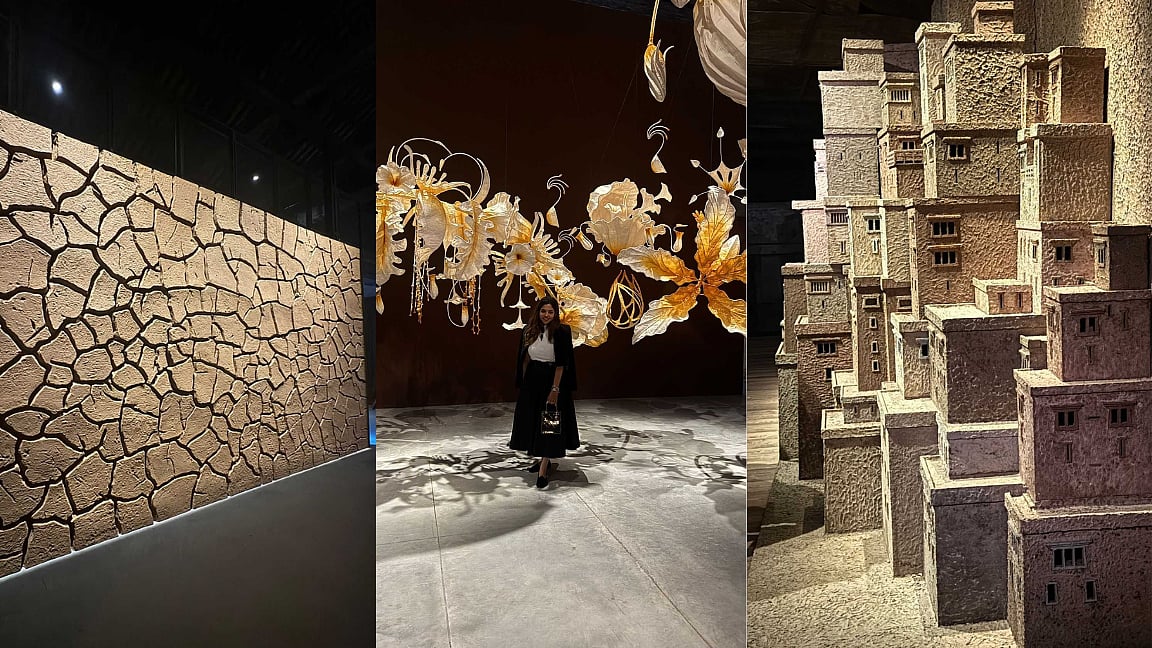
India at Venice |
There are days that refuse to be summarised. My third day at the 61st Venice Biennale was precisely one of those — a sequence of encounters so layered, so affecting, that any attempt to flatten them into prose feels faintly criminal. And yet, here I am, trying.
The morning began at the Chiostro della Madonna dell'Orto, where Bel Ouvrage (il corpo della materia) had taken up residence with the confidence of something that has always belonged there. This cloistered space — gifted by Napoleon to a Venetian family, painstakingly restored and returned to the public through Fondazione ALA — glowed in the particular Venetian gold that the lagoon seems to manufacture exclusively for artists. I lingered longer than I had planned.
Then came Anish Kapoor.
To call Anish Kapoor a genius feels insufficient and simultaneously unavoidable. Standing beneath At the Edge of the World — the eight-metre black pigment bell suspended from the glorious ceiling of Palazzo Manfrin — stops ordinary language in its tracks. The piece does not merely hang there; it pulls. It creates a gravity of its own, drawing the eye and then, somehow, the self, inward. This is what Kapoor has always understood better than almost anyone: that sculpture is not decoration but confrontation, and that void is not absence but a most specific, most demanding kind of presence.
He is a humble master — of scale, colour, imagination, and of things that have no name yet — and this exhibition, spanning fifty extraordinary years, is a testament to what happens when curiosity is given a lifetime to roam.
We then drifted past the Venice Hotel on the Canal Grande, where JR's Il Gesto had claimed the Byzantine façade of Palazzo Ca' da Mosto as its canvas. Drawing from Veronese's Wedding at Cana, JR assembled 176 faces from the Refettorio Paris community into a monumental contemporary fresco visible from the water. Inside, a tapestry woven by master Giovanni Bonotto completes the experience. This is art that knows exactly why it exists.
But the afternoon belonged entirely to India.
I had the extraordinary privilege of walking through the India Pavilion with its curator, Amin Jaffer, and the brilliant Tarana Sawhney of FICA, and of spending time with Vivek Agarwal, Secretary of the Ministry of Cultural Affairs, Government of India.
The pavilion's theme of home — of longing, belonging, and what we carry when the physical anchor is gone — resonated with every single visitor I observed, Indian or otherwise. Mr Agarwal said it with characteristic grace: "Home means beauty. Home means comfort. Home means bliss, and home means security" — before adding that such longing extends to every living being on this Earth. It is this universality that the pavilion wears so naturally.
Tarana, radiant and visibly moved throughout our walk, put it most simply when I asked what it felt like to stand there: "When I stand in the India Pavilion, I belong." These few words said everything a thousand could not.
Sumakshi Singh's Permanent Address is the work I will carry longest. A full-scale reconstruction of her family's Delhi home — demolished after seventy-four years and five generations — rendered entirely in thread, measured brick by brick before it was razed. She told me: "Somewhere sitting inside all of us is this deep human longing for a place to belong to, even if that place no longer exists." Standing inside those ethereal, translucent walls, I understood exactly what she meant. The house cannot offer shelter anymore, but it offers something rarer: the exquisite ache of recognition.
Equally commanding was Asim Waqif's monumental bamboo installation — a work of sweeping architectural ambition, built in just two weeks on-site, though, as Waqif told me himself, "at another level, it's taken thirty years to get here."
Alongside eight artisans from West Bengal and materials including Manipuri reed from Loktak Lake, the result is an installation that wears its craft with quiet pride.
Curator Amin Jaffer, when I pressed him on what home means to him personally — born in Central Africa, of Indian origin, lived everywhere — answered without hesitation: beauty, nature, culture, museums, art, creativity, and Indian food at home. Naturally.
The Arsenale and Giardini that followed delivered their own wonders: Lubaina Himid for Great Britain, Nilbar Güreş's luminous A Kiss on the Eyes for Turkey, the genuinely avant-garde provocation of Florentina Holzinger's Seaworld Venice for Austria — queues snaking endlessly, and rightly so. Japan offered visitors the chance to adopt a startlingly realistic baby doll for the duration of their stay. Everyone wanted one.
Venice gives you the world in a single city. On day three, it gave me the world and then India on top of it, and I left with a full heart and considerably sore feet.
Welcome back, India. Don't go anywhere.
RECENT STORIES
-
-
-
-
-