Beyond Dracula: Discovering The Haunted Charm Of Romania’s Transylvania
Discover Sighișoara, Bran Castle and Sibiu on an autumn journey through Transylvania’s haunting landscapes, medieval architecture and fascinating history

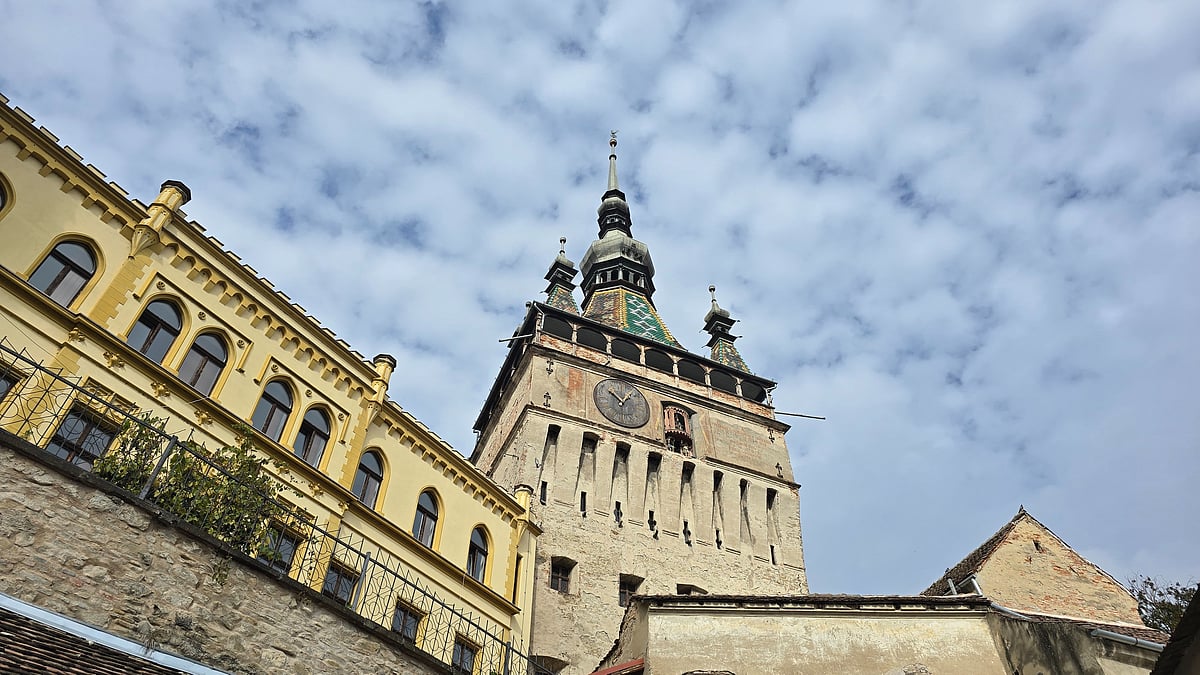
Sighișoara (Clock Tower) |
October in Romania’s Transylvania is a little bit of everything. The foliage turns shades of orange and red, with patches of green still holding on, lending the landscape a certain warmth. Then come the grey skies, sudden showers, and mist-covered hills, giving the countryside an eerie beauty.
We drive down the scenic Transfăgărășan Highway, winding our way through dramatic hairpin bends from an elevation of nearly 2,042 metres, before making our way towards Sighișoara, a UNESCO World Heritage Site. By the time we arrive, it is late evening. Dark clouds hang overhead, threatening more rain, while the chilly wind cuts through our jackets. The faint yellow streetlights barely light up the cobblestone streets, making it difficult to find our way around. Above us, the ancient Clock Tower looms in the darkness. A church bell rings in the distance, while birds circle overhead, their cries echoing through the otherwise quiet streets.
It is the kind of setting that makes your imagination run a little wild. I find myself thinking of Bram Stoker’s Dracula and the familiar image of the pale, brooding figure with thick eyebrows, pointed ears and long canines. For a moment, the thought feels a little too real. The next morning, though, Sighișoara reveals a different side of itself with its colourful medieval facades and sunken lanes.
The town where the legend begins
Travelling through Romania, you can't escape Dracula’s legacy. Whether you arrive knowing the history behind the legend or not, the country makes sure you leave familiar with it. From guided tours and themed wine bottles to fridge magnets and souvenir cutlery, the fictional count has found his way into the country’s tourism landscape. Come Halloween, the towns take their Dracula obsession up a notch, with spooky displays, costumed characters and themed events. Yet mention that you have come to Transylvania in search of Dracula, and you might still be met with a sarcastic laugh or a knowing shrug. There is, after all, a difference between the monster the world knows and the history that belongs to this place.
Published in 1897, Bram Stoker’s Dracula gave the world its most enduring image of this vampire: a pale, aristocratic figure who emerges after dark to prey on the living. Stoker never visited Romania, and his character was not a straightforward portrait of any one historical figure. So how did Transylvania become so closely associated with the story?
As we browse the souvenir shops tucked along Sighișoara’s cobbled lanes, a shopkeeper asks what brings us to town. When we excitedly mention Dracula, he bursts into laughter. The vampire may have made Transylvania famous among travellers, drawing curious visitors here for decades, but there is more to the story, he tells us. He brings up Vlad the Impaler, the 15th-century ruler whose name is often linked to Stoker’s fictional count. He is someone who holds a place in the country’s history as a national hero. For Romanians, this ‘Dracula’ is a good one.
Vlad III, also known as Vlad Țepeș, ruled Wallachia, a principality south of the Carpathian Mountains, during the 15th century. His epithet, the Impaler, refers to his preferred method of executing enemies. His reputation was shaped by the brutal politics of a region that fought against powerful neighbours, including the Ottoman Empire and the Kingdom of Hungary. His name, Vlad Dracula, came from his father, Vlad II Dracul, who was associated with the Order of the Dragon, a Christian military order. So, Vlad III was the son of the dragon, or Dracula - whose brutal reputation helped inspire the Dracula legend.
Sighișoara is traditionally identified as the birthplace of Vlad III, and its medieval turrets rise against the darkening sky - a theatrical Gothic charm. Come Halloween, the town embraces its Dracula connection with caricatures, themed souvenirs and plenty of reminders of the legend. Oddly, the house where Dracula was born is now a restaurant. But to visit Sighișoara only for Dracula would be to miss much of what makes it special.
A remarkably preserved medieval citadel, it is a maze of cobbled lanes and colourful houses with pastel facades. I find myself turning down one lane only to discover another opening into a quiet square, stopping to admire wooden shutters, arched doorways and flowerpots tucked beneath windows. Then there is the Scholar’s Stairway, a covered wooden passage with 176 steps that leads up to the Church on the Hill. It is a long climb, but the church’s restored medieval frescoes and historic altarpieces make the effort worthwhile. From the hilltop, the red-tiled roofs, fortified towers and colourful facades of the old town in the fading light take on that familiar autumnal gloom, but there is little of the menace I had imagined the night before.
A castle for Dracula
Just two hours from Sighișoara, Bran Castle, near the medieval city of Brașov, is widely believed to have inspired Castle Dracula. With its bulky turrets and dramatic mountain perch, it certainly looks the part. The approach is crowded with visitors, souvenir stalls and shops selling everything from Dracula memorabilia to local crafts. With pumpkins and Halloween decorations popping up among the stalls, the autumn foliage and rain make for an especially fitting backdrop. The commercial enthusiasm is hard to miss among tourists, though the same excitement doesn’t seem to extend to the locals. Even the parking attendant seemed rather indifferent when we told him we were there to visit the castle.
The castle’s actual history, however, is more grounded. It served as a royal residence and is most closely associated with Queen Marie of Romania, one of Queen Victoria’s granddaughters. Inside, narrow staircases wind between rooms, passageways lead into unexpected corners, and the building’s irregular layout makes it easy to lose your sense of direction. Wooden beams, antique furniture and small windows frame views of the surrounding hills. Away from the souvenir stalls, it is easier to imagine the castle as a historic residence than as the lair of a fictional vampire.
The displays inside also make an effort to separate fiction from fact. Romanian folklore has a rich tradition of supernatural beings associated with death, fear and the boundary between the living and the dead. Across Eastern Europe, such folklore evolved over generations. Bran Castle dedicates an area to these beliefs, bringing Romanian folklore to life through theatrical displays. Two hallways are devoted to Dracula and Vlad III, including an account of the ruler’s gruesome method of execution by impalement. The mood grows darker in the castle’s torture museum with displays of medieval instruments of torture.
The fascination with watchful eyes extends beyond the supernatural. In Sibiu, another Transylvanian town, the rooftops are punctuated by distinctive eyebrow dormers that make the houses appear to be watching passers-by. There is a local legend that they were designed to make people feel watched, although their actual purpose was to ventilate the attics. Against the pastel-coloured facades and centuries-old Saxon buildings, these little windows lend Sibiu an unexpected eccentricity. After days of hearing stories about Dracula and supernatural beings, I can see how easily an ordinary architectural detail might acquire a life of its own in Transylvania.
Flipping History Files
The territory that is now Romania was once divided among several historical regions and principalities, with Transylvania and Wallachia particularly central to the Dracula story. But as we travel between towns, it is the wider history of the region that begins to hold my attention. The road into Transylvania takes us past dense forests, quiet villages and sweeping mountain scenery. Every so often, a church with striking Gothic architecture rises above the rooftops, followed by an old cemetery tucked beside the road.
As the afternoon wears on, the landscape seems to grow darker, with wooded slopes giving way to open valleys and church spires and red-tiled rooftops appearing between the trees. Between one hamlet and the next, I find myself stopping at magnificent 13th-century churches, some of which once served as citadels. Outside these old stone walls, life carries on much as it has for generations - farmers tend their fields by hand, horse-drawn carts still share the roads, and stooped women in headscarves walk past. The roads cut through pastoral lands that stretch for miles, with little to interrupt the sweep of open fields and rolling hills. Every so often, a shepherd appears with his flock, or villagers guide their cows back to their sheds as the day draws to a close. From the car window, it feels like riding a time machine into the distant past. You can see why Transylvania draws those looking to slow down and disconnect.
But it’s also a window to Transylvania’s complicated history - conquered and ruled by various powers over the centuries. Among those who left the biggest mark were the Transylvanian Saxons, a German-speaking population who began settling here in the 12th century and can be credited with much of the region’s fabulous colourful architecture. Largely autonomous, with their own legal systems and institutions, the Saxons built towns and hundreds of fortified churches, combining Gothic architecture with practical defences. As Ottoman incursions and other conflicts threatened the region, communities reinforced their churches with thick walls, towers and maze-like layouts, sometimes adding communal living spaces and underground pantries where villagers could take refuge during sieges.
The Saxons remained a significant community in Transylvania for centuries, but their numbers declined sharply as many emigrated to Germany, particularly after the fall of Communism. As I wander through these towns, I notice how different histories seem to occupy the same streets. Pastel-coloured Saxon houses and fortified churches lend the region a character that feels distinctly Transylvanian, yet reminiscent of northern Germany, while the austere blocks of the communist era offer a stark contrast. Transylvania’s past feels less like a single story than a series of layers.
Back in the capital, Bucharest, I join another guided tour of the city’s churches. My guide asks if I’m carrying silver to protect myself from Dracula and other spirits. I laugh it off, but as dusk settles, the dark sky framing old stone towers and palaces, I begin to see why these horror tales cling to the landscape. Yet I suspect the landscape itself is the more persuasive storyteller.
RECENT STORIES
-
-
-
-
-