Future Of Journalism Careers In India: Why Media Education Is Evolving Fast
AAFT University of Media and Arts, Raipur, has redesigned its journalism and mass communication programmes to align with the evolving digital media landscape. The courses emphasise multimedia storytelling, mobile journalism, AI tools, data literacy and platform-specific content creation, supported by industry-led training, professional certifications and modern media infrastructure.

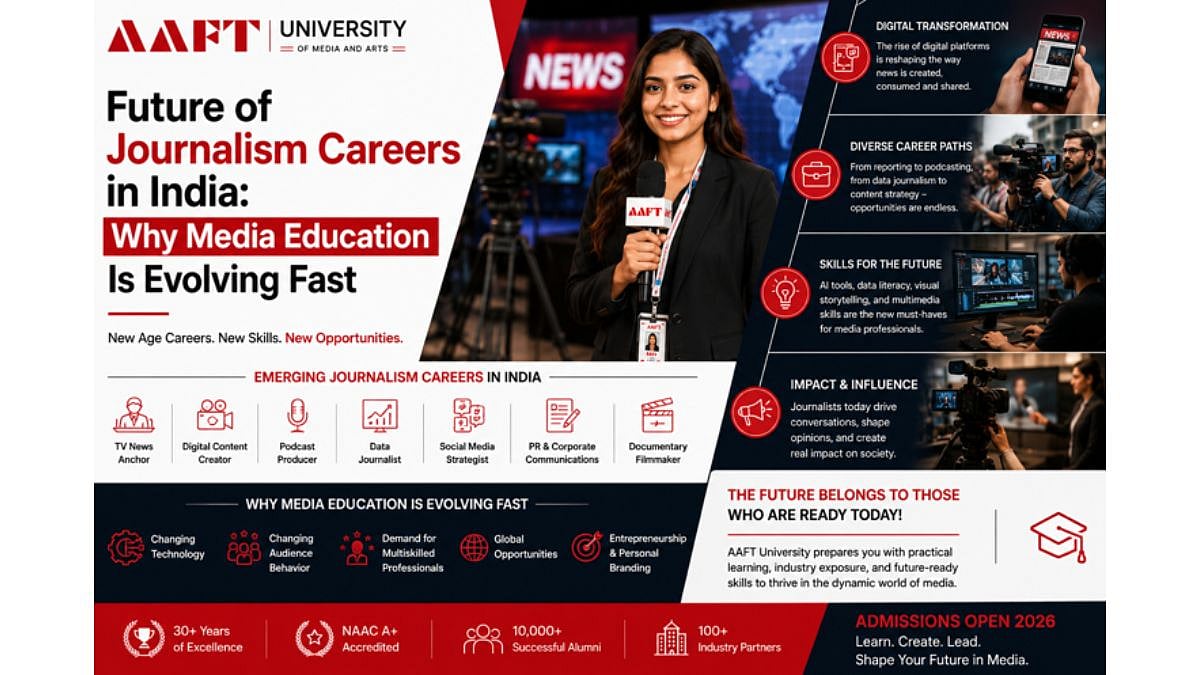
AAFT University highlights industry-focused journalism training designed for emerging digital and multimedia media careers | File Photo
Raipur, India. Ten years ago, a journalism student's career map was straightforward. Study, graduate, join a newspaper or TV channel, work your way up. That map no longer exists. The journalism industry in India has changed so completely and so quickly that a media education built around old formats is genuinely leaving students behind. AAFT University of Media and Arts, Raipur, recognised this shift early. Its B.A. in Journalism and Mass Communication and M.A. (Journalism and Mass Communication) programs have been rebuilt around where journalism is actually going, not where it has been.
The students entering media education today will retire in a profession that doesn't fully exist yet. That is not a warning. That is an opportunity. But only for those who trained for it properly.
What Has Actually Changed in Indian Journalism
The changes are not subtle. They are structural.
Print circulation has been declining steadily for years. Traditional TV news viewership is fragmenting as younger audiences move to YouTube, Instagram, and OTT platforms. Regional digital news outlets are growing faster than national ones. Citizen journalism is breaking stories before newsrooms even hear about them. AI tools are writing basic news summaries, sorting data, and generating first drafts of routine reports.
At the same time, the appetite for quality journalism has never been higher. People want real reporting, well-told stories, and trustworthy information. They are just consuming it differently. On their phones. Through short videos. Via newsletters. Through podcasts on their morning commute.
The journalist who understands all of this, who can report, shoot, edit, present, and publish across multiple platforms, is the most employable person in Indian media right now. The one who only knows how to do one of those things is already struggling.
Why Media Education Had to Change With It
A journalism program that teaches students to write for print and anchor for television is preparing them for an industry that is shrinking. A journalism program that teaches them to do all of that and also shoot mobile video, produce podcasts, manage social media accounts, use data tools, and understand digital publishing is preparing them for an industry that is growing.
The difference sounds simple. In practice, it requires a complete rethinking of curriculum, infrastructure, and teaching approach.
AAFT University built that rethink into its journalism programs. The BJMC Course and Mass Communication does not treat digital as an add-on module at the end of the program. It runs digital journalism, mobile reporting, social media content, and data storytelling through the entire three years. Students in the Honors track cover AI and data-driven journalism, science communication tools, and media research in their extended fourth year.
The M.A. (Journalism and Mass Communication) goes further. Postgraduate students work on documentary production, advanced broadcast journalism, media research methodology, and communication strategy at a level that prepares them for senior roles, not just entry positions.
The Skills That Will Define Journalism Careers in the Next Decade
Some skills will always matter in journalism. Accuracy. Curiosity. The ability to find a story and tell it clearly. These don't change.
What is changing is the technical layer around those core skills. The journalist of 2030 will need:
● Multimedia storytelling across text, video, audio, and interactive formats
● Mobile journalism production from shoot to publish without a production team
● Understanding of how algorithms decide what content gets seen
● Basic data literacy to read, interpret, and report on numbers and research
● AI tool familiarity for research, transcription, and content assistance
● Platform-specific content strategy for YouTube, Instagram, podcasts, and newsletters
● Strong personal brand building, because audiences increasingly follow journalists, not just publications
AAFT University's journalism curriculum covers all of these areas. Not as future-facing electives. As current, practical training that students use from their first semester onward.
The Role of Real Infrastructure in Modern Media Training
Knowing what skills journalism requires in 2026 is one thing. Having the infrastructure to actually train students in those skills is another.
AAFT University's campus in Raipur gives journalism students access to:
● A working TV studio with multi-camera setup, professional lighting, and teleprompter systems for broadcast training
● An in-house radio station for audio journalism, scripting, and live programming
● Post-production editing labs running Adobe Premiere Pro, Adobe Audition, DaVinci Resolve, Final Cut Pro, and Avid Media Composer
● Digital newsroom tools and content management systems used by working publications
● Mobile journalism training using professional field equipment
● Documentary production facilities for long-form storytelling projects
Students also earn certifications during their degree in Digital Marketing from Google and Facebook Blueprint, Mobile Journalism, Video Editing, Fact-Checking, and Social Media Management. These credentials matter when students sit in front of placement panels.
None of this infrastructure exists to impress visitors on open days. It exists because students cannot learn modern journalism without using modern tools. Regularly. On real projects.
Faye D'Souza and the Faculty Shaping Future Journalists
Industry Dean Faye D'Souza leads AAFT University's School of Journalism and Mass Communication. She is one of India's most respected broadcast journalists, a RedInk Award recipient, and someone who has navigated the transition from traditional to digital journalism at a working professional level.
Her presence in the program is not decorative. She brings current editorial standards, real industry connections, and a clear understanding of where journalism careers are actually heading into the academic environment.
The faculty includes Head of Department Mr. Somanath Sahoo, Ms. Ankisha Mishra, Ms. Rashmi Priya, and Dr. Shiv Gopal. All of them teach from professional experience, not just academic backgrounds. That combination of industry exposure and teaching capability is what makes the difference in a field that changes as fast as media does.
Where AAFT University Journalism Graduates Are Going
Graduates from AAFT University's journalism programs are working across:
● News anchoring and production at TV channels
● Digital reporting and content creation for online news platforms
● Radio journalism and podcast production
● Public relations in corporate and government sectors
● Documentary filmmaking and photojournalism
● Social media journalism and platform content management
● Indian Information Service and government media roles
● Independent content creation and media entrepreneurship
Placement partners include NDTV, India TV, R. Bharat, News Nation, and News India.
AAFT University Admissions 2026 Are Open
Class 12 graduates from any stream can apply for the B.A. in Journalism and Mass Communication. Graduates from any discipline can apply for the M.A. (Journalism and Mass Communication). Both programs require clearing the AAFT Global Entrance Exam, which includes an aptitude test and a personal interview available online and offline. NSDC Skill Loans at reduced interest rates are available for students who need financial support.
About AAFT University of Media and Arts
AAFT University of Media and Arts was set up in 2018 under Marwah Studios and is approved by the UGC and recognised by the Chhattisgarh State Government and MHRD. It is part of the AAFT Group, which carries a 33-year legacy in media education. The university offers more than 100 programs across Cinema, Journalism and Mass Communication, Fashion Design, Animation, Fine Arts, Hospitality, Interior Design, Performing Arts, Photography, Management, Law, and Wellness on a 27-acre campus in Raipur.
Kaveree Bamzai, former editor of India Today, leads the School of Journalism and Mass Communication as Industry Dean. The university holds an active NSDC partnership, through which students earn NSDC certifications and can access skill loans. More than 37,000 alumni from the AAFT Group work across broadcast media, digital journalism, advertising, film production, and corporate communication in India and abroad.
For Admissions and Media Inquiries, Contact:
AAFT University
Vill. Manth, Kharora, District Raipur
Chhattisgarh 493225, India
Admission Office: GF-18, Ground Floor, Shyam Plaza, Pandri, Raipur, Chhattisgarh 492001
Phone: +91 9109112078 / +91 8064057209
Published on: Thursday, June 18, 2026, 06:11 PM ISTRECENT STORIES
-
-
-
-
-