Indore Forests Record 449 Livestock Kills By Leopards In 7 Years, Yet No Budget To Prevent Attacks
Leopards killed 449 livestock across Indore Forest Division between 2019 and 2025, with Mhow, Choral and Manpur accounting for nearly 80% of incidents. Despite identifying 172 conflict hotspots, officials lack dedicated prevention funds. Villagers rely on fencing, lighting and group grazing, while compensation remains the primary official response.

Indore Forests Record 449 Livestock Kills By Leopards In 7 Years, Yet No Budget To Prevent Attacks | FP photo
Indore (Madhya Pradesh): Leopards killed livestock 449 times in Indore Forest Division over seven years, and 172 conflict hotspots have been identified. Yet the division has no provision for preventive measures and no separate budget for them; only compensation is paid after the loss.
A geographical analysis by IFS officer Pradeep Mishra of 2019-25 records found Mhow recorded the most incidents (147), followed by Choral (110), Manpur (102) and Indore (90). Mhow, Choral and Manpur together accounted for 359, nearly 80% of the total.
No provision, no funds
Mishra said territorial divisions like Indore have no provision for preventing leopard kills and no separate budget. He plans to take the study to headquarters to develop a prevention strategy.
“Possibly, we can divert leopard movement away from residents,” he said. Asked whether such kills can be prevented, he said measures can be taken, and they help. Trials elsewhere support this.
Annual compensation more than doubled, from Rs 4.92 lakh in 2019 to Rs 11.24 lakh in 2025. This covers cattle kills only, not all 449 livestock losses.
Standard precautions
Standard advisories include sheltering cattle in roofed, wire-sealed sheds before dusk; overnight lights or radios; clearing cover within 100 metres of pens; avoiding dawn and dusk grazing near forest edges; guard dogs; clearing garbage to keep strays away; and reporting pugmarks to the Forest Department.
Villagers rely on fencing, lighting, group grazing
There is palpable fear among villagers affected leopards attacking their livestock. Mangilal Patel, 63, Jalyamau village said “We have put fencing around our house. We come inside early in the evening and avoid going into the forest alone.” Similarly, Babulal, 42, of Chalya village said, “Two of us go together when taking the cattle to graze in the forest so the leopard does not attack.” Shyamlal Gehlot, 50, of Malendi village said, “We keep a light bulb on at night and also keep pet dogs. We take our cattle out to graze together in groups.” Nisha Banarji, 38, also of Malendi said, “We have put thorny fencing around our house and tie our cattle inside the shed at home.”
Three conflict clusters
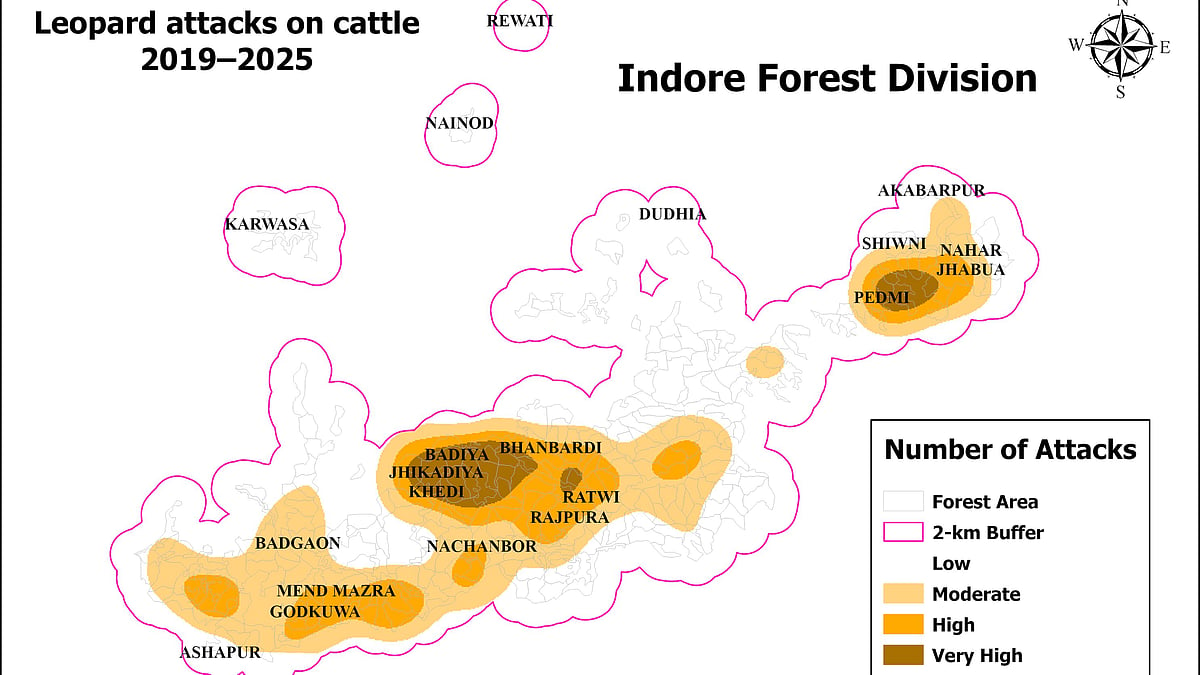
“Using KDE and Getis-Ord Gi* hotspot analysis, I identified 172 statistically significant hotspot cells among 1,352 examined, covering about 22% of the forest extent. The incidents are concentrated in three clusters: a central belt, a southwestern cluster and a northeastern chain around Choral Range.”
— Pradeep Mishra, IFS officer
What has worked elsewhere
Pauri Garhwal: Wildlife Institute of India trials of flashing solar lights around 27 villages cut nocturnal livestock kills by nearly 50%.
Himachal Pradesh: Studded collars on free-grazing cattle showed a 100% drop in fatal throat bites in field trials.
Himachal and Ladakh: Reinforced, roofed stone-and-wire pens sharply cut “surplus killing” in sheds.
Kanha Tiger Reserve: Conflict data guides targeted patrols and grazing advisories.
Level up your brain the fun way. Play daily games and quizzes on FPJ Smart!
ALSO READ
RECENT STORIES
-
-
-
-
-