Historic Sleeman Lines Demolished By The Central Public Works Department In Indore
The site also carried painful memories of India’s freedom struggle. During the Revolt of 1857, several revolutionaries were allegedly imprisoned and tortured inside the barracks adjoining the massive entrance gate that has now been demolished. The colonial barracks once echoed with stories of rebellion, suffering, and resistance against British rule.

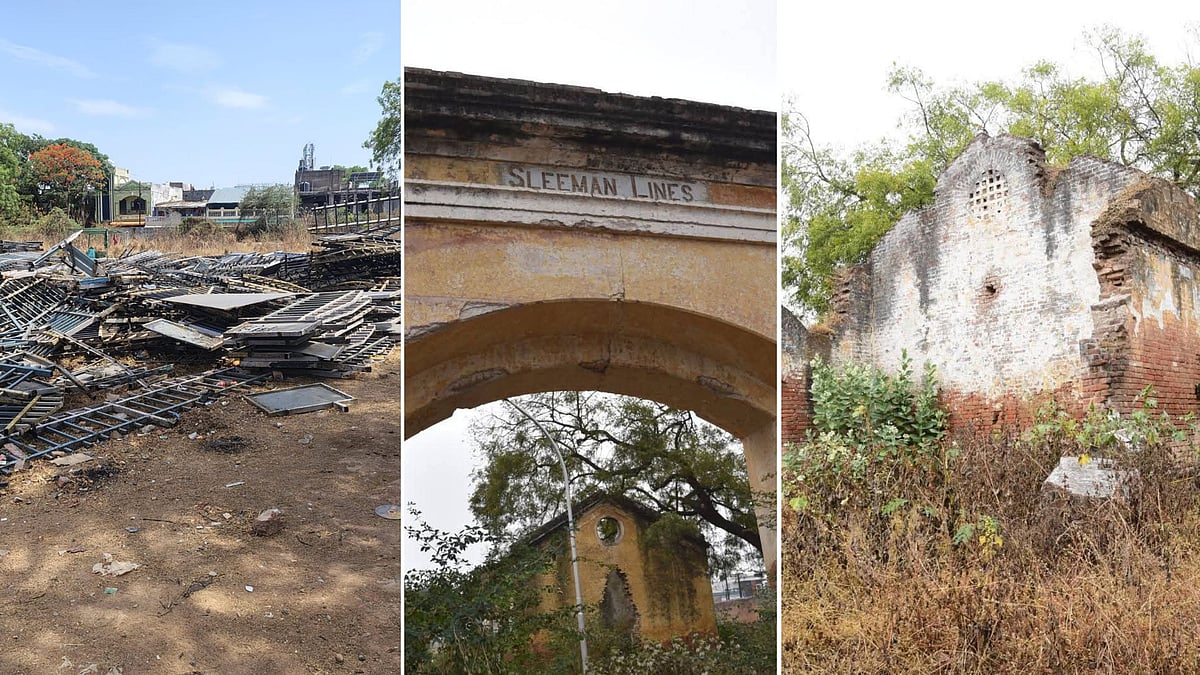
Historic Sleeman Lines Demolished By The Central Public Works Department In Indore | FP photo
Indore (Madhya Pradesh): Indore has lost yet another priceless piece of its forgotten heritage. The historic Sleeman Lines, once infamous across Central India as the legendary Thuggee Jail, has now been reduced to rubble after the Central Public Works Department (CPWD) demolished its centuries-old gateway and colonial-era structures, flattening the historic campus into an open ground.
With the demolition, not just bricks and walls collapsed, but a living chapter of India’s colonial, revolutionary, and cultural history vanished forever.
Historians and heritage lovers have expressed deep anguish over the destruction of the site, which stood in the Residency area and later in Musakhedi as one of the most historically significant remnants of British-era Indore. Historian Zafar Ansari called the demolition an irreparable loss to the city’s identity and collective memory.
According to Ansari, the site carried immense importance not only for Indore but for the entire Central Indian region. During the 19th century, the prison was used by the British East India Company to confine notorious Thuggee gangs and Pindaris who once terrorised trade routes across Malwa and Nimar. The prison later became known as Sleeman Lines after British officer William Henry Sleeman, whose pioneering research on Thuggee originated from Indore itself.
Ironically, the globally recognised English words Thug and dacoit, which today exist in the Oxford Dictionary, trace their roots back to the criminal networks studied inside this very prison complex. Historians claim the terminology emerged from British documentation connected to Indore’s Thuggee operations.
The site also carried painful memories of India’s freedom struggle. During the Revolt of 1857, several revolutionaries were allegedly imprisoned and tortured inside the barracks adjoining the massive entrance gate that has now been demolished. The colonial barracks once echoed with stories of rebellion, suffering, and resistance against British rule.
The legacy of Sleeman extended far beyond Indore. After his transfer to Jabalpur, Sleeman documented accounts of a mysterious man-eating child discovered in the forests of Seoni, notes that later inspired Rudyard Kipling’s world-famous classic The Jungle Book and the character of Mowgli.
Historians argue that while cities across the world preserve even the smallest fragments of their past, Indore continues to erase its own heritage in the name of development and neglect. No heritage plaque, no conservation effort, and no public consultation could save Sleeman Lines from demolition.
RECENT STORIES
-
-
-
-
-