El Niño Shadows Kharif Sowing: Delayed Rains Force Farmers To Rethink Plans
According to the Agriculture Ministry, the impact of El Niño is expected to be relatively severe in 12 states: Madhya Pradesh, Uttar Pradesh, Tamil Nadu, Andhra Pradesh, Telangana, Karnataka, Odisha, Gujarat, Rajasthan, Bihar, Jharkhand and Maharashtra. Union Agriculture Minister Shivraj Singh Chouhan has directed officials to prepare district-level contingency plans for vulnerable areas.

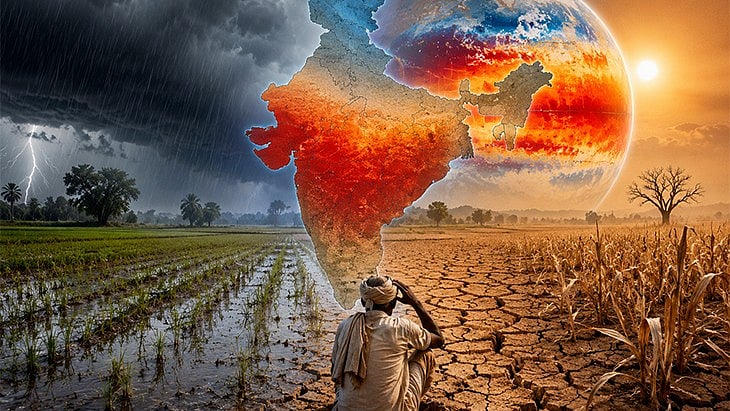
El Niño Shadows Kharif Sowing: Delayed Rains Force Farmers To Rethink Plans | AI Generated
Indore (Madhya Pradesh): With clouds playing hide-and-seek and the monsoon still uncertain, farmers across the Malwa region are entering the Kharif season with growing concern.
The fear of El Niño, which is associated with weaker monsoon conditions in India, has now prompted agricultural experts to advise farmers to prepare for a challenging season rather than rely on traditional farming practices.
In Indore, rainfall has remained uneven so far. On June 5 and June 14, only 0.2 mm of rainfall was recorded in one part of the city, while another pocket recorded comparatively higher rainfall of 29 mm and 11.4 mm, respectively. However, experts said such scattered showers cannot confirm the monsoon's arrival.
According to the Agriculture Ministry, the impact of El Niño is expected to be relatively severe in 12 states: Madhya Pradesh, Uttar Pradesh, Tamil Nadu, Andhra Pradesh, Telangana, Karnataka, Odisha, Gujarat, Rajasthan, Bihar, Jharkhand and Maharashtra. Union Agriculture Minister Shivraj Singh Chouhan has directed officials to prepare district-level contingency plans for vulnerable areas.
Avoid long-duration crops this season
Prof. Dr Anand Hasan Sadi from the Agriculture College explained that El Niño is a natural climatic phenomenon linked to changes in sea surface temperatures, particularly in the tropical Pacific Ocean.
“When sea surface temperature rises 0.5 degrees Celsius above normal, El Niño conditions develop. If the rise exceeds 2 degrees, it becomes a very strong El Niño. Its impact differs globally; some regions receive heavy rainfall while others face rainfall shortage,” he said.
He added that forecasts indicate rainfall may remain at around 90%-92% of the long-period average, underscoring the importance of preparedness.
“In Malwa, soybean is the major Kharif crop. Farmers should not depend on a single variety this year. They should choose at least two varieties and avoid long-duration crops. Short or medium-duration varieties will be safer,” Prof Hasan advised.
He further suggested that sowing should begin only after receiving around three to four inches (nearly 100 mm) of rainfall.
“Farmers should adopt broad bed furrow or ridge methods for soybean cultivation as these techniques conserve moisture and help crops survive during long dry spells. Farmers should also arrange backup water sources for life-saving irrigation,” he added.
Farmer’s worry: ‘Waiting for rain before sowing’
Farmer Anand Singh from the Malwa region said the delay has created confusion among cultivators.
“Every year we prepare our fields after early showers, but this time we are waiting. If we sow early and rainfall stops for several days, the entire crop can suffer,” he said.
With monsoon uncertainty, possible dry spells and El Niño concerns, farmers are now being pushed towards climate-smart decisions to protect their harvest.
What is El Niño?
• El Niño is a natural climate phenomenon caused by unusual warming of sea surface temperatures in the Pacific Ocean.
• When the temperature rises 0.5°C above average, El Niño conditions begin.
• A rise above 2°C is considered a very strong El Niño event.
• It can disturb weather patterns worldwide.
• In India, it is often linked with weaker monsoon, rainfall gaps and drought-like conditions in some regions.
Advice for Farmers Amid El Niño Threat
• Do not rush for sowing: Begin sowing only after receiving at least 3-4 inches (around 100 mm) of proper rainfall.
• Avoid long-duration varieties: Farmers should avoid crops that take a longer time to mature and prefer short or medium-duration varieties this season.
• Do not depend on a single variety: Keep at least two crop varieties to reduce the risk of loss due to uncertain rainfall.
• Prepare for dry spells: Long gaps between rainfall are possible; farmers should keep arrangements ready for life-saving irrigation.
• Adopt moisture-saving methods: Use techniques like broad bed furrow (BBF) and ridge planting, especially in soybean fields, to conserve soil moisture.
• Focus on water conservation: Store available rainwater and maintain soil moisture through scientific farm practices.
• Follow expert guidance: Stay connected with agriculture universities, KVKs and Agriculture Department advisories before making crop decisions.
ALSO READ
RECENT STORIES
-
-
-
-
-