'Year’s Laundered Money Can Buy Laptop For Everyone On Earth': CJI Surya Kant
Chief Justice of India Surya Kant said global money laundering in a year could buy a modest laptop for every person on Earth and still leave money unused. Speaking at Cambridge’s economic crime symposium, he highlighted that less than one per cent of illicit wealth is recovered. He also stressed India’s legal response must balance enforcement with due process.

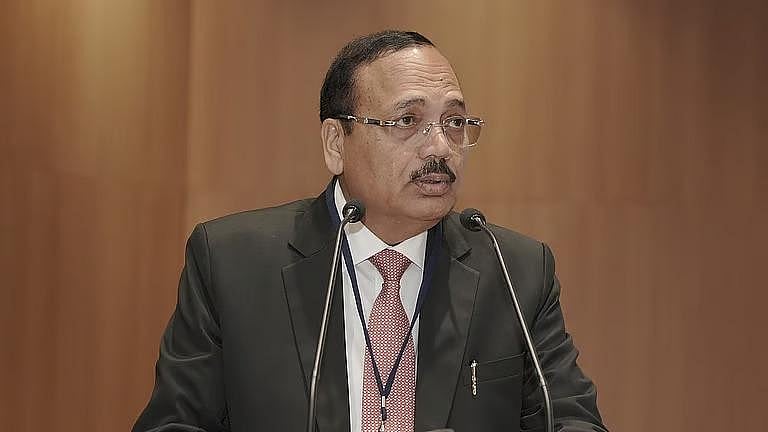
Chief Justice of India (CJI) Surya Kant | File
Money laundered across the world in a single year could buy a modest laptop for every person on Earth and still leave some money to spare, Chief Justice of India Surya Kant has said, underlining the enormous scale of illicit wealth and the difficulty authorities face in recovering it.
Speaking at the 43rd International Symposium on Economic Crime at the University of Cambridge, Chief Justice Kant also highlighted India's response to financial crime. He said the judiciary had proactively dealt with emerging frauds, including digital arrest scams, rather than waiting for Parliament to address them.
Eight Billion Laptops, Yet Money Left Over
"As of today, if the global estimates on money laundering are even roughly right, the world launders enough money in a single year to buy every one of the eight billion people alive on the planet today a modest laptop, and still have some change left," he said.
The comparison is striking because it translates an otherwise difficult-to-grasp financial crime problem into everyday terms. More worrying, however, is how little of this illicit wealth is eventually recovered.
"And of that immense tide of illicit wealth, by the most generous reckoning, less than one unit in a hundred is ever recovered. If I may present this more simply, for every hundred parts of that wealth, 99 are simply referred to in speeches and reports while only one part is ever actually put right," the Chief Justice said.
Chief Justice Kant said he had not travelled to Cambridge merely to unsettle the gathering with statistics. Instead, the figures explained why international discussions on economic crime remained necessary.
"Now, I have not travelled to Cambridge to unsettle such a distinguished gathering with these statistics but instead to impress upon this congregation that this is precisely why we have all convened here this week," he said.
India’s Layered Fight Against Economic Crime
Turning to India, Chief Justice Kant said the country's response to economic crime should not be viewed through a single law. Instead, it was a layered system developed over decades, with legislation, institutions and judicial doctrine performing distinct roles.
He referred to the Prevention of Money Laundering Act (PMLA), 2002, and the Fugitive Economic Offenders Act, 2018, as part of this framework, NDTV reports.
At the same time, the Chief Justice acknowledged concerns over the functioning of these mechanisms. His remarks point to the difficult balance between giving investigating agencies enough power to tackle sophisticated financial crimes and ensuring that those powers do not undermine individual rights.
"I must note that these are not infallible mechanisms. Numerous individuals have alleged misuse of the PMLA process by investigating authorities, including claims of arrests made without articulated reasons, and of custody extended beyond what the existing facts appear to justify. In each such instance, the judiciary has intervened to rectify the situation," he said.
Due Process Must Remain Central
Chief Justice Kant referred to the Supreme Court's ruling that grounds for arrest must be given to an accused in writing rather than merely read aloud. He said the Supreme Court had consistently maintained that due process and the presumption of innocence should remain guiding principles of its jurisprudence.
That emphasis is significant in the fight against economic crime. The scale and complexity of financial offences may demand strong enforcement, but the Chief Justice's remarks make clear that effectiveness cannot come at the expense of established legal safeguards.
He also said illicit wealth and economic crime did not respect national sovereignty, even though sovereignty ordinarily protects domestic legal structures from foreign interference. The observation underscored the need for countries and institutions to work together against financial crime that crosses borders.
"Let this symposium's answer be that vigilance, cooperation and the rule of law thwart fraudulence in equal and, I hope, escalating measures," Chief Justice Kant said.
RECENT STORIES
-
-
-
-
-