Tibetan Group Raises Concerns Over China's Ethnic Unity Law, Cites Cultural & Rights Issues
A Tibetan advocacy group has criticised China’s “Ethnic Unity and Progress Law”, alleging it threatens Tibetan linguistic, cultural and religious rights. Speaking in Guwahati, Tenzin Sangmo highlighted concerns over assimilation policies, restrictions and Tibet’s strategic importance for India. The group also raised environmental concerns linked to rivers and projects on the Tibetan Plateau.

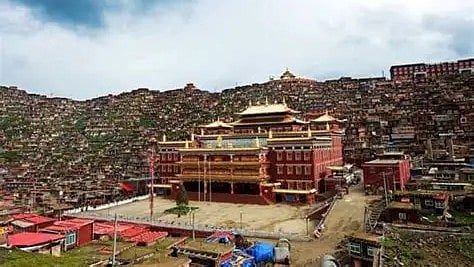
Tibetan Group Raises Concerns Over China's Ethnic Unity Law, Cites Cultural & Rights Issues | X - @stanzinnangmo
Guwahati, July 29: A Tibetan advocacy group on Wednesday expressed concern over the human rights situation in Tibet and criticised China's "Ethnic Unity and Progress Law", which came into force on July 1, 2026, saying it institutionalises policies affecting the linguistic, cultural and religious rights of Tibetans.
Addressing a press conference at the Guwahati Press Club, Tenzin Sangmo, media coordinator of Northeast India Tibetans' Call for Freedom, Justice, and Human Rights in Tibet, referred to the death of Tibetan activist Lobga Rangzen following a self-immolation protest in New York earlier this month and outlined the group's concerns over developments in Tibet.
Sangmo said, "On July 2, 2026, a 52-year-old Tibetan activist, Lobga Rangzen, died after a self-immolation protest he carried out in front of the UN headquarters in New York City. He called for the restoration of Tibet's independence and spoke against the imposition of China's 'Ethnic Unity and Progress Law' that went into force on July 1 in Tibet.
Tibetans reject this law as it is designed to legitimize the imposition of sinicization policies in Tibet. Tibetans are not an ethnic minority of China to be subjected to its ethnic unity law in the name of unity and progress."
Referring to Tibet's history, she said, "In 1950, the People's Liberation Army entered Tibet, fundamentally changing the course of Tibetan history. Following the 1959 Tibetan Uprising, His Holiness the 14th Dalai Lama and approximately 80,000 Tibetans fled into exile in India. Since China's military occupation of Tibet, Tibetans have lived under policies that many governments, UN experts and international human rights organizations say have severely restricted fundamental rights."
Sangmo said reports have documented the criminalisation of expressions of Tibetan national identity and political dissent; restrictions on the Tibetan language, religion and cultural practices; state-run colonial boarding schools; relocation of Tibetan nomads; repression and sinicization of Tibetan Buddhism; technoauthoritarian surveillance; arbitrary detention and disappearance of human rights defenders and protestors; torture, prison labour and custodial deaths; large-scale damming, mining and mineral extraction on the Tibetan Plateau; heavy securitisation and restrictions on internal movement; racial discrimination; and transnational repression and overseas policing.
She further said, "More than 170 Tibetans have self-immolated since 2009, peaking in 2012 with 85 self-immolations in one year. All the self-immolators unanimously called for freedom in Tibet, the protection of Tibetan identity, the return of His Holiness the XIV Dalai Lama to Tibet, and unity among Tibetans. His Holiness the XIV Dalai Lama and the exile government continue to make efforts toward peaceful resolution of the Sino-Tibetan conflict through its Middle Way Approach. However, China has only turned a cold shoulder to the proposals and responds with rhetoric that undermines the spirit of dialogue. It has put the Tibetans in a difficult position of experiencing the worsening human rights situation in Tibet while watching China intensify its hold on Tibet.
Self-immolations don't occur in a vacuum, but as a result of deep-seated anguish and exhaustion of tangible recourse."
On China's Ethnic Unity and Progress Law, Sangmo said it came into force on July 1, 2026. According to her, while the Chinese government says the law promotes national unity, eight UN human rights experts and international human rights organizations have warned that it further institutionalises policies affecting the linguistic, cultural and religious rights of ethnic minorities.
Also Watch:
She said there are major factual inaccuracies in the law and in the UN response. According to Sangmo, Tibet is not part of China to be absorbed into the project of national unity, and Tibetans are minoritised by the Chinese occupation and are not one of the ethnic minority groups China claims to constitute. She also said China is ethnically Han Chinese dominated, with no historical, cultural, racial, linguistic or political association with Tibetans except as the dominant race of the colonising power.
Sangmo said that, on the ground in Tibet, the law affects education, language, religion and cultural rights by mandating cultural integration.
She added that the single Chinese national identity promoted by the law includes provisions with extraterritorial application, raising concerns that it could exacerbate patterns of transnational repression against individuals and organisations globally. For many Tibetans, she said, the law is seen not as a new policy but as the formal codification of decades of assimilation measures through the instrumentalisation of law.
ALSO READ
Highlighting the issue's relevance to India, Sangmo said the Tibetan Plateau forms much of the strategic frontier between India and China. Since China's occupation of Tibet, she said, the Himalayan region has become one of Asia's most heavily militarised borders. She referred to China's territorial claims over Arunachal Pradesh, which it refers to as "South Tibet", unresolved border disputes in eastern Ladakh, and the 2020 Galwan Valley clash.
She also said the issue has environmental implications for Northeast India as the Brahmaputra (Yarlung Tsangpo) originates on the Tibetan Plateau before flowing through Arunachal Pradesh and Assam.
According to Sangmo, decisions affecting Tibet's rivers and ecosystem, including dam construction, hydropower projects, water diversion and mining, have implications for communities downstream that constitute two billion people.
RECENT STORIES
-
-
-
-
-