Supreme Court Stays HC Proceedings On Challenges To Transgender Persons Amendment Act 2026
The Supreme Court stayed proceedings in multiple High Courts hearing challenges to the Transgender Persons (Protection of Rights) Amendment Act, 2026. Acting on the Centre's transfer plea, the court said it may consolidate the cases to avoid conflicting rulings. The law has sparked debate over provisions affecting gender self-identification and transgender rights.

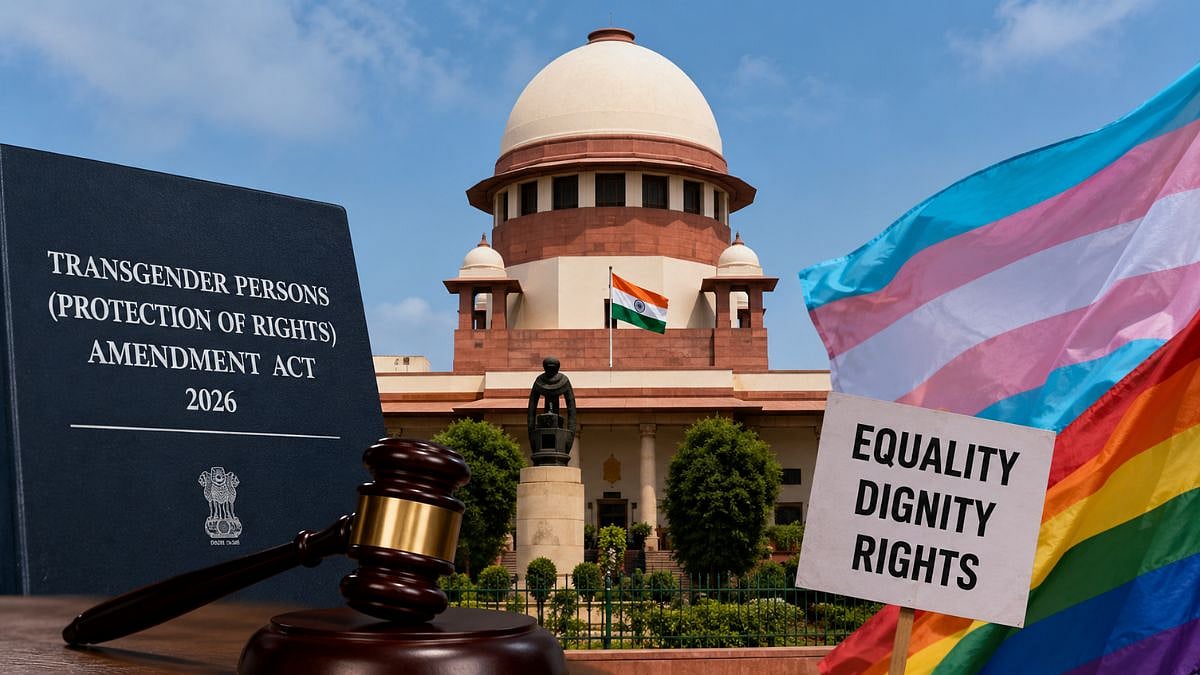
Supreme Court halts High Court hearings on petitions challenging the Transgender Persons Amendment Act while considering consolidation of cases | AI Generated Representational Image
Mumbai, June 15: The Supreme Court on Monday stayed proceedings in various High Courts hearing petitions challenging the constitutional validity of the Transgender Persons (Protection of Rights) Amendment Act, 2026, while issuing notice on the Centre's plea seeking transfer of all such cases to the apex court.
A partial working days Bench comprising Chief Justice of India Surya Kant and Justice V Mohana passed the order while hearing transfer petitions filed by the Union Government.
The Centre has sought consolidation of challenges pending before the Rajasthan, Karnataka, Kerala and Delhi High Courts, arguing that multiple courts examining the same legislation could result in conflicting judicial views.
Move To Avoid Divergent Rulings
While issuing notice to the respondents, who are petitioners before the High Courts, the Bench directed that further proceedings before the High Courts would remain stayed.
The court also indicated that it may either transfer all petitions to the Supreme Court or consolidate them and assign them to a particular High Court for adjudication.
The Centre had earlier sought urgent listing of the matter, with Solicitor General Tushar Mehta submitting that the constitutional validity of a central law should be examined in a coordinated manner. According to the Centre, allowing multiple High Courts to hear similar challenges simultaneously could lead to divergent interpretations and conflicting rulings.
Mehta also requested that if the cases are ultimately transferred to the Supreme Court, they be heard by a three-judge Bench. Referring to the Supreme Court's landmark 2014 National Legal Services Authority (NALSA) judgment, he argued that High Courts may find it difficult to take a view contrary to that ruling. The NALSA verdict, delivered by a two-judge Bench, recognised the right of transgender persons to self-identify their gender.
“There is one judgment of NALSA, so kindly issue notice. I can persuade your lordships to put it before a three-judge Bench. High Courts may find it difficult to take a view contrary to that,” Mehta submitted.
Self-Identification At The Centre Of Debate
The legal challenge to the 2026 amendment has largely centred on the issue of self-identification of gender. During the hearing, Dr Chandresh Jain, a petitioner before the Delhi High Court, argued that the amendment undermines the principles laid down in the 2014 NALSA judgment. He contended that self-identification of gender had been recognised as a fundamental right and further argued that the amendment lacked a medical basis.
The amendment has come under scrutiny from human rights activists and members of the LGBTQ+ community, who contend that it departs from the framework established by the Supreme Court. Petitioners have argued that the law's reported requirement of medical or administrative intervention for gender recognition violates rights relating to dignity, privacy and bodily autonomy.
The Supreme Court had previously sought responses from the Centre and other parties on May 4 in separate petitions challenging the validity of the amendment.
Parliament passed the amendment Bill on March 25, introducing changes to the law governing the protection and rights of transgender persons. The legislation, which excludes social orientations from the ambit of the statute, received Presidential assent on March 30. The Act also provides for graded punishments based on the gravity of harm inflicted on transgender persons.
Also Watch:
With proceedings in multiple High Courts now halted, the Supreme Court’s eventual decision on whether to consolidate the cases could shape the legal battle over one of the most debated social legislations enacted this year.
To get details on exclusive and budget-friendly property deals in Mumbai & surrounding regions, do visit: https://budgetproperties.in/
RECENT STORIES
-
-
-
-
-