Supreme Court Refuses To Stay CBI FIR Against Punjab CM Bhagwant Mann’s OSD, Bars Coercive Action
The Supreme Court has refused to stay the CBI FIR against Rajbir Singh Ghuman, OSD to Punjab Chief Minister Bhagwant Mann, in a corruption case. A bench of Justices MM Sundresh and Prasanna B Varale barred coercive action for now, issued notice to the CBI and directed the Punjab government to cooperate as the investigation continues.

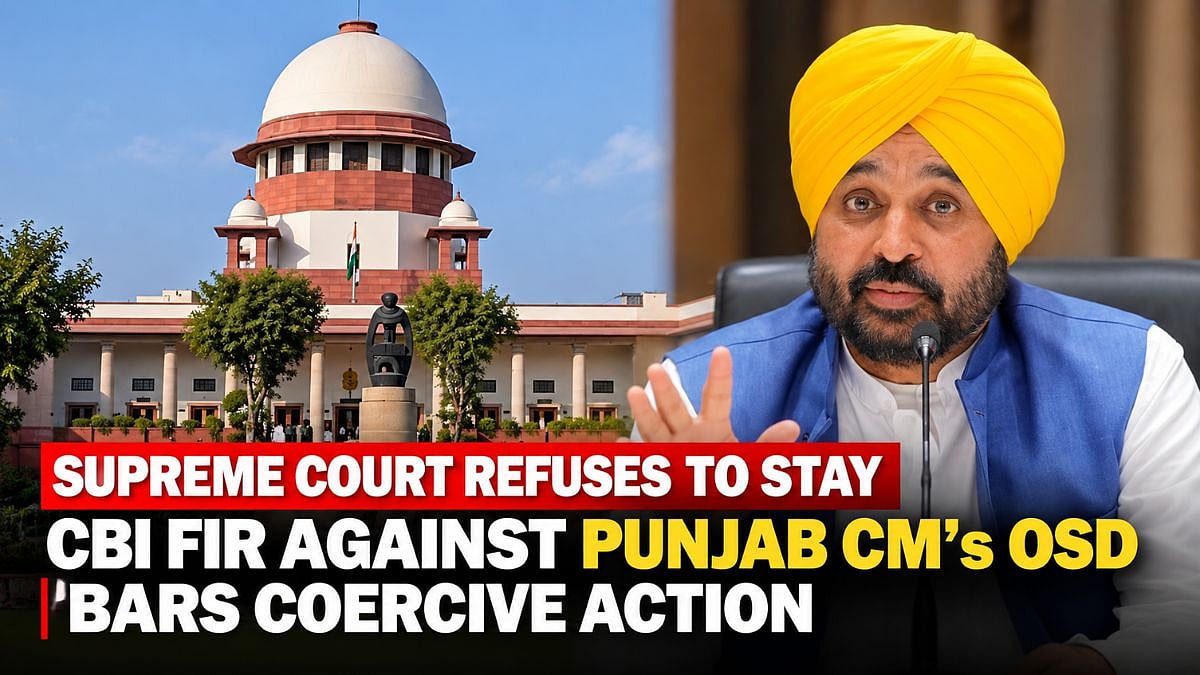
The Supreme Court has allowed the corruption probe involving Punjab Chief Minister Bhagwant Mann’s OSD to proceed while restricting coercive action | AI Generated Image
New Delhi, October 12, 2026: The Supreme Court on Monday refused to stay the Central Bureau of Investigation (CBI) FIR registered against Punjab Chief Minister Bhagwant Mann’s Officer on Special Duty (OSD), Rajbir Singh Ghuman, in a corruption case. However, the court directed the investigating agency not to take any coercive action in the matter.
A bench of Justices MM Sundresh and Prasanna B Varale passed the interim order while hearing an appeal filed by the Punjab government against the Punjab and Haryana High Court’s direction to the CBI to investigate allegations of corruption linked to the Chief Minister’s office.
The Supreme Court issued notice to the CBI and directed the state government to cooperate with the investigation, Live Law and Bar & Bench reported.
Supreme Court Allows Probe to Continue
“We are not staying the FIR. We are saying no coercive steps may be taken,” the Supreme Court observed during the hearing.
The court also made it clear that the investigation would continue despite the protection against coercive action. “Issue notice. In the meanwhile there will be no coercive steps. The petitioner shall, however, cooperate with the investigation,” the bench ordered.
Punjab Government Challenges High Court Order
Senior advocate Vikas Singh appeared for the Punjab government, while senior advocate Dama Seshadri Naidu represented advocate Nikhil Saraf, who had filed the original public interest litigation (PIL) before the High Court.
During the hearing, Naidu alleged that Saraf was facing vindictive action by the Punjab government and that his property had been demolished. He also sought protection for Saraf against alleged harassment by the state authorities.
What Is the Corruption Case About?
The case involves allegations of corruption and influence-peddling against Ghuman, Nitin Gohal and five other named suspects. According to the allegations, bribes were allegedly paid to influence government transfers and postings, tenders, policy decisions, licensing and land-related matters.
The CBI registered the FIR in Delhi on October 5 under provisions of the Prevention of Corruption Act and the Bharatiya Nyaya Sanhita, following directions from the Punjab and Haryana High Court. The allegations also involve access to confidential government documents, facilitation of arms licences and other benefits.
ED’s Findings Triggered Legal Battle
The case originated from communications sent by the Enforcement Directorate (ED) to the Punjab Police seeking an investigation into allegations involving Ghuman. The ED alleged that Gohal acted as an intermediary between Ghuman and people seeking favours from the Punjab government.
The ED had shared information with the Punjab Police on August 3, but the police did not register an FIR. Advocate Nikhil Saraf subsequently approached the High Court through a PIL, alleging that the police had failed to take appropriate action despite receiving information from the central agency.
High Court Questions Police Inaction
On October 5, a Punjab and Haryana High Court bench comprising Chief Justice Ashwani Kumar Mishra and Justice Rohit Kapoor directed the CBI to register a criminal case and investigate the allegations. The High Court also asked the agency to submit a report on its investigation within two months.
The High Court observed that the information shared by the ED prima facie indicated the commission of cognisable offences involving a high public office, potentially endangering public interest. It noted that the Punjab Police had conducted only a “preliminary inquiry” despite receiving the information in August.
Why the High Court Ordered a CBI Probe
The High Court also pointed out that although the Punjab Police had issued notices to several individuals during its preliminary inquiry, Ghuman had not been asked to join the investigation.
The court found that the material forwarded by the ED contained incriminating information and said the state police were expected to provide a responsible response. It subsequently directed the Punjab government and the Punjab Police to extend all necessary assistance to the CBI to ensure a fair investigation.
Supreme Court Draws a Line on Coercive Action
The matter reached the Supreme Court after the Punjab government challenged the High Court’s direction for a CBI investigation. It was initially listed before Justices Dipankar Datta and Sheel Nagu but was later placed before the present bench after Justice Nagu recused himself.
Also Watch:
ALSO READ
The Supreme Court’s interim order provides protection against coercive steps without stopping the investigation. The distinction is significant because the corruption allegations remain under investigation, while the Punjab government’s challenge to the High Court’s order is yet to be decided.
To get details on exclusive and budget-friendly property deals in Mumbai & surrounding regions, do visit: https://budgetproperties.in/
RECENT STORIES
-
-
-
-
-