Supreme Court Asks Delhi Govt To Ensure Treatment For Protesters Injured By Pellet Guns, Questions Plea For Blanket Ban
The Supreme Court directed the Delhi Government to provide medical treatment to protesters injured during the July 20 Sansad Chalo demonstration. Hearing a plea seeking a ban on metallic pellet guns, the Bench said such relief requires a challenge to existing rules permitting their use in exceptional circumstances. The Court also sought preservation of related evidence.

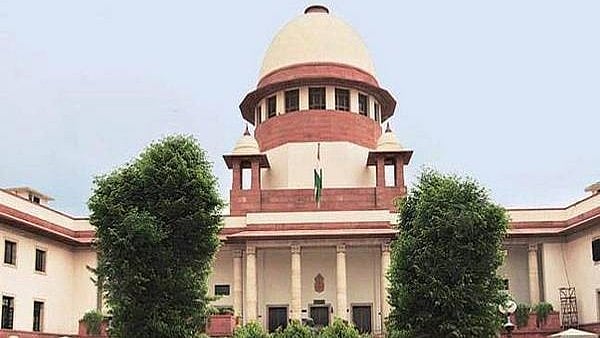
Supreme Court Asks Delhi Govt To Ensure Treatment For Protesters Injured By Pellet Guns, Questions Plea For Blanket Ban | ANI
The Supreme Court on Thursday directed the Delhi Government to ensure proper medical treatment for protesters injured during the July 20 Sansad Chalo demonstration, while indicating that a blanket ban on pellet guns cannot be considered unless the rules permitting their use are specifically challenged.
A Bench of Chief Justice of India (CJI) Surya Kant, Justice Joymalya Bagchi and Justice V Mohan was hearing a public interest litigation filed by former IPS officer and former Intelligence Bureau (IB) Special Director Yashovardhan Azad, along with Prasant Kumar Singh and Sheikh Irshad Mansoori, who alleged they suffered pellet injuries when the Rapid Action Force (RAF) dispersed protesters at Jantar Mantar during a demonstration over alleged exam paper leaks, Live Law and Bar & Bench report.
Court questions blanket ban, seeks focus on rules
Passing an interim order, the Bench directed the Delhi Government to provide adequate medical treatment to the injured petitioners and other similarly placed persons.
The petition seeks a ban on the use of wholly or partly metallic pellet guns for dispersing civilian assemblies, compensation for all those injured in the July 20 incident, and rehabilitation for the victims.
At the outset, Justice Bagchi pointed out that existing police regulations permit the use of pellet guns in exceptional circumstances. He observed that unless the validity of those regulations is challenged, a prayer seeking a blanket prohibition may not be maintainable.
"Police rules allow the use in exceptional circumstances unless you challenge the rules itself. One of the steps of graded approach is use of pellet guns," Justice Bagchi observed.
The CJI also suggested that, in view of the allegations of excessive force, the petitioners may instead seek judicial guidelines governing the use of pellet guns rather than an outright ban.
Referring to an earlier case, the Bench remarked that merely questioning the use of force in one incident would require examining whether law enforcement followed the prescribed graded response before resorting to pellet guns.
Appearing for the petitioners, Advocate Vrinda Grover clarified that the challenge was confined to metallic pellets and not to all less-lethal weapons. She submitted that metallic pellets had been recovered from the bodies of the injured petitioners after surgery.
Grover argued that she could not find any standing order issued by the Delhi Police permitting the use of pellet guns and had to rely on a 2016 document of the Bureau of Police Research and Development (BPRD), obtained through the Right to Information Act. She urged the Court to direct the Union government to place any such standing order on record if it existed.
Solicitor General Tushar Mehta assured the Bench that he would assist the Court and provide any relevant material required.
Treatment, evidence preservation and wider concerns
During the hearing, Grover informed the Court that while one injured petitioner was receiving proper treatment, the other was facing difficulties in obtaining medical care.
Responding to this, Mehta said he would have intervened had the matter been brought to his notice earlier. Grover replied that she was not going to burden the Solicitor General with phone calls. The Bench then orally directed the Solicitor General to ensure the necessary medical assistance, before formally directing the Delhi Government to provide treatment to all similarly placed injured persons.
Grover also requested an interim direction for preserving ammunition logs relating to the incident. She pointed out that the Supreme Court's earlier interim order dated July 28 had directed preservation of CCTV footage, drone and body-camera recordings, and wireless logs, but did not specifically mention ammunition records.
The Solicitor General assured the Court that all material required for investigation, including such records, would be preserved.
Justice Bagchi observed that even a bona fide protest could suddenly turn violent due to infiltration by anti-social elements, making graded responses by law enforcement necessary in certain situations. Mehta added that security personnel are often required to take decisions on the spot depending on how events unfold.
The Court also observed that while peaceful student protests deserve a non-violent response, police forces must be equipped in a manner that minimises the need to resort to such measures. Justice Bagchi remarked that protests could sometimes be hijacked by vested interests, but that law enforcement should still be armed and trained to avoid using force wherever possible.
Mehta agreed that the forces had protective equipment and acknowledged the broader concern.
The Bench ultimately asked the petitioners to amend their plea and directly challenge the rules permitting the use of pellet guns if they wished to pursue the prayer for a ban.
Petition cites serious injuries, constitutional concerns
According to the petition, Singh and Mansoori were among the protesters when RAF personnel allegedly fired a pump-action gun that discharged metallic pellets, causing severe injuries and bleeding. They were taken to Lady Hardinge Medical College, where doctors surgically removed pellets lodged in their bodies. Singh also claimed he saw at least one other person admitted with similar injuries.
Also Watch:
The petition refers to another injured protester, 19-year-old Sahil Lochab, who allegedly suffered a serious eye injury, arguing that the incident demonstrates the grave risks associated with metallic pellets when used against civilian gatherings.
It contends that pellet guns are inherently unsuitable for crowd control because their projectiles spread unpredictably, making it impossible to ensure the least amount of necessary force. Although classified as less-lethal weapons, the petition argues that they can cause fatal or grievous injuries, particularly when fired at close range into crowds.
The petition further argues that the use of metallic pellets violates the constitutional principles of proportionality, necessity and reasonableness. Referring to Section 148 of the Bharatiya Nagarik Suraksha Sanhita, 2023, it states that authorities must first order an unlawful assembly to disperse and should initially rely on civil force before escalating to stronger measures.
The petition also relies on the 2020 UN Guidance on Less-Lethal Weapons in Law Enforcement, which advises against the use of such weapons against crowds.
To support its legal challenge, the petition cites several Supreme Court judgments, including K.S. Puttaswamy v. Union of India, Ramesh Chandra Sharma v. State of Uttar Pradesh, DK Basu v. State of West Bengal, Nilabati Behera v. State of Orissa and Rudul Sah v. State of Bihar.
Apart from seeking a ban or decommissioning of metallic pellet guns for crowd control, the petition seeks exemplary compensation, comprehensive medical treatment, long-term care and rehabilitation for all those injured during the July 20 protest.
A larger debate over policing protests
The hearing underscored a larger constitutional debate over balancing public order with the right to peaceful protest. While the Supreme Court made it clear that allegations of excessive force deserve scrutiny, it also indicated that existing legal provisions governing pellet guns cannot be bypassed. By directing medical treatment for the injured while asking the petitioners to challenge the underlying rules, the Court has signalled that the case could shape future standards on the use of force during civilian protests.
RECENT STORIES
-
-
-
-
-