'Summoning Hotel Records, CDRs To Prove Adultery Does Not Violate Right To Privacy': Supreme Court
The Supreme Court upheld a Delhi High Court ruling that summoning hotel booking records and call detail records to examine allegations of adultery in matrimonial disputes does not violate the right to privacy. The Court said privacy is not absolute and family courts can rely on circumstantial evidence to decide such cases.

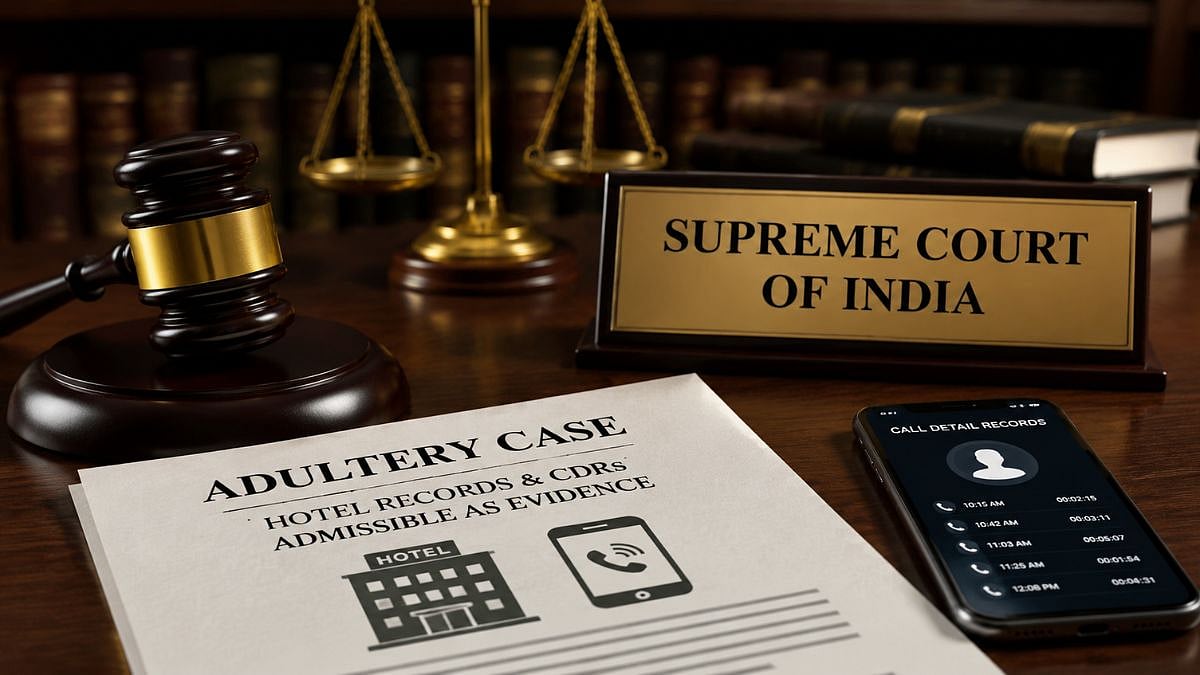
The Supreme Court has upheld the use of hotel records and call detail records as evidence in matrimonial cases involving allegations of adultery | AI Generated Representational Image
New Delhi, July 4, 2026: The Supreme Court on July 2 upheld a Delhi High Court judgment holding that directing the production of hotel booking records and call detail records (CDRs) to establish a charge of adultery in matrimonial proceedings does not violate the right to privacy.
A Bench of Justices Manmohan and K. Vinod Chandran affirmed the May 10, 2023, judgment of the Delhi High Court, which had rejected a husband's challenge to a family court order directing the production of records from a Jaipur hotel where he was alleged to have stayed with another woman, as well as the CDRs of two mobile numbers belonging to him. The dispute arose from a divorce petition filed by a woman alleging cruelty and adultery by her husband, Bar & Bench reported.
Privacy Right Not Absolute
The High Court Bench headed by former Justice Rekha Palli had held that while the right to privacy is a fundamental right, it is not absolute and is subject to reasonable restrictions when required in the larger public interest.
“The Hindu Marriage Act specifically recognises adultery as a ground for divorce and therefore, it would not at all be in public interest that the Court should, on the ground of right to privacy, come to the aid of a married man who, during the subsistence of his marriage, is alleged to have indulged in sexual relationships outside his marriage,” the High Court had observed.
According to the wife, her husband had stayed at a hotel in Jaipur with another woman and her daughter. She sought production of the hotel's booking records and the husband's call detail records, arguing that they were necessary to establish the allegation of adultery.
The husband opposed the request, contending that summoning such records would infringe not only his right to privacy but also that of the other woman. He argued that disclosure of the records would cast aspersions on her reputation and even raise questions regarding the legitimacy and paternity of her minor daughter.
Circumstantial Evidence Permissible
The Delhi High Court rejected this contention and held that direct evidence of adultery is rarely available and matrimonial courts often have to rely on circumstantial evidence. It held that the hotel's reservation records, payment details and identity documents of the occupants would help determine whether the husband had indeed stayed in the same room with a woman other than his wife. Similarly, the call records could indicate whether the frequency and duration of conversations between them were consistent with the wife's allegations.
The High Court also rejected the husband's argument that the family court had permitted a roving or fishing enquiry. “It is not as if the respondent is seeking information about any stranger staying in the hotel; her plea is only for records pertaining to her legally wedded husband, who she has reason to believe is indulging in adultery with a particular lady in a particular room,” the High Court said.
Also Watch:
Supreme Court Affirms View
Justice Palli had further observed that when a spouse seeks the court's assistance in procuring evidence that could materially establish adultery, the court ought to facilitate such evidence. It also relied on Section 14 of the Family Courts Act, which permits family courts to receive evidence that may otherwise not be admissible under the Evidence Act.
The Supreme Court has now affirmed that view, effectively upholding the family court's direction to summon the hotel records and call detail records.
To get details on exclusive and budget-friendly property deals in Mumbai & surrounding regions, do visit: https://budgetproperties.in/
RECENT STORIES
-
-
-
-
-