Pakistan-China Axis: Why Sharif-Xi Renewed Bonhomie Over Kashmir Is India's Ultimate Two-Front Nightmare
Marking the 75th anniversary of diplomatic ties, Pakistani Prime Minister Shehbaz Sharif’s Beijing summit formalised an aggressive new security partnership with China, presenting a two-front threat that directly challenges India’s territorial sovereignty over Jammu and Kashmir

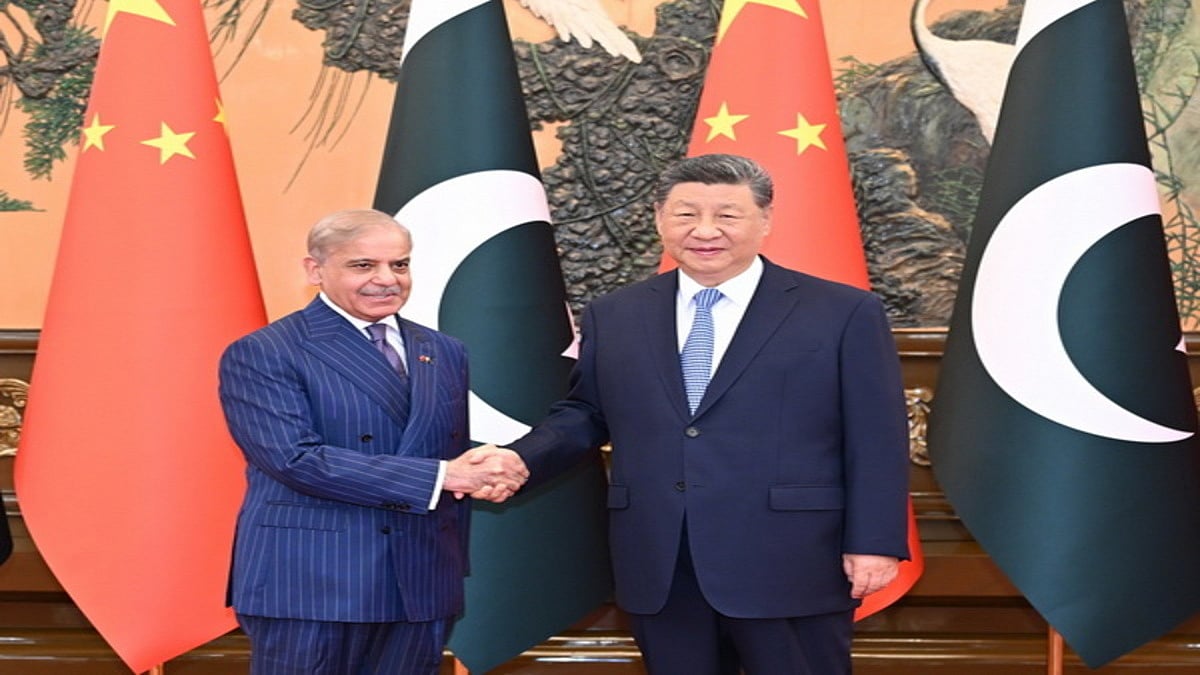
Pakistan Prime Minister Shehbaz Sharif meets Chinese President Xi Jinping in Beijing on May 25, 2026 |
The conclusion of Pakistan Prime Minister Shehbaz Sharif’s visit to Beijing on Tuesday, timed deliberately to celebrate the 75th anniversary of bilateral relations, is a calculated geopolitical provocation that should provoke deep anger and serious alarm in New Delhi. The resulting joint statement is not mere diplomatic boilerplate, it represents an aggressive, highly synchronised assault on India's core territorial sovereignty and national security.
By formalising an intrusive new security framework and openly challenging India's internal administrative decisions, Beijing and Islamabad have signalled a dangerous escalation in their collusion. For New Delhi, this summit is a blunt reminder that its two nuclear-armed neighbours are actively combining forces to cage India within its own subcontinental borders.
Direct diplomatic challenges to sovereignty over Kashmir
The language used in the joint statement regarding Jammu and Kashmir represents an aggressive effort to internationalise an issue that New Delhi maintains is strictly internal and bilateral.
According to a report in Dawn, the Chinese side "reiterated that the Jammu and Kashmir dispute is left over from history, and should be properly and peacefully resolved in accordance with the UN Charter, relevant UN Security Council resolutions and bilateral agreements”.
By formally characterising the region as a historical dispute that must be settled through the United Nations Charter and relevant Security Council resolutions, Beijing is systematically validating Islamabad's geopolitical narrative.
Furthermore, the explicit inclusion of a clause opposing unilateral actions serves as a direct, coordinated rebuke of India’s 2019 decision to abrogate Article 370. This unified rhetorical front is designed to consistently challenge the legitimacy of India's administrative and territorial integrity on the global stage.
“Both sides reiterated opposition to any unilateral actions and reaffirmed the significance of maintaining peace and stability in South Asia, and resolving all outstanding disputes through dialogue and diplomacy,” the joint statement said.
Institutionalising the two-front military threat
The formalisation of a comprehensive China-Pakistan Security Partnership elevates their long-standing strategic alignment into a more dangerous, structured military alliance. For India, this defence architecture hardens the reality of a collusive, simultaneous two-front threat along both the western border and the Line of Actual Control.
By extending unwavering support toward Pakistan's national security and sovereignty, China effectively provides an umbrella of deterrence for Islamabad. This protective diplomatic and strategic shield complicates India's options for conventional retaliation against cross-border terrorism, as any potential escalatory actions must now factor in the structural presence of a major nuclear superpower closely backing Pakistan.
Technological escalation and strategic encirclement
The integration of Pakistan into China's Global Security Initiative introduces advanced asymmetric capabilities into India's immediate neighbourhood, threatening to shift the regional balance of power. Deeper military-to-military cooperation translates directly to the accelerated transfer of sophisticated Chinese hardware, including advanced fighter platforms, naval assets and air defence frameworks. This may push New Delhi into an expensive defence modernisation cycle to preserve its conventional edge.
Evolution of China-Pakistan Economic Corridor
The transition of the China-Pakistan Economic Corridor into a high-quality development phase signals a shift from basic infrastructure connectivity toward deep economic and structural integration. India has consistently opposed this corridor because its layout traverses Pakistan-occupied Kashmir, directly violating Indian territorial claims.
The latest engagements indicate that the project is successfully moving into complex sectors such as mining, digital infrastructure management and agricultural technology. For India, a fragile neighbour presents standard security vulnerabilities, but an adversary whose digital backbones, industrial parks and supply chains are completely hardwired into the world's second-largest economy creates a far more resilient and formidable challenge on its western flank.
Countering coordinated diplomatic manoeuvers in West Asia
A major geopolitical shift emerging from the visit is China's open endorsement of Pakistan’s proactive diplomatic role in the Middle East, particularly Islamabad's mediation efforts during the tense security crisis in West Asia. By backing President Xi Jinping’s four-point peace proposal and highlighting Pakistan's facilitation of temporary ceasefires, Beijing is deliberately elevating Islamabad as a legitimate, stabilising actor in the Gulf and Middle East region.
This presents a direct diplomatic counterweight to India, which has invested immense diplomatic capital in building strong, independent strategic ties with Gulf nations and promoting competing transit projects like the India-Middle East-Europe Economic Corridor.
Strict reciprocity on core geopolitical fault lines
The absolute diplomatic reciprocity displayed during the Beijing summit highlights the durability of this axis, leaving very little room for India to exploit diplomatic divisions.
In exchange for China's sustained economic and territorial backing, Prime Minister Sharif reaffirmed Pakistan's total compliance on Beijing's core sensitivities, including an explicit rejection of any form of Taiwan independence.
This highly institutionalised quid pro quo extends into neighbouring security theatres, with both nations agreeing to maintain tight, exclusive trilateral coordination over the future political trajectory of Afghanistan through dialogue platforms like the Urumqi talks.
Ultimately, this comprehensive alignment demonstrates that New Delhi is no longer dealing with two distinct neighbours, but rather a single, highly integrated Eurasian axis actively working to constrain India's global and regional ambitions.
RECENT STORIES
-
-
-
-
-