Media Cannot Call Suspects 'Mastermind' Or 'Scamster' Before Trial: Patna High Court
The Patna High Court ruled that media organisations may report factual developments in criminal cases but cannot describe suspects as "mastermind", "scamster" or similar terms implying guilt before trial. The Court said such reporting could undermine a fair trial and directed responsible coverage while allowing objective reporting of judicial proceedings.

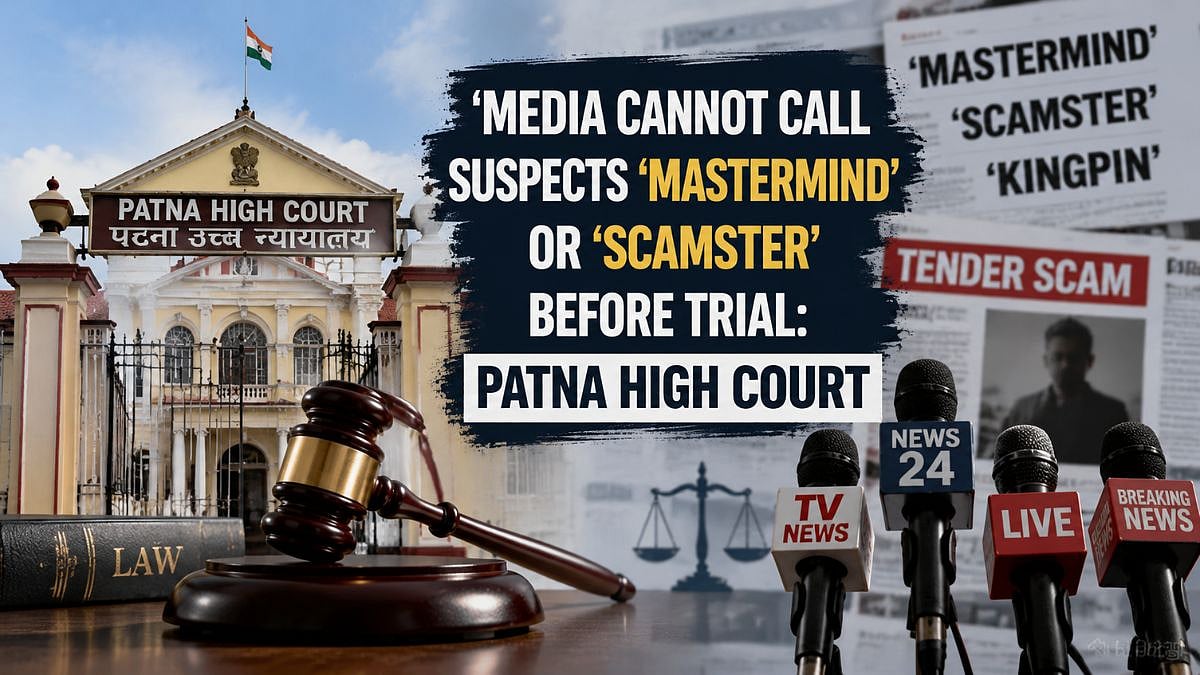
Patna High Court directed media organisations to avoid portraying suspects as guilty before the conclusion of a trial | AI Generated Representational Image
Patna, June 29: The Patna High Court has held that while the media is free to report factual developments in criminal cases, it cannot describe a suspect as a “mastermind”, “scamster”, “kingpin” or use any other expression that suggests guilt before a court has decided the case.
Hearing a petition filed by Rishu Shree, the Court said an individual’s right to a fair trial must be protected and warned against media coverage that effectively declares a person guilty even before judicial proceedings are completed. The order was passed in Rishu Shree v State of Bihar.
Fair Trial Comes First
In its order dated June 24, Justice Ansul observed that news organisations cannot conduct a “media trial” that undermines the right to a fair hearing. The Court said prejudging a person's guilt can damage their reputation even before a court reaches any conclusion.
“Maligning the image of a person who is yet to be held guilty may come within the ambit of a defamatory act, immoral act or even an indecent act. This is pre-judging the issue when the matter is sub judice,” the Court observed.
The observations came while the Court was hearing Shree's plea seeking the quashing of a First Information Report (FIR) registered by the Bihar Special Vigilance Unit (SVU) in connection with an alleged tender scam.
Questions Over Media Coverage
According to the petition, the FIR was registered on April 30, 2025, while raids at Shree's residence were conducted more than a year later, on May 27, 2026, when he was arrested.
Senior Advocate Nandita Rao, appearing for Shree, argued that although nothing incriminating was recovered during the searches, television channels, newspapers, online news portals and social media platforms portrayed him as guilty. The petition also stated that prime-time television debates publicly condemned him before the trial, creating prejudice and potentially influencing witnesses.
The Court examined several media reports placed on record. These included headlines about the Enforcement Directorate (ED) probe, searches linked to the alleged tender scam, and reports claiming that Shree had built a network to secure government tenders through commissions.
Press Freedom Has Limits
The Court noted that similar content had spread widely on social media, with Shree being portrayed as guilty before the trial had even begun. It reiterated that freedom of speech and expression under Article 19(1)(a) of the Constitution is subject to reasonable restrictions.
Referring to Supreme Court judgments in State of Maharashtra v Rajendra Jawanmal Gandhi, M.P. Lohia v State of West Bengal and Sahara India Real Estate Corporation Ltd. v SEBI, the High Court said there must be a balance between press freedom and a suspect's right to a fair trial.
The Court also recorded that counsel appearing for the ED had expressed concern over the growing trend of media trials.
Court Restrains Irresponsible Reporting
While declining to impose a complete ban on reporting, the Court said irresponsible reporting that imputes guilt cannot be permitted.
“Having seen both sides of the coin, this Court is clearly not in a view of media gag over the issue. However, the Court would certainly direct for control over irresponsible reporting and imputation of guilt upon the petitioner without any initiation of trial at all,” the order said.
The Court directed that media organisations may continue reporting factual developments and court proceedings. However, they have been restrained from describing Shree as guilty, portraying him as having committed the alleged offences, publishing or broadcasting material that determines his criminal liability, using expressions such as “mastermind”, “scamster”, “kingpin” or similar terms conveying criminal responsibility, and conducting media trials based on alleged confessions, investigation material or unproved documents whose evidentiary value has not yet been determined.
At the same time, the Court clarified that its directions do not prohibit fair, accurate and objective reporting of court proceedings or factual developments in the case.
Also Watch:
ALSO READ
Delay In Probe Questioned
Apart from issuing directions to the media, the Court also sought an explanation from the Special Vigilance Unit over the one-year gap between the registration of the FIR and the raid at Shree's residence. It also directed the ED to file its counter affidavit. The matter has been listed for further hearing on July 10.
RECENT STORIES
-
-
-
-
-