'Listen To Them, Understand Why They Are Shouting': Supreme Court On Student Protests Over Paper Leak Demonstrations
The Supreme Court urged authorities to listen to and counsel student protesters instead of responding with aggression while hearing petitions related to paper leak demonstrations. The Bench tagged a fresh plea seeking accountability from protest organisers with pending cases and stressed that police should exercise restraint to prevent violence while maintaining public order.

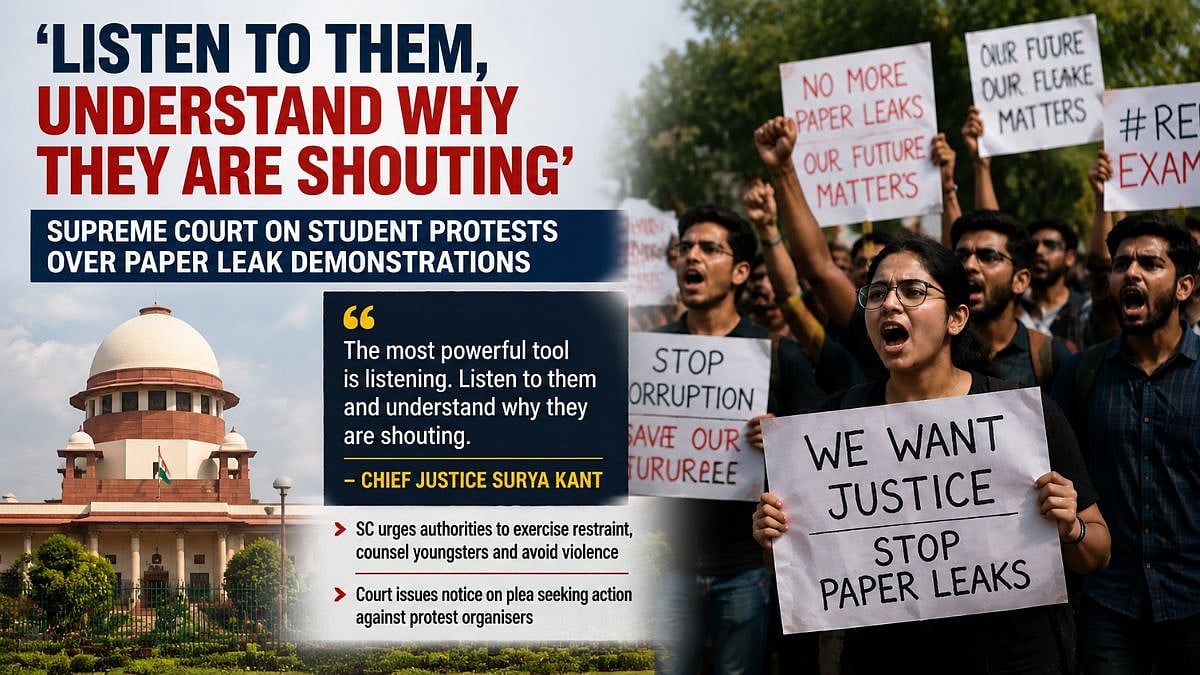
The Supreme Court emphasised listening to and counselling student protesters while hearing petitions linked to paper leak demonstrations | AI Generated Representational Image
New Delhi, August 5, 2026: The Supreme Court on Wednesday said authorities should listen to protesting youngsters and exercise restraint, observing that counselling and dialogue could prevent demonstrations from escalating into violence.
A Bench of Chief Justice of India Surya Kant, Justice Joymalya Bagchi and Justice V. Mohana was hearing petitions arising from student protests over repeated question paper leaks.
The court issued notice on a plea seeking accountability from protest organisers and tagged it with other pending petitions concerning the demonstrations, Live Law and Bar & Bench reported.
Court Urges Dialogue
“We need to tread carefully so that these youngsters do not indulge in violence. The better course is to counsel them and pacify them. The most powerful tool is listening. Listen to them and understand why they are shouting,” Chief Justice Kant said.
The court stressed that police should exercise restraint during demonstrations to ensure situations do not spiral out of control. It also said decisions on handling protests should be left to law enforcement agencies.
The protests began in June following a call by the online collective Cockroach Janta Party (CJP), which demanded the resignation of then Union Education Minister Dharmendra Pradhan over repeated question paper leaks.
The demonstrations culminated in a Sansad Chalo march towards Parliament on July 20 despite Delhi Police saying permission had not been granted.
Clashes broke out during the march, with allegations that police used disproportionate force, including lathi charges, tear gas and pellet guns. Pradhan resigned on July 25 and the protests were subsequently called off.
Questions Over Organisers
One of the pleas sought action against organisers for their alleged role in the July 20 demonstrations, arguing that accountability could not be limited to the government and police.
Advocate Rizwan Ahmed, appearing for petitioner Maneesh Kumar Solanki, questioned why protest organisers had not faced similar scrutiny.
“Where is the accountability of the so-called organisers? I am saying so-called organisers because it is not a registered organisation,” Ahmed submitted.
He argued that withdrawing criminal cases against protesters solely on the basis of a political understanding could set a dangerous precedent for future demonstrations.
“Tomorrow, Generation Alpha, Beta, Delta will come,” Ahmed said, arguing that other groups could similarly attempt to march towards Parliament.
Ahmed also raised security concerns over the July 20 march, saying authorities could not have known whether anyone in the crowd was carrying weapons.
Restraint And Accountability
Chief Justice Kant cautioned that an aggressive response from the State could aggravate tensions and lead to further violence.
“These are youngsters. They need a lot of advisory consulting. Any aggression coming from the other side in the name of the mighty State may also unnecessarily aggravate the situation and precipitate further violence. That needs to be avoided,” he said.
The observation reflects the central issue before the court: maintaining public order while ensuring that the response to young protesters does not itself worsen the situation.
Ahmed clarified that he was not seeking coercive punishment for minors and proposed supervised community service for those who allegedly used abusive slogans. However, he argued that “stone-pelters cannot be allowed to go scot-free just because the government was caught on the wrong foot”.
Plea Challenges Case Withdrawal
The Supreme Court had on July 28 directed that no coercive action be taken against protesters and ordered the immediate release of minors detained by police. On August 3, it clarified that first information reports (FIRs) registered against protesters could be withdrawn.
The public interest litigation seeks identification, through videos, photographs and other credible evidence, of juveniles and adults who allegedly used abusive, derogatory or defamatory language against police and security personnel during the protests.
It also seeks supervised community service for those identified, without prejudice to criminal proceedings.
The petitioner has further sought a declaration that the Union Government or State Governments cannot grant blanket pardons or amnesty, or withdraw riot-related prosecutions merely on the basis of political agreements.
Also Watch:
ALSO READ
Pending adjudication, the plea seeks to restrain the Union Government, States and Union Territories from withdrawing prosecutions arising from the June-July 2026 protests, or similar riot-related incidents, solely on the basis of political agreements.
The court tagged the matter with the other pending petitions concerning the student protests.
To get details on exclusive and budget-friendly property deals in Mumbai & surrounding regions, do visit: https://budgetproperties.in/
RECENT STORIES
-
-
-
-
-