'Employees Cannot Claim Non-Receipt Of Notices Sent To Their Own Declared Address': Supreme Court
The Supreme Court has held that employees cannot claim non-receipt of official notices sent to the address they provided to their employer. Setting aside orders granting reinstatement and back wages, the court found that the employee failed to update his address, remained absent without authorisation, and produced no documentary evidence to support his explanation for the absence.

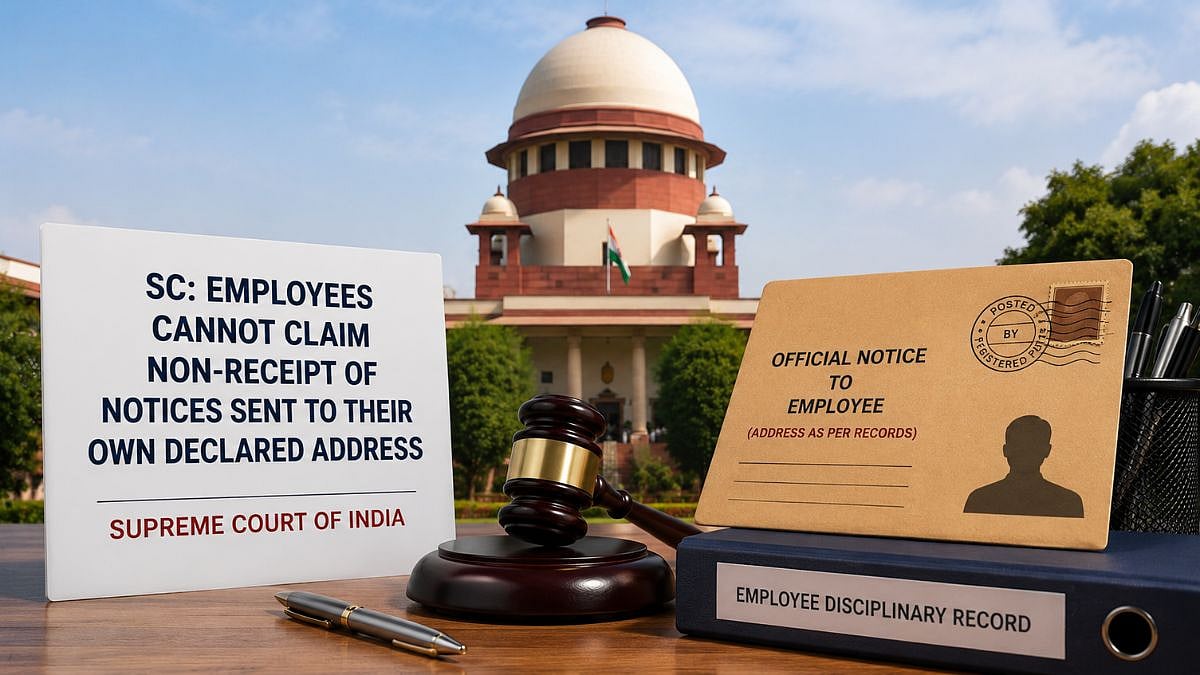
Supreme Court ruled that employees must update employers about address changes and cannot dispute notices sent to recorded addresses | AI Generated Representational Image
New Delhi, June 22: In a significant ruling on employee responsibility and workplace discipline, the Supreme Court has held that an employee cannot claim non-receipt of an official notice if it was sent to the address provided by him and he failed to inform the employer about a change in residence.
The judgment came while setting aside a Labour Court award that had directed the reinstatement of an employee with back wages. The top court said an employee who remains absent without authorisation and fails to support his claims with evidence cannot seek relief based on unverified assertions, Live Law reported.
A Bench of Justice Vikram Nath and Justice Sandeep Mehta observed that an employer can only be expected to communicate with an employee at the address available in its records. If an employee changes residence, it is his responsibility to inform the employer.
“An employer can only be expected to communicate with an employee at the address the employee has provided. If the respondent-employee had changed his place of residence, the obligation to inform his employer of the change rested on him. He cannot be permitted to take advantage of his own omission in this regard,” the court said.
Employee's Absence Under Scrutiny
The case involved an employee who remained absent from work without authorisation for about 24 days. During this period, the employer sent a show-cause notice to his permanent residential address in Bihar, asking him to explain his absence and warning that strict action could follow.
However, the employee was living in Noida at the time and claimed that he never received the notice. The court noted that he had not updated his current address with the company, resulting in the notice remaining unanswered.
The dispute later escalated when the employee attempted to rejoin duty after the 24-day absence but was allegedly prevented from doing so by the company. He claimed that he had informed his superior verbally and had stayed away from work because his mother was unwell.
Evidence Matters, Says Court
The company's refusal to allow him to resume work eventually led to litigation. The Allahabad High Court later directed the company to reinstate him with back wages, following which the company approached the Supreme Court.
While overturning the earlier relief granted to the employee, the Supreme Court accepted the company's argument that the employee had remained absent without authorisation and had failed to produce any documentary evidence to support his claim regarding his mother's illness.
The court observed that there was no material on record to show that he had stayed away from work to care for his ailing mother. It also pointed out that he had not sent any written communication to the employer during his absence seeking leave or explaining the circumstances.
“The respondent-employee claims that his absence was due to his mother's serious illness and that he had verbally informed his superior before leaving. This claim is entirely unsubstantiated. No documentary evidence has been placed on record in support of it,” the Bench noted.
Relief Denied Without Proof
The court further said that if the explanation had been genuine, the employee could have sent a letter or any other written intimation to the employer. Having failed to do so, he could not rely solely on an oral claim to justify his unauthorised absence.
In its final findings, the Bench held that the employee had neither provided documentary proof explaining his absence nor produced evidence showing any attempt to rejoin duty. Consequently, it ruled that both the Labour Court and the High Court erred in granting relief in the absence of supporting evidence.
Also Watch:
ALSO READ
The ruling underscores the importance of maintaining proper communication with employers and highlights that courts may be reluctant to accept claims that are not backed by documentary proof.
To get details on exclusive and budget-friendly property deals in Mumbai & surrounding regions, do visit: https://budgetproperties.in/
RECENT STORIES
-
-
-
-
-