Delhi HC Allows Sonam Wangchuk’s Shift To Medanta, Says Move Protects His Fundamental Rights
The Delhi High Court on Tuesday allowed activist Sonam Wangchuk’s transfer from Safdarjung Hospital to Medanta Hospital in Gurugram during his hunger strike. The Bench considered medical reports from Safdarjung, AIIMS and doctors before ordering the move for continuous monitoring and treatment. The Centre had no objection to the transfer, while Wangchuk was directed to cooperate.

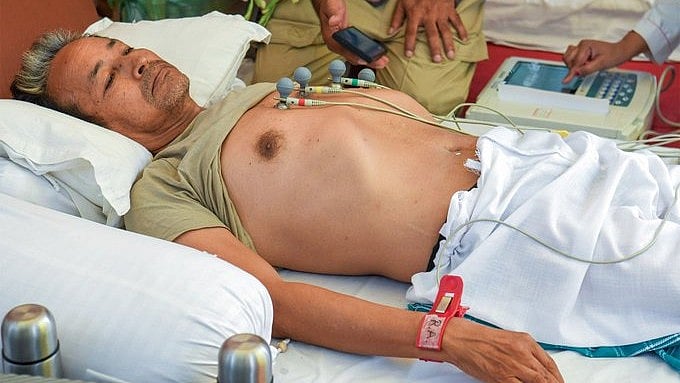
Educationist Sonam Wangchuk | X - @ani_digital
The Delhi High Court on Tuesday allowed activist Sonam Wangchuk to be shifted from Safdarjung Hospital to Medanta Hospital in Gurugram, observing that the move would safeguard his fundamental rights while ensuring he receives constant medical monitoring during his ongoing hunger strike.
A Division Bench of Chief Justice Devendra Kumar Upadhyaya and Justice Tejas Karia passed the order while hearing an appeal filed by Wangchuk's wife, Gitanjali Angmo, against a single judge's refusal to permit his transfer to a private hospital. The Bench directed that Wangchuk be immediately shifted to Medanta, where a specialised team of doctors will continuously monitor his condition and administer treatment according to accepted medical protocols. The Court also directed Wangchuk to cooperate with the medical team and follow the treatment advised, Live Law and Bar & Bench report.
Court Balances Personal Choice With Medical Need
The Bench said the decision was taken after examining medical records from Safdarjung Hospital, the All India Institute of Medical Sciences (AIIMS) and a private laboratory, besides hearing doctors from all sides in court. It noted that there was broad agreement among medical experts that Wangchuk required constant monitoring because of changes in his health parameters, particularly his low potassium level and low total leukocyte count (TLC).
"Having regard to the submissions made, the opinion expressed by the doctors present and the concerns raised by them, we are of the opinion that the husband of the appellant ought to be shifted to a hospital of his choice," the Court said.
The judges observed that shifting Wangchuk to Medanta would fulfil the requirement of protecting his fundamental rights under Articles 19 and 21 of the Constitution. The Court also accepted the Centre's submission that it had no objection to the transfer.
It further directed that Angmo must be allowed unrestricted access to her husband during his hospitalisation, subject only to medical protocols.
"So far as access to the appellant to her husband during the course of hospitalisation, she shall be allowed to visit her husband as she desires," the order stated.
During the hearing, the Bench also told Angmo's counsel, Senior Advocate Akhil Sibal, that its concern was limited to Wangchuk's health.
"Please cooperate. Court's concern is only with his health. Nothing to do with all that is going on," the Bench remarked.
Doctors Flag Health Concerns As Court Weighs Medical Evidence
The hearing saw extensive discussions on Wangchuk's medical condition after doctors from Safdarjung Hospital, AIIMS and his personal medical team appeared before the Bench.
Justice Karia noted from the reports that Wangchuk's potassium levels had fallen. Solicitor General Tushar Mehta argued that clinical observations should be given greater weight than laboratory reports.
The Chief Justice questioned doctors about Wangchuk's raised urea and uric acid levels, asking whether they indicated any organ malfunction. A doctor explained that such changes were expected during prolonged fasting because the body begins breaking down fat for energy, resulting in ketones in the urine.
Additional Solicitor General Chetan Sharma highlighted that one report described Wangchuk's TLC as "critical". Doctors from AIIMS told the Court that Wangchuk's white blood cell count, haemoglobin and platelet levels were below normal, indicating reduced immunity.
The AIIMS Director informed the Court that Wangchuk was receiving oral potassium replacement therapy. The doctor added that because his ability to fight infections had been significantly weakened, visitors were required to wear protective gowns, caps and masks before meeting him.
Sibal argued that although some medical parameters had changed, Wangchuk's vital signs remained stable and continuous monitoring could continue at Medanta. He also submitted a letter from Wangchuk alleging that his phone had been taken away and visitors were being subjected to searches and surveillance at Safdarjung Hospital.
After interacting with the doctors, the Bench said that while it was not composed of medical experts, it found a clear consensus that constant monitoring was essential. It therefore proposed shifting Wangchuk to the hospital of his choice.
Mehta reiterated that the government had no objection to the transfer but urged that Wangchuk should not seek discharge against medical advice. The Court, however, declined to examine those concerns, remarking, "We will not go into all that. Do not drag the court into all that."
Background Of The Dispute
Wangchuk has been on an indefinite hunger strike at Delhi's Jantar Mantar since June 28 in solidarity with the Cockroach Janta Party (CJP)-led student movement demanding accountability for repeated examination paper leaks and the resignation of Union Education Minister Dharmendra Pradhan.
On July 18, Delhi Police removed him from the protest site and shifted him to Safdarjung Hospital, citing concerns over his deteriorating health. Angmo approached the High Court the following day, alleging that her husband was being kept at the hospital against his wishes and that the family had lost confidence in the treatment due to a lack of transparency regarding his medical reports. She also claimed his continued stay amounted to illegal detention.
On July 19, a single judge declined to interfere, holding prima facie that the decision to move Wangchuk from Jantar Mantar to Safdarjung Hospital was not arbitrary and refusing interim relief. Angmo then challenged that order before the Division Bench.
ALSO READ
Her appeal argued that the earlier order effectively deprived Wangchuk of his right to decide where he should receive treatment. It contended that Article 21 guarantees a competent adult the right to refuse medical treatment and choose the hospital where treatment is provided, and that his continued stay at Safdarjung without consent violated his personal liberty, bodily autonomy and right to protest.
During an earlier hearing on July 20, the Division Bench had directed Safdarjung Hospital to submit all pathological reports, including those prepared by AIIMS and a private laboratory, while asking Angmo to place her medical records on record. The Court had also directed all treating doctors to remain present during Tuesday's hearing.
After considering all submissions, the Bench disposed of the appeal, directing Wangchuk's immediate transfer to Medanta Hospital, where he will remain under continuous medical supervision while retaining the right to receive treatment at a hospital of his choice.
RECENT STORIES
-
-
-
-
-