'Daily-Wage Status Cannot Deny Annual Increment After Regularisation': Supreme Court
The Supreme Court has ruled that workers initially appointed as daily wagers cannot be denied an annual increment after being regularised and granted permanent status, regular pay scales and retirement benefits. The Court directed authorities to calculate and release the applicable dues within 30 days, with 6% interest applicable in case of delay.

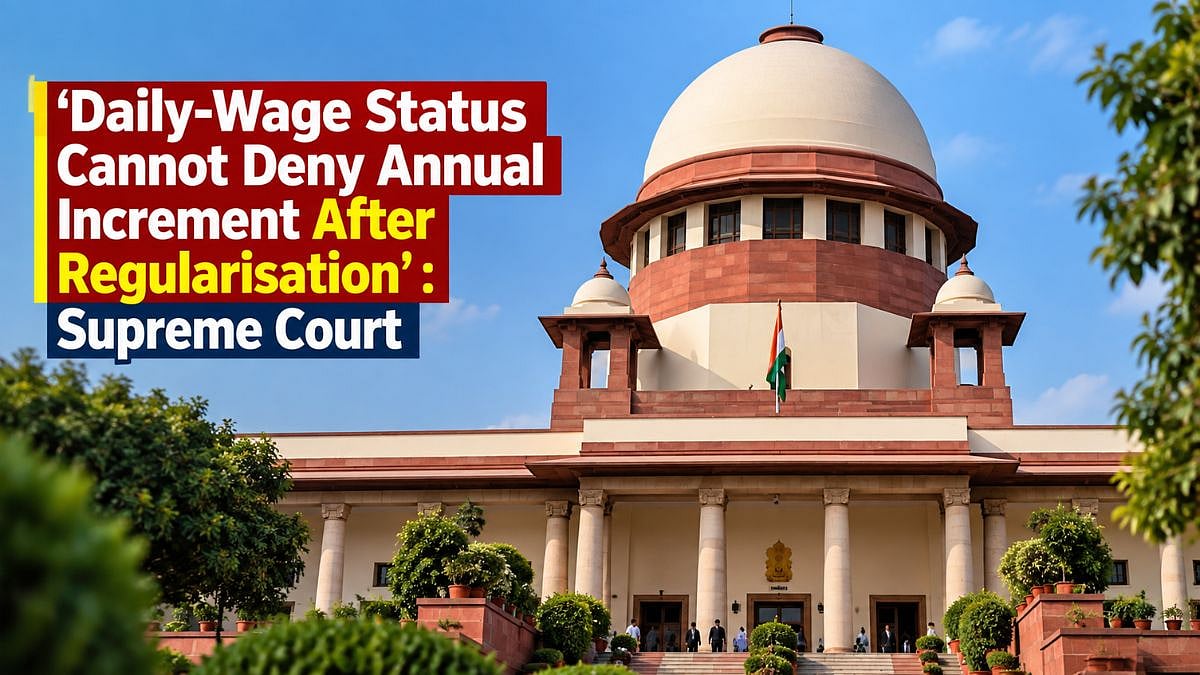
The Supreme Court has upheld the increment and pension entitlement of workers who were regularised after beginning their service as daily wagers | AI Generated Image
October 6, 2026: The Supreme Court has held that skilled workers who were initially engaged as daily wagers cannot be denied an annual increment after they were treated as permanent employees and granted regular pay scales and retirement benefits under a government resolution.
A bench of Justices Sanjay Kumar and Sanjeev Sachdeva set aside a Gujarat High Court Division Bench judgment and rejected the Gujarat government’s argument that the retired employees were not entitled to the increment because they had originally been appointed as daily-wage workers, Live Law reports.
Regularisation Changes The Equation
The Supreme Court relied on the Gujarat government’s October 17, 1988, resolution, under which daily-wage skilled workers who completed the prescribed 10 years of service were treated as permanent employees. They were also granted regular pay scales, allowances, pension and other retirement benefits.
The court noted that the state did not dispute that all the petitioners fell within this category. It said the argument that they could be denied the increment solely because they were originally daily wagers ignored the 1988 resolution and the benefits flowing from it.
The ruling underlines a straightforward principle: once workers have been brought within a regular employment framework and given the corresponding service benefits, their earlier daily-wage status cannot by itself be used to take those benefits away.
What Led To The Dispute?
The appellants had worked in the Gujarat Irrigation Department for more than 30 years and retired on June 30 in different years. Their dispute centred on the annual increment that became due on July 1, a day after their retirement.
A Single Judge of the Gujarat High Court had accepted their claim on the basis of the Supreme Court’s 2023 ruling in Director (Administration and Human Resources), KPTCL v. C.P. Mundinamani. In that case, the Supreme Court held that government employees could not be denied an annual increment merely because they retired the day after earning it.
The Single Judge had also ordered payment of arrears and consequential revision of pension and retirement benefits.
The state challenged the ruling before a Division Bench. It argued, for the first time, that the employees were daily wagers and therefore could not claim the benefit recognised in C.P. Mundinamani.
The Division Bench accepted the state’s contention and set aside the Single Judge’s order. The retired employees then approached the Supreme Court.
Supreme Court Backs Retired Workers
Allowing their appeal, Justice Sanjay Kumar, who authored the judgment, observed that the employees’ right to claim the increment was no longer res integra, meaning the legal question had already been settled.
The court relied on C.P. Mundinamani and the subsequent ruling in Union of India and another v. M. Siddaraj. The two decisions established the entitlement of employees retiring on June 30 to have the annual increment falling due on July 1 considered for pension purposes.
The monetary benefit, however, is subject to the Supreme Court’s subsequent directions in the M. Siddaraj proceedings.
Three Years’ Enhanced Pension
In February 2025, the Supreme Court restricted the retrospective monetary benefit available under the earlier ruling. Under modified Clause (d), a retired employee who had approached a court or tribunal could receive enhanced pension after including one increment for the three years preceding the month in which the proceeding was filed.
The appellants had approached the Gujarat High Court in 2022. The Supreme Court, therefore, held that they were covered by the modified direction.
“As it is an admitted fact that the appellants filed their writ petition in the year 2022 itself, they would be covered by the modified clause (d), which provided that enhanced pension, by including one increment, would be payable for the period of 3 years prior to the month in which the writ petition was filed,” the court said.
It added that the appellants were consequently entitled to the increment and pension calculated after taking that increment into account.
The decision provides clarity for workers whose employment began on a daily-wage basis but who later acquired permanent status and regular service benefits. The key consideration, the ruling indicates, is the employment status and benefits granted under the applicable government resolution rather than merely the nature of the worker’s original appointment.
Payment Within 30 Days
The Supreme Court directed the authorities to calculate and release the amounts payable to the appellants within 30 days. If the authorities fail to meet the deadline, the amount will carry interest at 6% from the date of default.
The appeal was accordingly allowed.
Also Watch:
ALSO READ
The petitioners were represented by advocates CB Gururaj, Pragya Smriti, Hari Abishek P, Srishti, Naveen Chandrashekar and KP Singh, with Gururaj & Nayak as advocate-on-record.
Additional Solicitor General Archana Pathak Dave appeared for the respondents along with advocate-on-record Deepanwita Priyanka and advocate Priyal Sheth.
To get details on exclusive and budget-friendly property deals in Mumbai & surrounding regions, do visit: https://budgetproperties.in/
RECENT STORIES
-
-
-
-
-