Centre Caps Cancer Drug Trade Margins At 30 Per Cent, Supreme Court Questions High Prices Of Other Medicines
The Centre has informed the Supreme Court that trade margins on anti-cancer drugs are capped at 30% of MRP. The Bench questioned why similar controls were not being considered for other medicines and medical devices, citing price differences involving cardiac stents, azithromycin and saline drip lines. The court will hear the matter again on October 27.

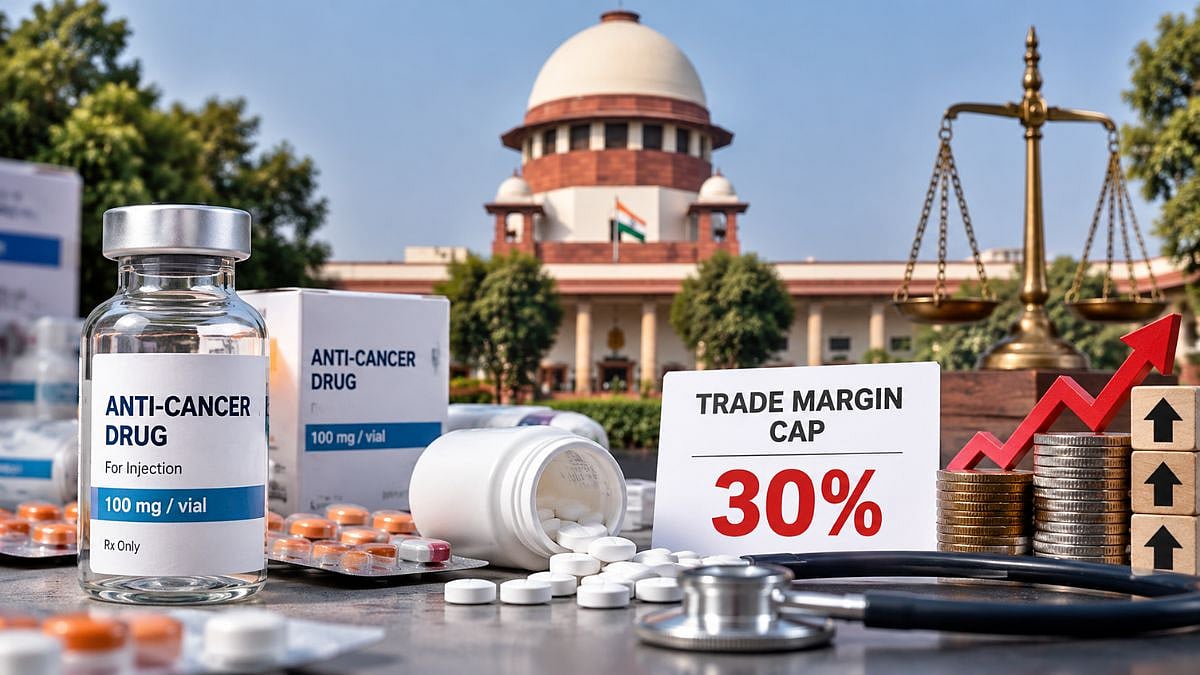
The Supreme Court has pressed the Centre to explain steep price differences in medicines and medical devices despite existing price-control measures | AI Generated Image
New Delhi, October 12, 2026: The Central government informed the Supreme Court on Monday, October 12, that it has capped trade margins on anti-cancer drugs at 30% of the maximum retail price (MRP). The move comes weeks after the top court raised serious concerns over the steep prices of cancer medicines and the profits made on their sale.
However, a Bench of Justices Vikram Nath and Sandeep Mehta questioned why the government had restricted the measure to cancer drugs when several commonly used medicines and medical devices also carry high profit margins.
The court’s observations brought attention to the wider issue of medicine affordability and whether existing price controls adequately protect patients, Bar & Bench reported.
Court Flags Huge Gaps in Medicine Prices
During an earlier hearing, the Supreme Court had highlighted an instance in which a cancer medicine priced at ₹2,700 carried an MRP of ₹27,000. The court had described the difference as “broad daylight dacoity” and raised concerns over fraud involving public health schemes.
At Monday’s hearing, the government informed the court that it had addressed the pricing issue concerning cancer medicines. The Bench, however, questioned why similar measures were not being considered for other medicines and medical devices, particularly those used in routine treatments.
Cardiac Stent Prices Come Under Scrutiny
The judges cited the example of an Indian-made cardiac stent, pointing out that its price to the retailer was ₹5,000 while its MRP stood at ₹25,000. The Bench suggested that limiting such margins could significantly reduce unnecessary medical interventions driven by financial incentives.
The court observed, “You put a cap of 16 percent and you will reduce medical interventions by three-fourths. Doctors cause interventions to be done because the margins are so high.”
Solicitor General Tushar Mehta informed the Bench that cardiac stent prices were already capped. However, the judges continued to question the large differences between wholesale and retail prices of other commonly used medical products.
Antibiotics and Medical Supplies Also Questioned
The Bench referred to the antibiotic azithromycin, which had an MRP of ₹78.29 despite its price to the stockist being ₹28.50. It also cited a saline drip line while questioning pricing practices in the medical supplies market.
“Azithromycin, MRP ₹78.29, PTS (Price to Stockist) ₹28.50. Tell us one beneficial reasoning for the patient,” the Bench asked.
The judges also referred to a drip line for saline, citing prices of ₹11 and ₹270, and questioned how manufacturers and sellers determined such widely differing prices.
Petition Seeks Wider Price Controls
The Supreme Court was hearing a petition filed by Kishan Chand Jain seeking mandatory prescriptions of generic medicines, stricter initial price controls on non-scheduled drugs and MRP caps on medical devices.
Jain had earlier submitted that under the Drug Price Control Order (DPCO) of 2013, the National Pharmaceutical Pricing Authority (NPPA) fixes ceiling prices for only around 1,000 scheduled medicines. According to his submission, nearly 82% of medicines available in the market remain outside this category.
The figures raised an important question before the court about the extent of government regulation and whether patients receive adequate protection against high medicine prices.
Centre Warns Against Excessive Regulation
Additional Solicitor General Aishwarya Bhati defended the government’s approach, arguing that medicine pricing requires a balance between affordability, availability and market forces.
“We don’t want to control the entire ecosystem of drugs. India already has amongst the lowest prices of medicines. If there is too much intervention by the government, then it will lead to the market getting suffered. It will affect availability,” Bhati submitted.
The Bench remained unconvinced and questioned whether existing price controls had affected the availability of regulated medicines.
“Give us one justification where there is a concern shown for patients. You are giving a 16 percent margin on DPCO. Do the DPCO controlled medicines not reach the consumers?” the court asked.
Government to Update Cancer Drug List
Mehta informed the court that the Centre would announce a list of approved cancer medicines covered by the 30% trade margin cap. The list would be updated periodically, while inexpensive formulations would remain outside its scope.
Senior Advocate Kapil Sibal, appearing for the Indian Pharmaceutical Alliance, argued that such high mark-ups were not common across the majority of drug formulations.
Also Watch:
The hearing highlighted the challenge of keeping medicines affordable without affecting their availability. While the government has introduced a margin cap for cancer drugs, the court’s questions have brought the pricing of other essential medicines and medical devices into focus.
The Supreme Court will hear the matter next on October 27.
To get details on exclusive and budget-friendly property deals in Mumbai & surrounding regions, do visit: https://budgetproperties.in/
RECENT STORIES
-
-
-
-
-