'Breakup, Refusal To Marry Do Not Automatically Amount To Abetment Of Suicide': Supreme Court
The Supreme Court has ruled that a breakup or refusal to marry does not automatically constitute abetment of suicide. Quashing proceedings against six people, the court said criminal liability requires evidence of intentional instigation or knowledge that refusal to marry would lead to suicide.

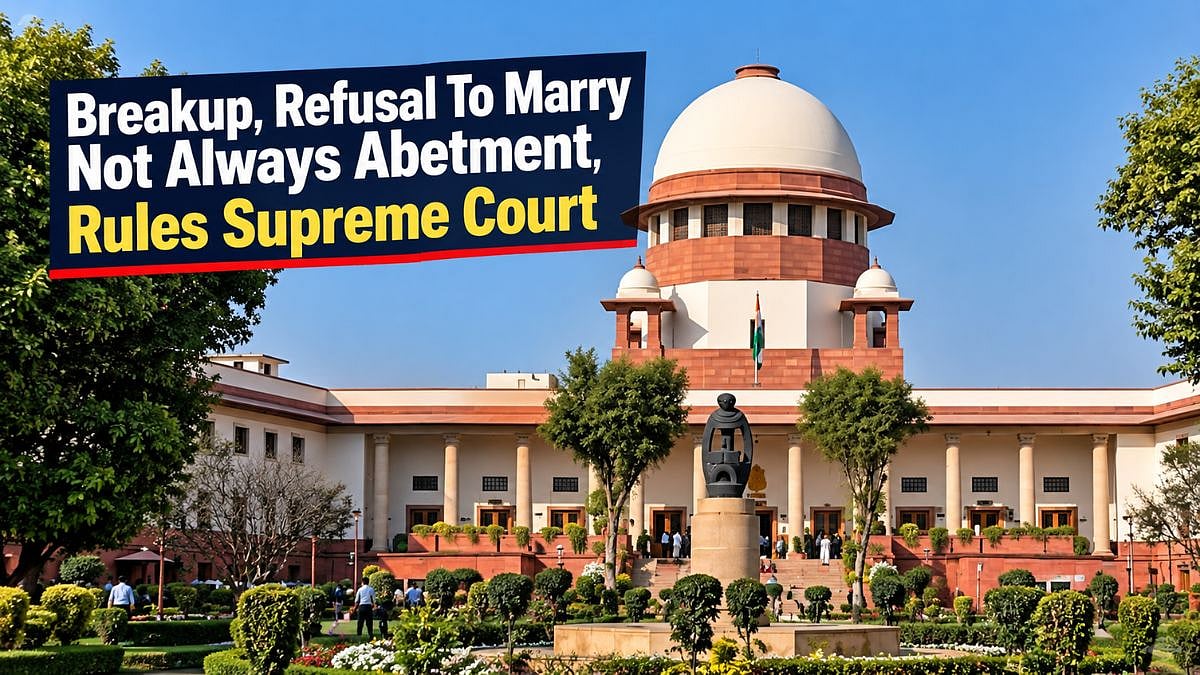
The Supreme Court said criminal liability for suicide requires evidence of intentional instigation, not merely the end of a relationship | AI Generated Image
New Delhi, October 8, 2026: The Supreme Court quashed criminal proceedings against six people, observing that refusing to marry a live-in partner does not automatically amount to abetment of suicide unless there is evidence of intentional instigation.
The Supreme Court has ruled that a breakup or refusal to marry, even if followed by suicide, cannot automatically be treated as abetment of suicide.
The court said that people react differently to difficult situations and that a person cannot be held criminally responsible for another’s suicide merely because a relationship ended, Live Law and Bar & Bench report.
A bench of Justices JB Pardiwala and K Vinod Chandran made the observations while quashing criminal proceedings against six people, including a woman's former partner and his family members.
The court found no evidence that the suspects had deliberately instigated the woman to take her own life or knew that refusing marriage would lead to her suicide.
What Led To The Case?
The case arose from a First Information Report (FIR) registered in 2022 under Section 306, read with Section 34, of the Indian Penal Code (IPC), relating to abetment of suicide with common intention. The complaint was based on a statement given by the deceased woman's sister.
According to the prosecution, the woman and her partner were childhood friends who later entered into a consensual relationship. They lived together at his residence for around three months, and his family had accepted their relationship. The man had also proposed marriage, which the woman and his family initially accepted.
Opposition To Marriage And Woman's Death
The prosecution alleged that the relationship deteriorated after the man's friend spoke ill of the woman and his sister's prospective husband opposed the marriage. His parents, sister and others allegedly pressured him to end the relationship, following which he refused to marry her.
The woman subsequently told her eldest sister over the phone that her partner had refused to marry her and that she would end her life if the marriage did not take place the following day.
According to the prosecution, an altercation later occurred at the man's residence, after which the woman allegedly locked herself in a room and died by suicide.
Trial Court And High Court Rejected Plea
The six suspects, including the woman's partner, his parents, sister, a friend and his sister's prospective husband, sought discharge from the criminal case. However, the trial court rejected their plea in December 2024.
The Telangana High Court also dismissed their revision petition in February 2026, observing that the disputed facts required a full trial. The suspects subsequently approached the Supreme Court, challenging the continuation of criminal proceedings against them.
What Did The Supreme Court Say?
The Supreme Court examined the allegations and found that even if the complainant's version was accepted, there was no material to establish that the suspects had instigated the woman to die by suicide.
“People react differently to situations and if a breakup ends up with suicide, it cannot always be termed an abetment to suicide,” the court observed.
The bench also made it clear that refusing marriage, without an intention to cause suicide or knowledge that such a consequence would follow, was insufficient to establish the offence.
“The refusal to marry was not with an intention to drive the woman to death by suicide nor can knowledge be attributed to the accused that on such refusal, she would commit suicide,” the court said.
No Evidence Of Instigation, Says Court
The bench further observed that the allegations, even when considered in their entirety, pointed to a refusal to marry rather than any deliberate attempt to push the woman towards suicide.
“We are unable to find any instigation by the accused/appellants to drive the deceased to death by suicide. It was neither intended nor can it be said to be abetment,” the court held.
The Supreme Court consequently quashed the criminal proceedings against all six suspects, overturning the decisions of the trial court and the Telangana High Court.
Why The Ruling Matters
The judgment draws an important distinction between the emotional consequences of a failed relationship and criminal responsibility for suicide. It reinforces the need for evidence of instigation rather than treating the tragic outcome of a relationship as sufficient proof of a criminal offence.
Also Watch:
ALSO READ
The ruling also highlights the importance of examining intention and knowledge before proceeding with an abetment of suicide case. While the emotional impact of a breakup can be severe, the court's findings make clear that criminal liability cannot rest on the refusal to marry alone.
To get details on exclusive and budget-friendly property deals in Mumbai & surrounding regions, do visit: https://budgetproperties.in/
RECENT STORIES
-
-
-
-
-