Assam Assembly Elections 2026: Young, Erudite And Digitally Savvy, Yet Women Face A Shrinking Space In State Polls
Despite a surge of highly educated, digitally savvy women and Gen Z candidates entering the political fray, structural barriers and "winnability" formulas have caused the actual number of female contestants to drop to just 8 per cent in the 2026 polls

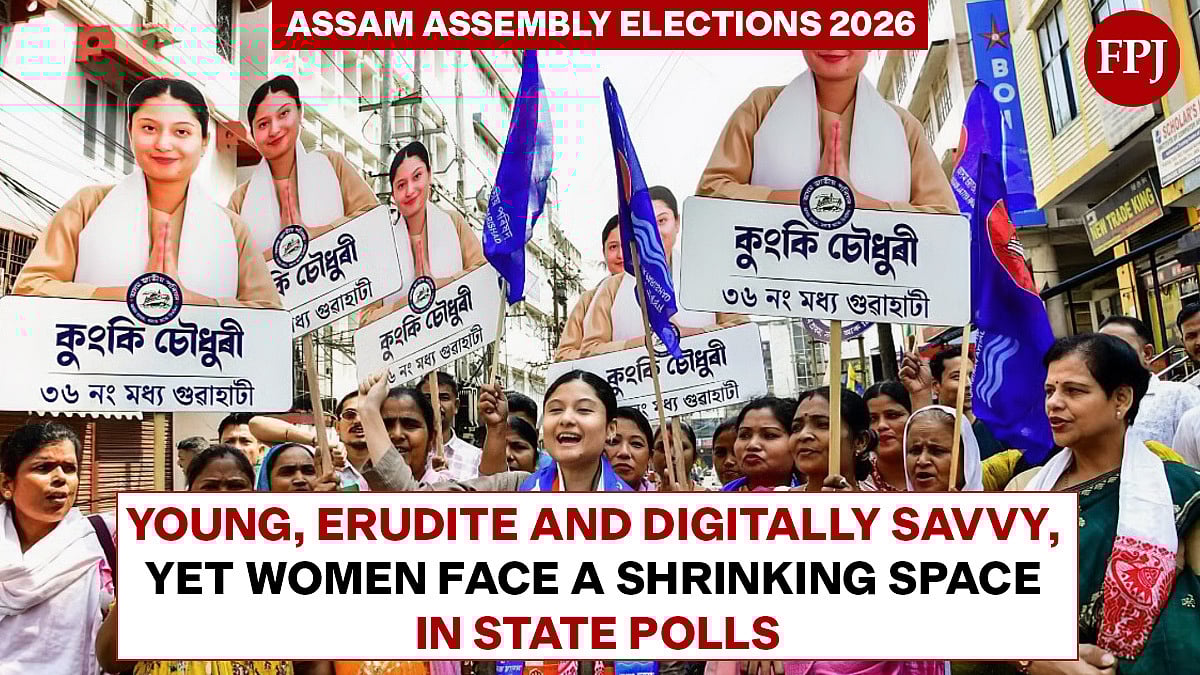
Assam Jatiya Parishad (AJP) candidate Kunki Choudhury during a door-to-door election campaign ahead of the Assam Legislative Assembly elections in Guwahati on Wednesday, March 25, 2026 | FPJ
In the race for the Assam Assembly, the electoral clash is as brutal on the digital battleground as it is on the physical one. Two candidates in particular—Kunki Chowdhury, representing the Assam Jatiya Parishad in Guwahati Central and Dr Gyanashree Bora, contesting from the Mariani constituency for Raijor Dal—have created a significant wave, causing visible discomfort to the ruling BJP.
However, despite these individual surges, the broader reality of women's empowerment this election cycle remains disappointing. The 2026 elections present a stark gap between a nearly equal female electorate and their representation on the ballot.
Analysis of the 722 candidates shows that only 59 are women, accounting for just 8.17 per cent of the total field. While this is a marginal percentage increase from 2021 (8.03 per cent), the absolute number of women in the fray has plummeted from 76 to 59—the lowest in decades.
On the brighter side, this small cohort is marked by the emergence of young, highly educated women who are aggressively challenging established political norms and forcing a shift in the campaign narrative.
Gen Z and academic narrative
A notable feature of this cycle is the presence of candidates from the Gen Z and younger millennial demographics. Approximately 24 per cent of the total candidates (174 individuals) fall between the ages of 25 and 40. Within this group, specific younger women have become central to the political discourse.
Kunki Chowdhury: At 27 years old, Chowdhury is a standout representative of the Gen Z demographic, contesting from the Guwahati Central constituency for the Assam Jatiya Parishad (AJP). Her campaign has gained attention for its focus on modern governance and youth-centric issues, representing a shift toward digitally-driven political engagement.
Dr Gyanasree Bora: Representing the 31–40 age bracket, the 34-year-old Bora is contesting from Mariani for Raijor Dal. As a former academic who transitioned into active political life, her candidacy highlights a trend of professional outsiders entering the electoral fray. However, Bora was part of Raijor Dal previously.
Bidisha Neog: Another young voice in the race, 34-year-old Neog is contesting from the high-profile Jalukbari constituency for the Congress party. She faces Chief Minister Himanta Biswa Sarma and nearly lost her candidature after the Election Commission of India rejected one set of her nomination papers. However, the poll body accepted another valid set of papers submitted by her ensuring her candidature remains intact.
Party strategies and candidate backgrounds
The major political alliances have adopted varying approaches to gender and youth representation. The Congress has fielded the highest number of women among major parties with 13 candidates, accounting for 13 per cent of their total nominees. The BJP has fielded six women, representing 7 per cent of its analysed candidates. Other younger women in the race include Roselina Tirkey (Congress, Khumtai, age 44) and Nandita Das (Congress, Hajo-Sualkuchi, age 55).
Structural realities
While 53 per cent of candidates hold a graduate degree or higher, the generational divide remains stark. Most candidates (60 per cent) are between the ages of 41 and 60, while only 42 candidates (6 per cent) are in the youngest 25–30 age group.
In this environment, where 14 per cent of candidates have declared criminal cases, the success of younger, independent-minded women like Chowdhury and Bora is seen as a key indicator of whether the state's political culture is moving toward greater inclusivity or continuing its reliance on established "winnability" formulas.
RECENT STORIES
-
-
-
-
-