The Wartime CEO: How Vijay Shekhar Sharma Drove Paytm To Record Profits
Paytm reported record Q1 FY27 profit of ₹220 crore, up 79%, as revenue rose 28% to ₹2,448 crore. EBITDA surged 182% to ₹203 crore, driven by financial services, payment growth, cost discipline and AI-led efficiencies, shifting investor focus towards margins and long-term profitability.

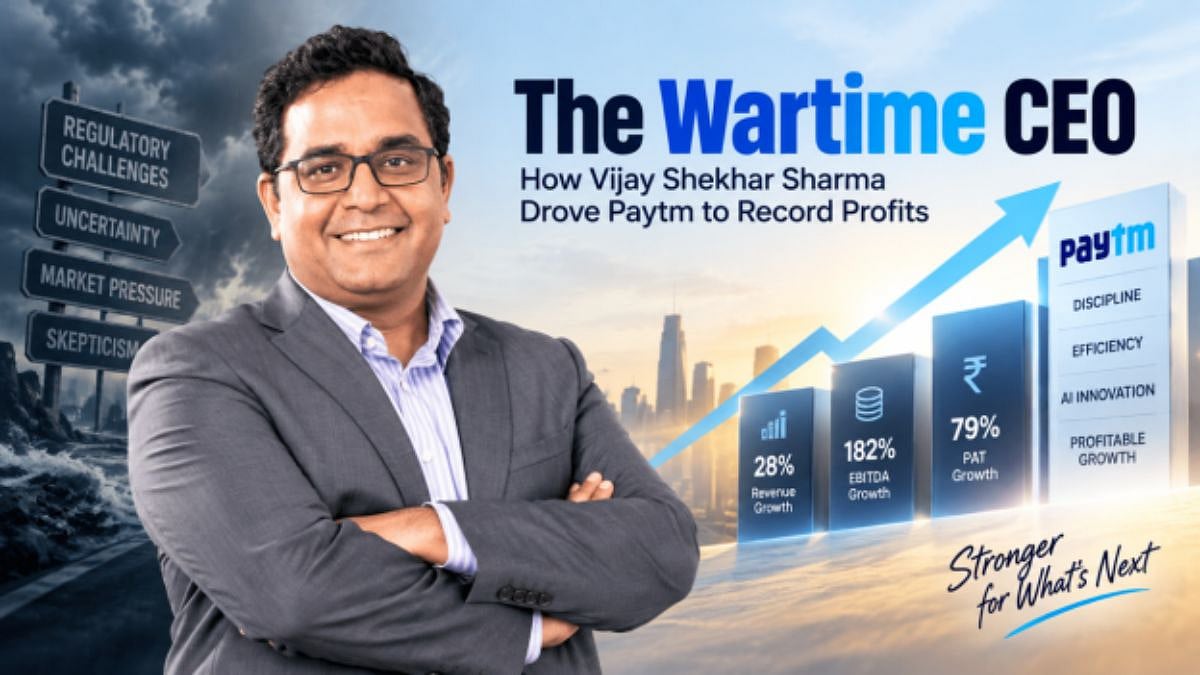
The Wartime CEO: How Vijay Shekhar Sharma Drove Paytm To Record Profits | File photo
Less than two years after Paytm navigated one of the biggest regulatory challenges in its history, Vijay Shekhar Sharma is leading a company being recognised for record profitability rather than resilience alone. The founder who built Paytm in peacetime has spent the past two years proving he can run it in wartime, and the June quarter suggests the fight is turning his way. The June quarter has changed the conversation around Paytm. Instead of recovery, analysts are now discussing operating leverage, AI-driven efficiencies and margin expansion after the company delivered its strongest quarterly performance.
Paytm reported a 28% year-on-year rise in operating revenue to ₹2,448 crore in Q1 FY27, while profit after tax rose 79% to a record ₹220 crore. EBITDA more than doubled to ₹203 crore, up 182%, taking margin to 8%, the company's highest ever, from 4% a year earlier. The gap between growth and spending was the story: indirect expenses rose just 6% against 28% revenue growth. Merchant GMV rose 31% to ₹7.1 lakh crore, while financial services revenue climbed 45% to ₹814 crore, led by merchant loans, personal loans and Postpaid.
Bernstein, which rates the stock Outperform, said the quarter "supports our investment thesis of non-linear profit growth driven by healthy revenue growth and significant operating leverage." It called financial services "the star performer".
On the earnings call, Sharma said Paytm is no longer chasing growth at any cost, adding, "We should not recklessly spend money on acquiring consumers." Hardened by the regulatory fight, the warrior-founder struck a combative note, telling analysts "the past is behind us and now we are having cash in our hand and the aggression in our mind and body." Management reiterated confidence of reaching a 15 to 20% EBITDA margin over the next two to three years and said the long term structural margin is significantly higher, supported by operating leverage and artificial intelligence.
Brokerages echoed the theme. Goldman Sachs said Paytm delivered a "meaningful beat on EBITDA", driven by market share gains in offline and online payments and sustained momentum in merchant loan distribution. It said the quarter's monthly transacting user additions were the highest since the regulatory action in 2024 and expects EBITDA to more than double this year.
The consumer business has now become a growth driver. Customer UPI transaction value rose 45%, and UBS noted the 28% revenue growth was "the highest in several quarters", with Paytm's share of the person-to-merchant market rising to 21.2%. UBS also flagged that Paytm Postpaid is "scaling faster than before, with current ramp-up at 2x the pre-FY24 pace."
Morgan Stanley expects the profit curve to steepen, projecting a 25% revenue CAGR through FY29 and EBITDA margin "improving from 8% in 1QF27 to ~19% in F29e." Yes Securities, which raised its price target to ₹1,700, framed the quarter as "revenue growth accelerates on twin engines", pointing to strength in both payments and financial services.
Much of the cost discipline is now powered by artificial intelligence, which Paytm is applying across engineering, customer support, merchant operations and collections. Emkay said "AI-led productivity" absorbed appraisal increments and "optimized cloud efficiency", while Haitong Securities noted software, cloud and data centre expenses declined "owing to AI application across businesses." Citi attributed the "EBITDA Momentum" partly to lower cloud costs and said Paytm is "seeing growth acceleration, led by both merchant & consumer franchises" and "delivering solid operating leverage."
For Sharma, the June quarter changes what investors watch. The focus is no longer regulatory disruption, but how fast margins can expand, how AI can drive the next phase of operating leverage and how financial services can become a larger growth engine.
RECENT STORIES
-
-
-
-
-