Beyond Counselling: How Pune Schools Are Teaching Emotional Intelligence To Children
Schools are increasingly focusing on emotional intelligence, social-emotional learning and student wellbeing alongside academics. From counselling and mindfulness to sports, leadership and classroom culture, Pune schools are helping children build resilience, empathy, emotional regulation and stronger relationships.

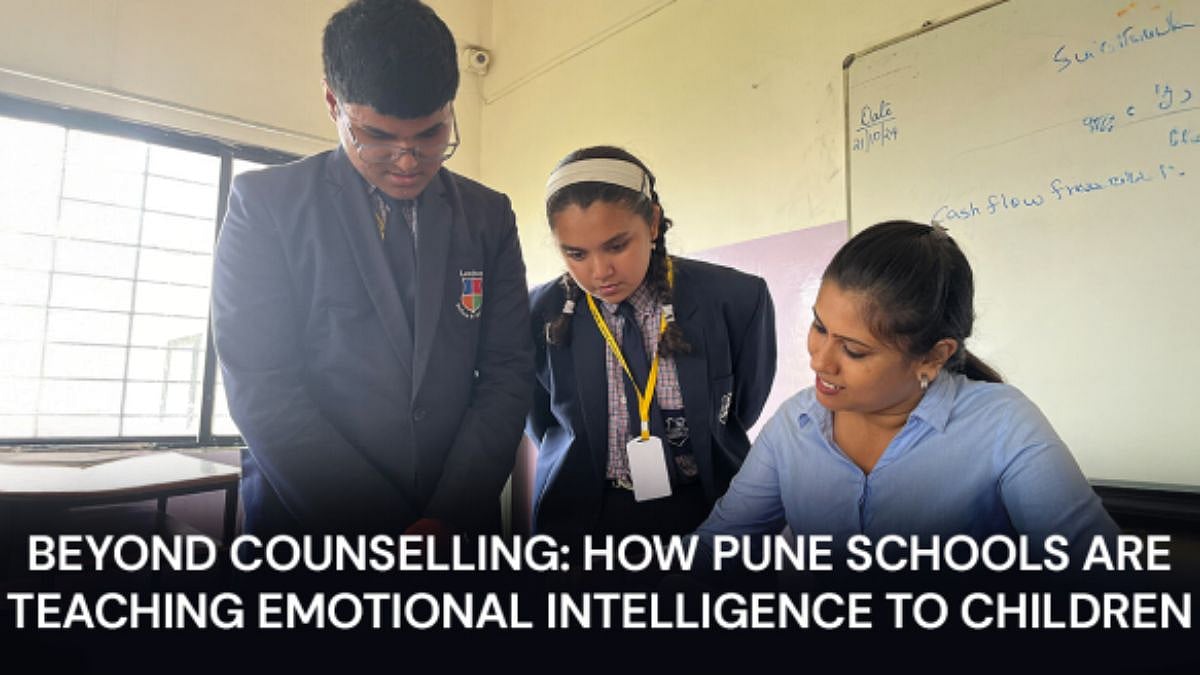
How Pune schools are supporting emotional intelligence, resilience, and social-emotional learning in children. | File photo
What parents should look for when choosing a school that supports emotional wellbeing, resilience and social-emotional learning
How leading schools in Pune approach emotional intelligence, social-emotional learning, counselling and wellbeing, and what parents should look for when choosing a school.
For many parents, choosing a school begins with familiar questions: How are the academic results? How good are the teachers? What are the sports facilities? Does the school offer international exposure? How strong is its infrastructure?
Increasingly, however, another set of questions is entering the conversation.
How does the school help a child deal with failure? What happens when two children have a disagreement? How are anxiety, peer pressure and academic stress addressed? Are children taught how to recognise their emotions, regulate them and understand the feelings of others?
These questions point towards a broader area of education: emotional intelligence and social-emotional learning (SEL).
The distinction matters because having a counsellor is not necessarily the same as teaching emotional intelligence.
A counsellor can provide important professional support when a child is struggling. But emotional intelligence develops through repeated experiences: how teachers respond to mistakes, how children work in teams, how conflict is handled, how leadership opportunities are created and whether students are encouraged to reflect on their choices.
For parents, the question is therefore becoming less about whether a school has a counselling room and more about whether emotional development is woven into everyday school life.
What Is Emotional Intelligence in Children?
Emotional intelligence in children is the ability to recognise and understand their own emotions, manage feelings appropriately, understand other people's emotions, build healthy relationships and make responsible decisions. Schools can develop these skills through classroom experiences, counselling, sports, leadership, collaboration, reflection and social-emotional learning.
The concept overlaps significantly with what education researchers describe as social and emotional skills. The OECD identifies competencies including persistence, responsibility, self-control, stress resistance, emotional control, empathy, collaboration, curiosity and tolerance as important skills connected with children's educational and wider life outcomes.
This is important because emotional intelligence is not simply about making children feel happy all the time.
It is about helping them become better equipped to deal with difficult moments.
A child who loses a football match and learns to handle disappointment is practising emotional regulation.
A student who disagrees with a classmate and learns to listen before responding is practising empathy and relationship skills.
A child who makes a mistake in front of the class and tries again is developing resilience.
A student who leads a team, listens to different opinions and takes responsibility for an outcome is developing social and emotional skills.
That makes school culture particularly important.
How Leading Schools in Pune Integrate Social-Emotional Learning (SEL)
Pune has a diverse school ecosystem, and schools approach emotional wellbeing in different ways. Some place considerable emphasis on counselling and professional psychological support. Others use life-skills programmes, social-emotional learning sessions, mindfulness, mentoring or student leadership. Some attempt to integrate emotional development more broadly into the school environment.
The schools discussed below should not be read as a ranking. They illustrate different approaches that parents can investigate when evaluating emotional wellbeing and holistic child development.
The Bishop's School: Counselling, Wellbeing and Student Development
The Bishop's School has publicly emphasised student wellbeing alongside academic and extracurricular development. Its approach includes counselling and attention to emotional and social development.
For parents, the useful question is not simply whether counselling exists, but how accessible that support is, how students are encouraged to seek help and how emotional wellbeing connects with the broader student experience.
A school environment that gives children opportunities for relationships, sports, leadership and participation can provide additional settings in which social and emotional skills are practised.
Kothari International School: Counselling and Socio-Emotional Development
Kothari International School provides a particularly clear example of a school making counselling and socio-emotional wellbeing part of its formal student-support structure.
Its counselling department describes its purpose as promoting the psycho-socio-emotional wellbeing of students, parents and teachers. The school identifies areas including personality development, academic counselling, career planning and socio-emotional counselling. It also describes trained psychologists working with children and adolescents and collaboration among students, teachers and parents.
This reflects an important aspect of emotional development: the child does not exist in isolation. Teachers, parents and school counsellors all influence the environment in which emotional skills develop.
For parents, the next question is how frequently these interventions occur and how closely they connect with everyday classroom life.
Indus International School Pune: Leadership, Counselling and Holistic Development
Indus International School Pune places considerable emphasis on holistic education, leadership and experiential learning.
This approach is relevant to emotional intelligence because leadership is not simply about standing on a stage or holding a title. Children learn to listen, communicate, make decisions, accept responsibility and respond to setbacks through meaningful experiences.
Sports, activities, projects and collaborative learning can therefore become important settings for developing resilience, empathy and interpersonal skills.
Symbiosis International School: Counselling and Emotional Wellbeing
Symbiosis International School has a structured approach to student wellbeing, including counselling and support for students' social, psychological and emotional needs.
For a large school community, accessible professional support can be particularly important. Counselling can help students navigate anxiety, academic pressure, relationships and personal challenges.
But counselling represents only one part of the larger picture.
The interesting question for parents is how the school helps students develop emotional skills before a difficulty becomes a crisis.
DPS Pune East: Life Skills, Leadership, Sports and Student Development
DPS Pune East provides another example of the broader connection between emotional wellbeing and extracurricular education.
Sports, arts, leadership, creativity and life-skills experiences can help children develop communication, confidence, teamwork, problem-solving and decision-making.
These experiences matter because children do not develop resilience by reading about resilience.
They develop it by encountering situations where they have to make decisions, cope with disappointment, work with others and try again.
Victorious Kidss Educares: Mindfulness and Whole-School Wellbeing
Victorious Kidss Educares takes a particularly explicit approach to wellbeing.
The school's published material describes mindfulness, reflection and moments of calm as part of the school day. It also discusses strategies for managing stress and describes mental health as a whole-school responsibility rather than something belonging only to the counsellor's office.
The school also highlights inclusion, student support, movement, sports and spaces for expression. Its stated objectives include fostering empathy and emotional, mental, physical and social wellbeing.
This is significant because it illustrates the difference between a programme and an environment.
If children encounter opportunities for reflection, expression, movement, collaboration and emotional support throughout their school experience, wellbeing becomes part of the culture rather than a separate intervention.
Lexicon Schools: Emotional Intelligence Through Everyday School Experiences
Lexicon Schools offers another model worth examining because its approach places emotional development alongside teacher development, counselling, leadership and experiential learning.
The important distinction is that emotional development need not be restricted to a scheduled counselling or SEL session.
At Lexicon, activities such as student leadership, sports, performing arts, assemblies, collaborative projects and student-led events create situations in which children have to communicate, cooperate, make decisions and respond to outcomes.
The school's broader ecosystem also includes child-development and therapeutic support through Lexicon Rainbow, alongside counselling and specialised support.
Programmes and events can provide the structure. But the real educational opportunity often lies in what happens around them.
A child preparing for a performance may learn to manage nervousness.
A student captain may have to resolve a disagreement within a team.
A participant in a competition may experience disappointment.
A child presenting an idea publicly may have to overcome hesitation.
A student organising an event may discover that leadership involves responsibility rather than simply authority.
The distinction is subtle but important: the objective is not merely to conduct an emotional-intelligence programme, but to give children repeated opportunities to practise the skills associated with emotional intelligence.
School Counselling and Emotional Wellbeing: Why Both Matter
School counselling has an essential role.
Children can face anxiety, friendship difficulties, academic pressure, family changes, bullying, social challenges and other issues that require trained professional support. A school with accessible counsellors and psychologists can give children an important safety net.
But counselling should not carry the entire responsibility for emotional wellbeing.
The OECD's work on social and emotional learning points to the importance of active promotion within schools, teacher learning and strong relationships. Its research describes schools as important environments for developing social and emotional skills, rather than treating those skills as something that happens only during individual interventions.
This leads to a useful distinction for parents:
Counselling can support a child when there is a problem. Social-emotional learning helps equip the child to navigate everyday life.
The strongest school environments may need both.
The Role of Teachers in Developing Emotional Intelligence in Students
Teachers are often the adults children interact with most consistently during the school day.
Their influence therefore extends beyond the subject they teach.
How does a teacher respond when a child gives the wrong answer?
Is disagreement treated as disruption or as an opportunity to learn?
Are students allowed to ask for help without embarrassment?
Does the classroom encourage listening as well as speaking?
Are mistakes treated as evidence of failure or as part of learning?
These small interactions accumulate.
The OECD has highlighted teacher preparation, self-efficacy, relationships and active learning as important elements of effective social and emotional education.
That is why parents should ask not only whether a school has counsellors, but also whether teachers receive guidance or training in supporting children's social and emotional development.
The Role of Sports in Building Emotional Resilience in Children
Sports are sometimes discussed mainly in terms of fitness, competition and achievement.
They can also be an extraordinary environment for emotional learning.
A child who loses a match learns to manage disappointment.
A child who makes a mistake in front of teammates learns how to recover.
A team captain learns that leadership requires listening.
A player learns that individual ability does not guarantee team success.
A child who keeps practising after repeated failure learns persistence.
These experiences cannot be completely replicated through a worksheet.
This is one reason extracurricular activities matter in social-emotional learning. The OECD's research specifically identifies extracurricular activities, school climate, relationships and opportunities for learning as relevant to the development of social and emotional skills.
For parents evaluating schools, the question should therefore be: How seriously does the school treat sport, arts, clubs and student participation as part of education?
How Student Leadership Builds Emotional Intelligence in Children
Leadership programmes can also play an important role.
But genuine student leadership is not simply giving children badges, titles or positions.
A meaningful leadership opportunity requires children to make decisions and deal with consequences.
It may involve organising an event, representing classmates, managing a team, resolving disagreement or speaking to an audience.
These situations require communication, empathy, confidence, responsibility and self-regulation.
In other words, leadership can become a practical classroom for emotional intelligence.
This is particularly valuable during adolescence, when young people are developing a stronger sense of identity and independence.
Social-Emotional Learning in Schools: Programme or School Culture?
This may be the most important question parents can ask.
A school can conduct an annual workshop on emotions.
It can organise a life-skills session.
It can have a counsellor.
It can celebrate Mental Health Day.
All of these can be useful.
But emotional intelligence is unlikely to develop through isolated events alone.
The more difficult task is creating consistency.
Does the language of empathy appear in classrooms?
Do teachers model respectful disagreement?
Can students talk about stress without stigma?
Are children given opportunities to lead?
Are sports and performing arts treated as meaningful developmental experiences?
Do parents and teachers communicate about a child's emotional development?
Does the school notice changes in behaviour early?
This is where the concept of a whole-school approach becomes important. OECD research points towards school policies, teacher practices, school climate, relationships and extracurricular experiences as interconnected parts of social and emotional development.
8 Questions Parents Should Ask Pune Schools About Emotional Wellbeing
When visiting a school, parents can move beyond general questions such as "Do you have counselling?"
Instead, ask:
1. How is emotional intelligence taught in the school?
Is there a structured SEL or life-skills curriculum? If yes, how frequently is it delivered?
2. What happens when a child is struggling emotionally?
Who identifies the concern, who speaks to the child and when are parents involved?
3. Are teachers trained to recognise emotional or behavioural difficulties?
A counsellor cannot observe every classroom interaction. Teacher awareness therefore matters.
4. How does the school handle bullying and peer conflict?
Ask for the process rather than simply asking whether bullying occurs.
5. How are sports, arts and extracurricular activities connected to student development?
Look for opportunities where children collaborate, lead, fail, practise and try again.
6. What leadership opportunities are available to students?
Are these meaningful responsibilities or largely ceremonial positions?
7. How does the school work with parents on emotional wellbeing?
Strong home-school communication can reinforce emotional skills beyond the campus.
8. How do you know whether your emotional-wellbeing programmes are working?
This may be the most revealing question of all.
A school should be able to explain what it is trying to develop and how it evaluates whether students are benefiting.
Emotional Intelligence Is Built Between the Programmes
There is a temptation in modern education to create a programme for every important skill.
There is a programme for leadership.
A programme for communication.
A programme for wellbeing.
A programme for life skills.
A programme for mindfulness.
But children do not experience school as a collection of programme brochures.
They experience it as a series of moments.
A teacher correcting them.
A friend excluding them.
A team losing.
An idea being rejected.
A presentation going badly.
A disagreement with a classmate.
A difficult examination.
A new responsibility.
A second attempt.
That is where emotional intelligence is built.
The programme can provide vocabulary and structure. The culture provides repetition.
What Parents Should Look For in the Best Schools for Child Development in Pune
The phrase "best school" is often reduced to rankings, examination results, infrastructure or reputation.
Those factors matter, but they do not tell the complete story of a child's development.
Parents looking for holistic child development in Pune should also examine:
The quality and accessibility of counselling
Teacher training and student support
Social-emotional learning opportunities
Sports and physical education
Performing arts and creative expression
Student leadership
Collaborative learning
Mental-health awareness
Parent-school communication
Opportunities to develop resilience
How the school responds to failure and mistakes
Whether children have a genuine voice in school life
A school's philosophy becomes most visible not when everything is going well, but when something goes wrong.
That is when parents can see whether empathy, resilience, responsibility and emotional regulation are actually part of the culture.
Why Emotional Intelligence Matters in the Digital Age
Children today are growing up in an environment of constant connectivity.
They communicate through screens, encounter social comparison at an early age and are exposed to enormous quantities of information.
Technology can expand learning and connection, but it can also make emotional regulation more complicated.
The ability to pause before reacting, understand another person's perspective, tolerate frustration, communicate clearly and recover from setbacks becomes increasingly valuable.
The OECD's research reinforces the broader importance of social and emotional skills, linking skills such as self-control, stress resistance, empathy, responsibility and curiosity with important educational and life outcomes.
As artificial intelligence changes what machines can do, distinctly human capabilities such as empathy, collaboration, judgement and self-awareness may become even more important.
How Parents Can Build Emotional Intelligence at Home
Schools cannot do this alone.
Parents play an equally important role.
Children learn emotional regulation partly by watching adults regulate themselves.
A parent who listens before reacting teaches something more powerful than a lecture on listening.
A parent who admits a mistake teaches accountability.
A parent who allows a child to experience disappointment without immediately removing the problem teaches resilience.
Simple questions can also help:
"What do you think the other person was feeling?"
"What could you do differently next time?"
"What was difficult about that?"
"What are you proud of?"
"What would you like help with?"
The objective is not to solve every emotional problem for the child.
It is to help the child gradually develop the capacity to understand and handle those problems.
The Future of Holistic Education in Pune
The conversation around school education is gradually expanding.
Academic achievement remains important. Children need strong foundations in mathematics, science, languages, technology and other disciplines.
But education is increasingly being asked to prepare children for a world that demands more than academic knowledge.
They will need to collaborate.
They will need to communicate.
They will need to deal with uncertainty.
They will need to recover from failure.
They will need to understand people who think differently from them.
They will need to manage pressure.
And they will need to make responsible decisions even when nobody is watching.
That is why emotional intelligence and social-emotional learning deserve a more serious place in conversations about school choice.
The OECD's international research makes the case for treating social and emotional skills as teachable and important to students' wider development, while also emphasising the role of school environments, teachers, relationships and extracurricular opportunities.
For parents, the takeaway is relatively simple.
Do not ask only whether a school has a counsellor.
Ask how the school teaches a child what to do when life does not go according to plan.
Because emotional intelligence is not ultimately demonstrated by a certificate, a workshop or a timetable entry.
It is demonstrated when a child loses, listens, apologises, leads, fails, recovers, helps someone else and tries again.
That is where education becomes bigger.
RECENT STORIES
-
-
-
-
-