NCERT Clarifies Grade 9 Maths Syllabus: No Topics Dropped, Concepts Integrated Across Chapters; Final Syllabus In October
NCERT has clarified that no overall topics were dropped from the draft Grade 9 Mathematics syllabus. Several concepts, including Lines and Angles and Euclidean geometry, have been integrated across chapters. Final syllabus is due in October.

NCERT Clarifies Grade 9 Maths Syllabus: No Topics Dropped, Concepts Integrated Across Chapters; Final Syllabus In October |
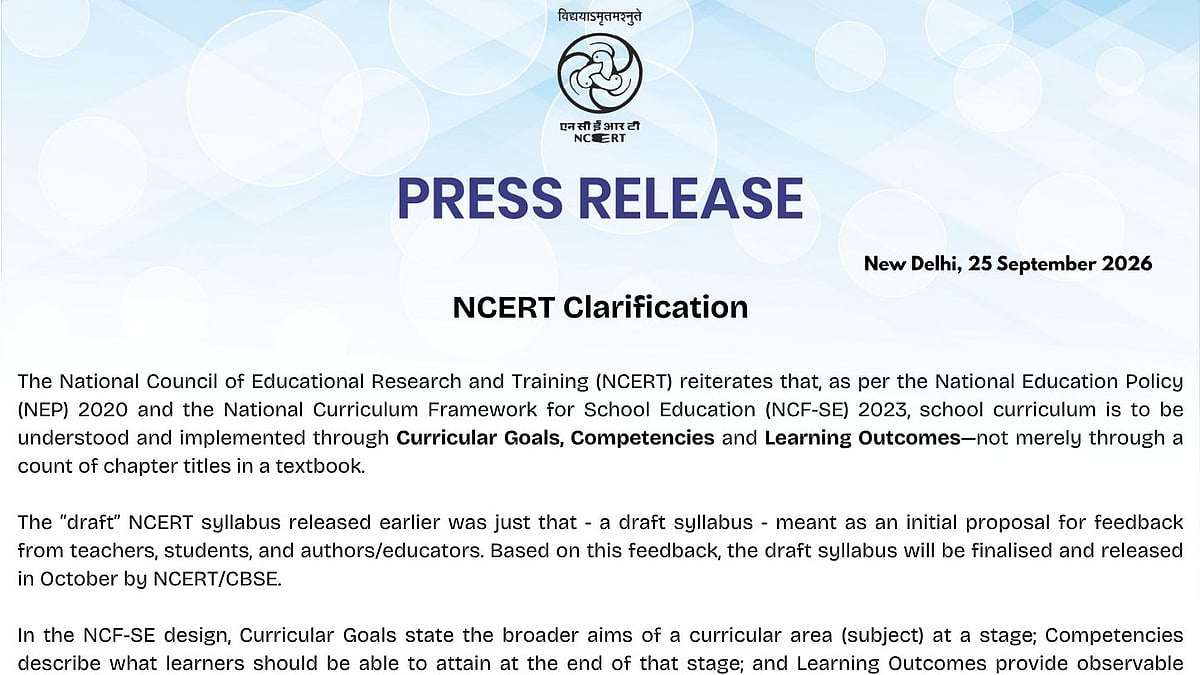
The National Council of Educational Research and Training (NCERT) on Friday clarified that no overall topics have been dropped from the draft Grade 9 Mathematics syllabus, stating that several concepts have instead been integrated into different chapters.
The clarification comes after concerns were raised over changes in the draft syllabus. NCERT said the document released earlier was only a draft proposal and that the final syllabus will be released in October following feedback from teachers, students, authors and educators.
NCERT explains changes in Grade 9 maths
NCERT said the curriculum under the National Education Policy (NEP) 2020 and the National Curriculum Framework for School Education (NCF-SE) 2023 is designed around curricular goals, competencies and learning outcomes, rather than the number of chapters in a textbook.
According to the council, textbook chapters are a pedagogical arrangement intended to help students develop competencies. Therefore, the absence of a particular topic as a standalone chapter does not mean that the concept has been removed from the curriculum.
Addressing concerns over Grade 9 Mathematics specifically, NCERT said several concepts from Lines and Angles have been incorporated into other chapters in Part 2 of the textbook.
The council pointed to “Propositions and Their Converses” (Chapter 9) and “Quadrilaterals” (Chapter 12), which contain key new ideas and applications related to lines and angles. NCERT also noted that the topic already has a dedicated chapter in the Grade 6 Ganita Prakash textbook.
Euclidean Geometry concepts spread across chapters
NCERT also clarified the treatment of Euclidean geometry in the Grade 9 Mathematics curriculum.
The council said concepts relating to flat two-dimensional geometry, including polygons, circles, parallel lines and intersecting lines, are covered across Chapters 5, 6, 9, 12 and 13.
NCERT said it decided, following consultations with teachers and educators, not to retain a traditional standalone chapter based on an abstract presentation of axioms, theorems and proofs.
Instead, students will explore the concepts across different chapters, with the objective of developing their conceptual understanding and applying those concepts in different contexts.
Algorithms chapter added amid focus on AI
NCERT also explained the addition of a chapter on algorithms to Grade 9 Mathematics.
With the rapid development of artificial intelligence (AI), the council said it considered it important for students to understand mathematical concepts related to algorithms, data structures and running-time efficiency.
NCERT linked this approach to the NEP's emphasis on computational thinking, saying that understanding the mathematical ideas underlying AI would become increasingly important.
The council also stated that a standalone module on AI is being developed, while mathematical concepts related to AI are being introduced through the Grade 9 Mathematics curriculum.
Final syllabus to be released in october
NCERT said the draft syllabus was released to obtain feedback and will be finalised after considering responses from teachers, students, authors and educators.
The final Grade 9 syllabus is expected to be released in October by NCERT/CBSE.
The council has advised schools, teachers, school boards and other stakeholders to plan classroom teaching and assessment around the prescribed competencies and learning outcomes.
NCERT further said that assessing curriculum coverage solely by comparing the number of chapter headings in a textbook with entries in a syllabus document does not reflect the approach of competency-based education.
RECENT STORIES
-
-
-
-
-