India's Education Crisis: Why We Need Gurus, Not Just Teachers
India’s vast education system faces a quality and employability crisis, with many graduates lacking essential skills. NEP 2020 offers a timely reform push, but real change depends on transforming teachers into “Gurus” who foster critical thinking, life skills, and holistic growth, moving beyond rote learning to create truly enlightened individuals.

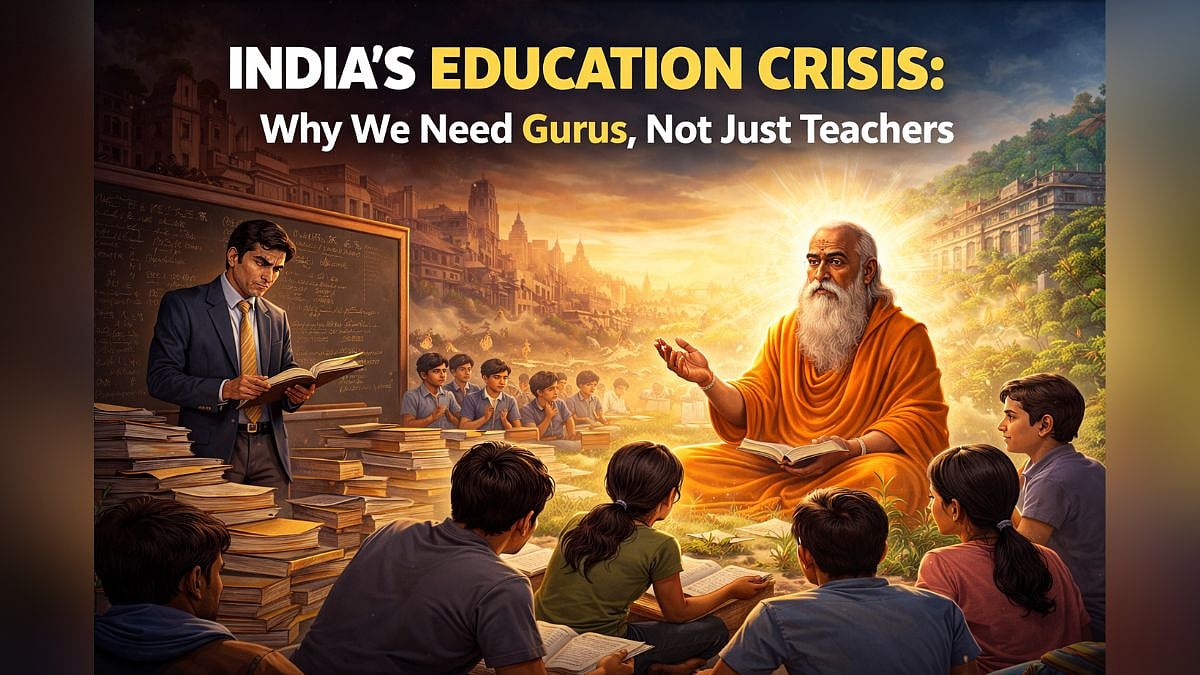
India's Education Crisis: Why We Need Gurus, Not Just Teachers |
Indian education system is at a crossroad; huge in terms of size with more than 1,000 universities, 50,000 colleges and 15 lac schools but not so highly rated in global standards and quality. Not only for economic development, but education also plays a pivotal role for social growth as well and therefore, NEP 2020 has come at the right time to take Indian education to the next level.
At the core of change of the educational system lies the role of teachers and classroom teaching as that is fundamental for transformation of a student’s life. As the complexities arise and aspiration of Gen Z skyrockets, one issue that is a matter of serious concern is the growing scale of unemployment and under-employment among the educated youth. All research shows that majority of the youth graduating today are unemployable in terms of skills and competencies.
And one of the reasons for this mismatch is the system of our “educational processes” and the “teaching acumen” of teachers at various levels. The country has no doubt brilliance in terms of teachers, but their number is not adequate considering the size of the educational system. We need radical transformation in the type of teachers and the ways things are taught for a real transformation in the educational system.
It is in the above context, we are trying to look at alteration role of a teacher from a mere “TEACHER” to a “GURU”.
What Makes the Difference:
Teacher is more of “transmitter of knowledge” from books / literature / situations / personal experiences to another group of persons known as students. This may work up to some point of time; after that it may not work as it does not result in action. On the other hand, a Guru is an enabler / mentor / facilitator who enables / motivates students to know / discover by themselves what they do not know by experience and action. The word “GURU” comes from “Gu= darkness” and “Ru= remover”; it means Guru is a person who removes the darkness and takes the students to enlightenment. How does it happen? It happens through the conscious actions of the students through their thinking and actions. This means Guru knows the ways and enables the students to go the way through analysis and thinking. This tinkering of “analytical ability” among the students is the essence of “active learning” that is missing in Indian education system; shift in the role of a teacher from “mere teacher” to “Guru” may change the scenario.
Qualities of a Guru:
A Guru as described above is much above a traditional teacher. In terms of the classical Indian scriptures, a Guru should have the following traits:
Lived Wisdom: A Guru has not only learnt the lessons of life from his / her Guru but also practiced them. Therefore, he / she has lived the life wisdom known as “Shrotriya Brahmanistha” as per our scriptures. Thus, they are the wisest of all learned people who have lived a life of wisdom through knowledge from tested sources.
Clarity of Thought and Action: Since they are the people with ultimate wisdom, they “say” as they “think” and “act” also in the same way. They are clear in their thoughts, communication and actions. This automatically renders them with supreme honesty and character.
Compassion and Empathy: A Guru is also considered a person with immense compassion and empathy for the people whom they lead; they are human by nature, and this is the result of wisdom they have.
Equanimity: This is an essential quality of an ideal Guru who always keeps a calm state of mind and does not get stressed or disturbed because of the external winds of turbulence. In other words, they have tremendous emotional balance.
Ability to Awaken: A Guru not only can teach and answer but has the capacity to make you think and raise you. That essentially means the Guru can enable you to “unravel yourself”.
What It Implies in Current Scenario:
The above qualities imply that a Guru is a higher pedestal than a mere teacher who is involved in transmission of knowledge. A Guru is a teacher but vice versa is not true. This means the Guru can do more than a teacher in some ways as under:
A teacher can teach a subject and make you “subject expert”. A Guru can give all the knowledge of the world and make you “life expert”.
A teacher follows a “transaction route” of being at a time on a day, imparting knowledge, and then leave. A Guru is your life companion, always with you whenever you need him / her for any guidance. A Guru, therefore, acts as a “transformation catalyst”.
A teacher often spends maximum time in teaching “what’s of things” whereas a Guru acts a “Mentor” or “Facilitator” focusing mainly on “how’s” and “why’s” and provides “alternative frames of thinking”. Gurus therefore make you a “critical thinking expert” in life skills that are needed for success in any difficulties of life.
A teacher tries to make you “job ready”, a Guru makes you both “JOB” and “LIFE” ready.
Moving Ahead:
The above discussions try to differentiate between the essential differences between what a traditional teacher attempts to achieve in schools and colleges and what a Guru can do to a life of students (disciples). The Gurukuls of ancient India flourished because we had many Gurus. It is time we started the debate and tried to refocus our priorities from teaching to sharing of living wisdom through Guru approach. That can only make India a “Viswaguru”. We need more Gurus than Teachers.
Dr A K Sen Gupta, Founder, Higher Education Forum (HEF). He may be contacted at aksengupta51@gmail.com and /or 98211 28103.
RECENT STORIES
-
-
-
-
-