CBSE Releases Class-Wise Guidelines On Three-Language Policy; Current Class 10, 9, 8 & 7 Students Get Special Relaxation
CBSE has issued class-wise guidelines for the NEP 2020 three-language policy from 2026-27. Current Class 10 students are exempt, while Classes 7, 8 and 9 will receive transitional relief and internal assessment.

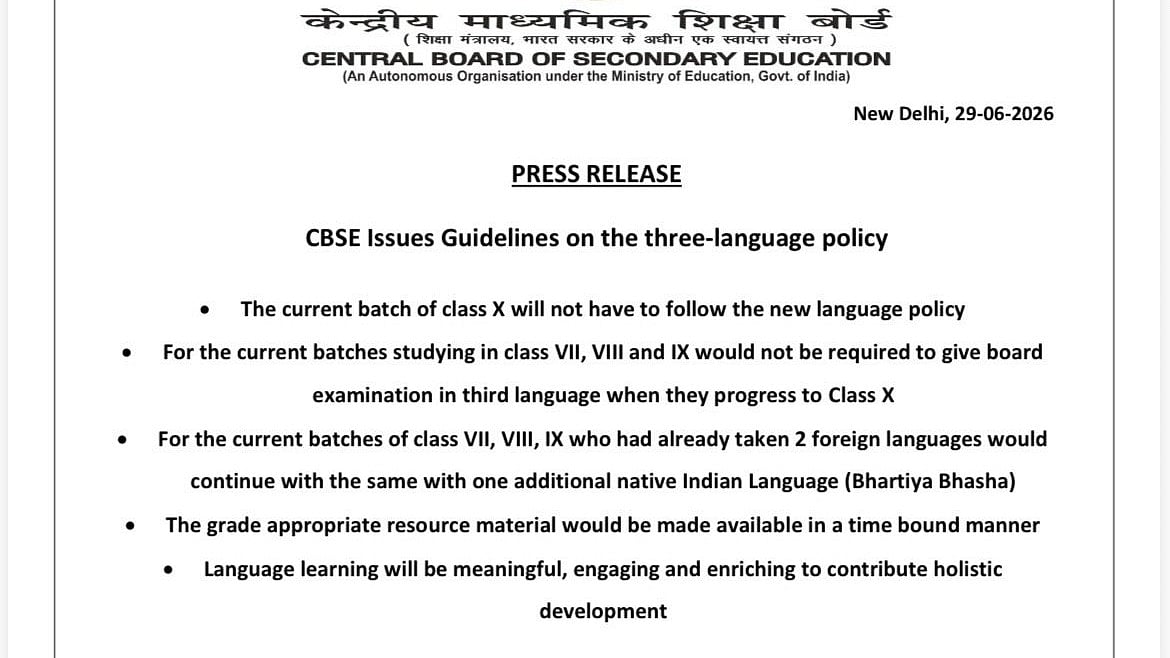
The Central Board of Secondary Education (CBSE) has issued detailed guidelines for implementing the three-language policy under the National Education Policy (NEP) 2020 from the 2026-27 academic session, while granting significant transitional relaxations to students currently studying in Classes 7, 8, 9 and 10.
The Board clarified that no student currently studying in Class 10 will be affected by the new policy, while students in Classes 7, 8 and 9 have been given one-time exemptions to ensure they are not disadvantaged during the transition.
In its press release, CBSE said the objective is to promote multilingual learning in line with NEP 2020 while ensuring that language education remains "meaningful, engaging and enriching" rather than becoming an additional examination burden.
NEP 2020 three-language policy
The Board noted that the National Education Policy 2020 recommends that students learn three languages, with at least two of them being Bhartiya Bhashas (Indian languages).
According to CBSE, the policy aims to strengthen students' proficiency in multiple Indian languages, encourage cultural rootedness and support their overall development. The Board also emphasised that the introduction of the third language at the secondary stage is a continuation of language learning that begins in the middle stage (Classes 6 to 8).
The guidelines will come into effect from the 2026-27 academic session across CBSE-affiliated schools.
Which languages are considered Bhartiya Bhashas?
Under the CBSE guidelines, Bhartiya Bhashas refer to native Indian languages. The Board has listed examples including Hindi, Sanskrit, Tamil, Telugu, Kannada, Malayalam, Marathi, Bengali, Punjabi, Gujarati, Odia and Assamese, among others recognised under the Constitution. These languages fulfil the requirement that at least two of the three languages studied by students should be Indian languages.
On the other hand, languages such as English, French, German, Arabic and Spanish are treated as non-native (foreign) languages. Students may choose one of these as their third language only if the other two languages in their combination are Bhartiya Bhashas, subject to the transitional relaxations announced for the current batches of Classes 7, 8 and 9.
No change for current Class 10 students
CBSE has made it clear that students studying in Class 10 during the 2026-27 academic session will continue under the existing language pattern.
They will study only two languages, as per the current system, and will not be required to take a third language.
This means the present Class 10 batch will not be affected by the revised policy.
What changes for students currently in Class 9?
Students studying in Class 9 during 2026-27 will be required to study three languages, with at least two being Bhartiya Bhashas.
The Board has provided examples to explain different language combinations:
If a student already studies two Indian languages, such as Hindi and Tamil, they may choose either another Indian language or a non-native language like English or French as the third language.
If a student studies one Indian language and one foreign language, such as Tamil and English, the third language must be another Bhartiya Bhasha.
If a student is already studying two foreign languages, such as English and French, CBSE has granted a special one-time relaxation. These students may continue with both foreign languages but must add one Bhartiya Bhasha as their third language.
Importantly, the third language for this batch will be assessed only through internal school-based evaluation. When these students appear for the Class 10 Board examination in 2027-28, there will be no CBSE Board examination for the third language.
The Board also said that CBSE and NCERT will provide grade-appropriate learning resources to support students learning the additional language.
Relief for current Classes 7 and 8
Students currently studying in Classes 7 and 8 have also been given transitional relief.
When these students move to Classes 9 and 10, they will continue studying three languages, with at least two being Bhartiya Bhashas.
However, those who have already started studying two non-native languages will be allowed to continue with those subjects and simply add one Bhartiya Bhasha.
Like the current Class 9 batch, these students will not have to appear for a CBSE Board examination in the third language when they reach Class 10. The additional language will instead be assessed internally by their schools.
New rules will fully apply from current Class 6 onwards
For students entering Class 6 in the 2026-27 academic session, the three-language policy will be implemented in full.
These students must study three languages, with two being Bhartiya Bhashas.
Unlike the transitional batches, this group and all future batches, will appear for the Class 10 Board examination in the third language.
CBSE also informed schools that dedicated textbooks for the third language covering all 22 Scheduled Bhartiya Bhashas are being made available by NCERT.
Exemptions under the new policy
The Board has announced several exemptions to ensure flexibility.
Children with Special Needs (CwSN) will receive relaxations and exemptions under the Rights of Persons with Disabilities (RPWD) Act, 2016.
All CBSE-affiliated schools located outside India have been exempted from the requirement of teaching an Indian language as the third language.
Similarly, foreign students returning to India will not be required to study a Bhartiya Bhasha as the third language.
In another important provision, students whose parents or guardians migrate to another state may continue with the third-language combination they had already chosen during the middle school stage. Schools have been directed to provide the necessary academic support in such cases.
Flexible staffing and additional learning support
Recognising that schools may face challenges in arranging teachers for multiple languages, CBSE has allowed flexible staffing arrangements.
Schools may utilise teachers already available with functional language proficiency, appoint retired teachers or qualified postgraduates, collaborate through Sahodaya school clusters, or use virtual and hybrid teaching models wherever required.
The Board also assured schools that they would receive additional academic support, learning resources and capacity-building programmes to facilitate smooth implementation of the policy.
Focus on learning, not examination
CBSE stressed that the revised language policy is intended to promote joyful and meaningful learning rather than increase examination pressure.
The Board said it remains committed to conceptual understanding, continuous assessment and innovative teaching practices while ensuring that no student is placed at a disadvantage during the transition to NEP 2020.
Schools have been asked to communicate the new guidelines positively to parents, teachers and students, highlighting the long-term advantages of multilingual learning, cultural awareness and broader educational development.
RECENT STORIES
-
-
-
-
-