Delhi AQI Still In 'Very Poor' Category, Chandni Chowk Tops The List Of Extremely Polluted Areas
Delhi's air quality remained ‘very poor’ on Tuesday, with an AQI of 304, even as delayed pollution data revealed extreme PM2.5 levels on Diwali night. DPCC data showed Mundka recorded 3,744 µg/m3, while 125 previously missing hourly readings exceeded 1,000 µg/m3.

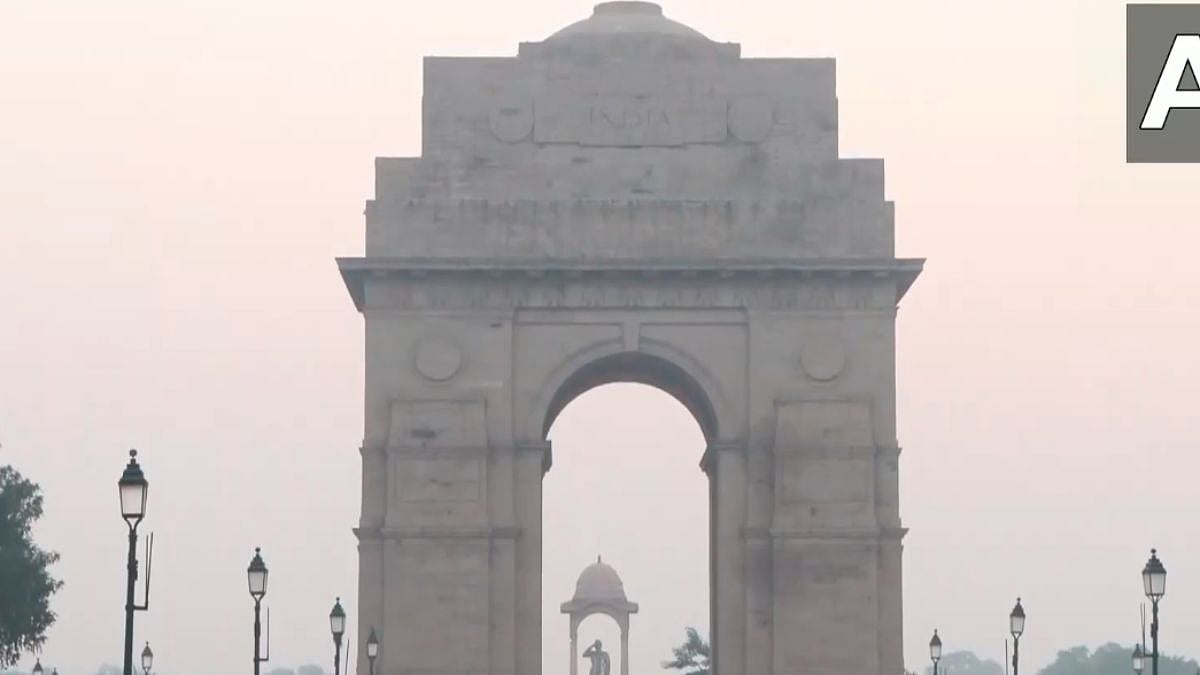
Delhi AQI Still In 'Very Poor' Category, Chandni Chowk Tops The List Of Extremely Polluted Areas | X @ANI
Delhi's air quality improved only marginally on Tuesday morning and stayed in the 'very poor' category. Newly released data from the Delhi Pollution Control Committee (DPCC) has shown that pollution on Diwali night was far worse than official records first suggested.
Air quality stays 'very poor'
The Central Pollution Control Board (CPCB) recorded Delhi's overall AQI at 304 at around 8:10 am on Tuesday. On Monday, the day after Diwali, several stations had slipped into the "severe" category, with readings above 400 in multiple areas and poor early-morning visibility.
Many stations still reported high pollution. Pusa and Chandni Chowk topped the list at 395 each, followed by NSUT Jaffarpur at 382 and Commonwealth Sports Complex at 380. Talkatora Garden logged 370 and Sirifort 365. Aya Nagar stood at 349, Punjabi Bagh 348, NIH Narela 339 and RK Puram 329. DTU recorded 323 and Shadipur 312.
The Delhi government has stepped up measures, deploying water sprinklers across the capital to limit particulate matter.
Missing Diwali-night readings
The DPCC published delayed hourly data around 8 pm on Monday. Every one of the 125 station-hours absent from CPCB records read above 1,000 µg/m3.
Mundka recorded the highest PM2.5 level, at 3,744 µg/m3. Jawaharlal Nehru University followed with 3,023 µg/m3 at 4 am, and NSUT West Campus with 3,008 µg/m3 at 5 am. Eleven DPCC stations crossed 2,000 µg/m3. The national 24-hour PM2.5 standard is 60 µg/m3.
The gap emerged when 36 of Delhi's 59 monitoring stations stopped reporting overnight into November 9. Only one station was missing data at 7 pm on Sunday. That rose to seven by 10 pm, 23 by 11 pm, 29 by midnight and 36 by 1 am. Reports said the number of stations with gaps peaked in the early hours of Monday and eased through the morning, with two still silent by 9 am. The Centre for Research on Energy and Clean Air (CREA) counted 227 missing hourly observations across the 59 stations between midnight and 5 am.
'Technical glitch' versus 'data fraud'
The Aam Aadmi Party (AAP) alleged "AQI data fraud" by the ruling BJP government. AAP MP Saurav Bharadwaj said the data was being manipulated to pull down the city's average AQI.
DPCC member Anil Gupta reportedly said that a station stops giving a reading once it reaches 999, and called the problem a technical glitch. Technical specifications from 2019 require continuous particulate matter analysers to have a measuring range of 0 to 1,000 µg/m3.
That explanation leaves questions unanswered. Stations dropped out at different levels. RK Puram's last reading was 924 µg/m3, which a single hard cutoff at 1,000 would not explain, though its next hourly reading may have crossed that mark. No mechanism or configured threshold has been publicly explained. An audit of station firmware and of the CPCB/DPCC data-validation rules could settle the matter. According to WION, the Supreme Court has set December 14 as the deadline for comprehensive compliance reports, which could be the first official account.
The row echoes last year's, when AAP accused the BJP-led government of deliberately shutting down monitoring stations to hide rising pollution.
No relief in sight
The India Meteorological Department (IMD) forecasts no rain in Delhi between November 10 and 15. A Western Disturbance will affect the western Himalayan region from Tuesday night but is unlikely to bring rain to the capital. Wind speeds are forecast at 5 to 15 kmph, which limits dispersion. Moderate fog is expected over the next five days. The morning temperature was 17-degree celsius.
GRAP III stays in force
Stage III restrictions under the Graded Response Action Plan (GRAP) remain in place after a Commission for Air Quality Management (CAQM) decision. They cover Delhi and adjoining districts of Haryana, Uttar Pradesh and Rajasthan. Authorities have been told to intensify enforcement and ensure compliance. GRAP is a four-stage emergency mechanism run by the CAQM, CPCB and state governments. It is triggered on IMD and IITM forecasts, so measures can begin before air quality turns 'severe'.
Under CPCB classification, AQI of 201-300 is 'poor', 301-400 'very poor' and 401-500 'severe'.
RECENT STORIES
-
-
-
-
-